

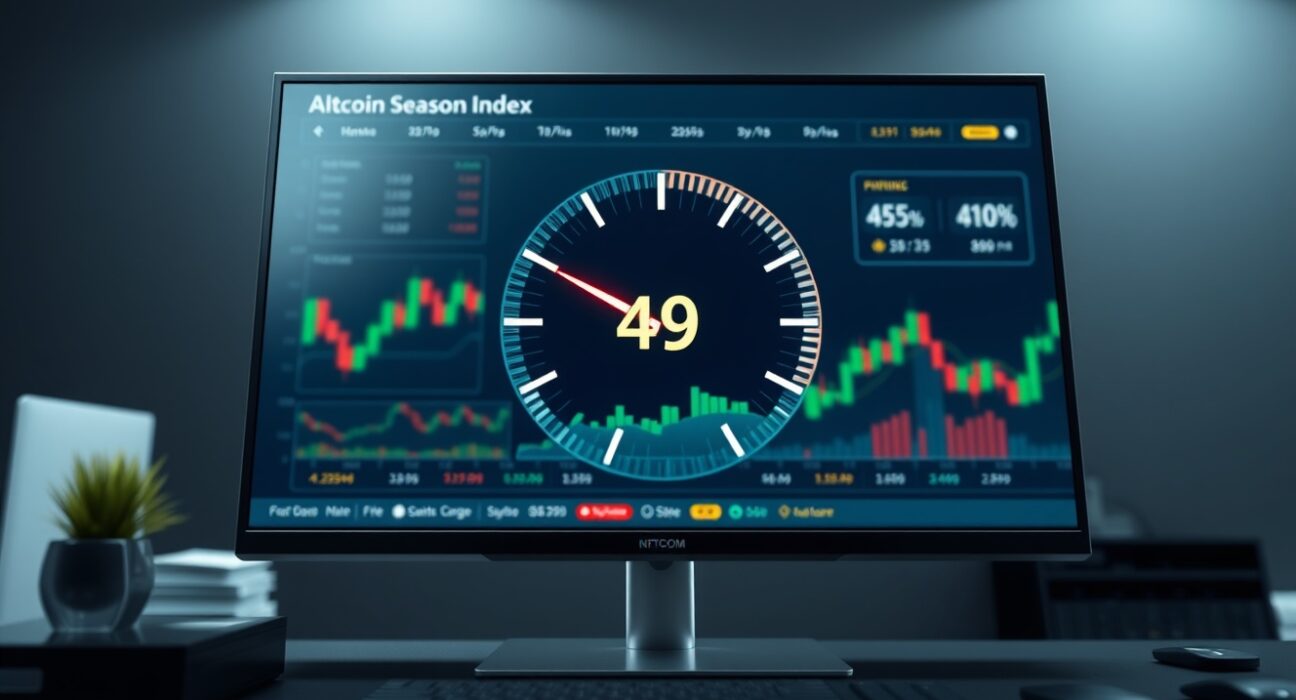
The cryptocurrency market’s pulse quickened this week as CoinMarketCap’s pivotal Altcoin Season Index climbed to 49, marking a subtle yet significant one-point increase from the previous day and edging closer to a critical threshold that could redefine investor strategies for the coming quarter. This metric, a barometer of relative strength between Bitcoin and the broader altcoin universe, now sits at its highest level in months, prompting analysts to scrutinize historical patterns and on-chain data for clues about an impending regime shift. The movement, while incremental, reflects underlying capital flows and sentiment changes across the top 100 digital assets, excluding stablecoins and wrapped tokens, over a rolling 90-day window. Consequently, market participants are now asking whether this is the prelude to a full-fledged altcoin season or merely a temporary recalibration within Bitcoin’s enduring dominance.
Decoding the Altcoin Season Index and Its 49-Point Signal
CoinMarketCap’s Altcoin Season Index functions as a sophisticated market thermometer. It measures the percentage of top cryptocurrencies that have outperformed Bitcoin over the previous 90 days. Specifically, the index analyzes the price performance of the top 100 cryptocurrencies by market capitalization, deliberately filtering out stablecoins like USDT and USDC and wrapped assets like Wrapped Bitcoin (WBTC) to focus purely on speculative performance. The calculation is straightforward but powerful: if 75% or more of these assets beat Bitcoin’s returns during that period, the index declares an official “altcoin season” with a score of 100. Therefore, the current reading of 49 indicates that nearly half of these major altcoins are currently outperforming the pioneer cryptocurrency, a notable shift from environments where the index languishes in the 20s or 30s.
This one-point rise, while seemingly minor, is not an isolated data point. It represents the culmination of weeks of subtle capital rotation. Several factors typically contribute to such a rise. First, a period of Bitcoin consolidation often allows altcoins to capture investor attention and capital. Second, successful network upgrades or positive developments within major altcoin ecosystems can spark outperformance. Finally, broader macroeconomic conditions that favor risk-on assets can benefit the more volatile altcoin segment disproportionately. The index’s climb to 49 suggests these forces may be aligning, though it remains well below the definitive 75 threshold.
Historical Context and the Path to a True Altcoin Season
To understand the potential significance of a 49 reading, one must examine historical precedent. Previous altcoin seasons, such as those in early 2018 and mid-2021, were not sudden events but were preceded by a gradual, sustained climb in the index over several weeks. The transition often follows a recognizable pattern: Bitcoin leads a bull market, experiences a period of price stability or correction, and then capital begins flowing aggressively into altcoins, pushing the index above 75. The current market structure shows some parallels to these historical inflection points, particularly with Bitcoin trading in a relatively defined range after its recent all-time highs.
The following table compares key market characteristics during previous altcoin season declarations with the current environment:
| Period | Altcoin Season Index at Declaration | Bitcoin Dominance Trend | Primary Catalysts |
|---|---|---|---|
| Q1 2018 | 75+ | Sharp decline from ~65% to ~35% | Retail frenzy post-2017 BTC peak |
| Q2 2021 | 75+ | Decline from ~70% to ~40% | DeFi and NFT boom, institutional altcoin adoption |
| Current (2025) | 49 | Moderate decline from recent highs | Ethereum ETF approvals, Layer-2 scaling adoption, RWA narratives |
This historical lens reveals that the index often acts as a confirming indicator rather than a leading one. The real capital rotation typically begins before the index hits 75. Therefore, a reading of 49 could be interpreted as an early-stage signal that this rotation is commencing, though its persistence is key.
Expert Analysis on Market Structure and Capital Flows
Market analysts emphasize that the index is a lagging indicator, reflecting performance that has already occurred. The more crucial analysis lies in the sustainability of the trend. Data from blockchain analytics firms shows increasing network activity and value settled on several major Layer-1 and Layer-2 altcoin networks. Furthermore, futures and perpetual swap funding rates for altcoins have normalized from previously negative levels, suggesting a reduction in bearish leverage and a more balanced market. However, experts from firms like Glassnode and CryptoQuant consistently warn that Bitcoin’s dominance remains structurally high by historical standards. A true, sustained altcoin season likely requires a decisive break below key Bitcoin dominance support levels, which has not yet occurred. The current environment, therefore, may be best described as a “pre-season” or testing phase where altcoins are demonstrating relative strength but have not yet collectively usurped Bitcoin’s leadership.
The Mechanics of Measurement and Excluded Assets
The methodology behind the Altcoin Season Index is critical for accurate interpretation. By excluding stablecoins, the index avoids skewing data with assets designed for price stability, not appreciation. Similarly, excluding wrapped coins (tokens representing Bitcoin on other blockchains) prevents double-counting Bitcoin’s performance. The 90-day window is a deliberate choice—it is long enough to smooth out short-term volatility and hype cycles but short enough to reflect recent, relevant market dynamics. This creates a robust framework for identifying genuine, medium-term trends in capital allocation. The index’s rise to 49 means that, on a risk-adjusted basis over a quarter, a significant minority of altcoin investments would have yielded better returns than simply holding Bitcoin. This can influence institutional and retail allocation models, potentially creating a self-reinforcing cycle if the trend continues.
Key components of the index’s calculation include:
- Timeframe: Strict 90-day rolling window.
- Universe: Top 100 coins by market cap.
- Exclusions: All stablecoins (USDT, USDC, DAI) and wrapped assets (WBTC, WETH).
- Benchmark: Bitcoin’s USD price performance.
- Threshold: 75% of assets must outperform for a “season.”
This transparent methodology allows traders to backtest strategies and researchers to model market cycles with a clear, consistent metric.
Conclusion
The Altcoin Season Index’s ascent to 49 serves as a noteworthy marker in the evolving cryptocurrency landscape. It signals a measurable shift in relative performance, with a growing cohort of altcoins beginning to outpace Bitcoin over a meaningful timeframe. While the market remains far from declaring an official altcoin season, the trend direction merits close observation. Historical cycles suggest such movements can accelerate once a critical mass of investor perception shifts. For now, the index provides a data-driven snapshot of a market in transition, highlighting the ongoing competition for capital between the established leader, Bitcoin, and the innovative, diverse array of altcoins. Monitoring whether this index can sustain its climb toward the decisive 75 level will be one of the most critical exercises for crypto investors in the coming weeks.
FAQs
Q1: What exactly does an Altcoin Season Index of 49 mean?
An index reading of 49 means that approximately 49% of the top 100 cryptocurrencies (excluding stablecoins and wrapped coins) have outperformed Bitcoin in terms of price appreciation over the past 90 days. It indicates a market where altcoins are showing significant relative strength but have not yet collectively surpassed Bitcoin’s performance to trigger a formal “season.”
Q2: How is the Altcoin Season Index calculated?
The index is calculated by CoinMarketCap by comparing the 90-day price performance of each of the top 100 cryptocurrencies against Bitcoin’s performance over the same period. It then calculates the percentage of those assets that outperformed Bitcoin. Stablecoins and wrapped assets are excluded to ensure the metric reflects only speculative, non-pegged assets.
Q3: What is the threshold for an official “altcoin season”?
An official altcoin season is declared when the index reaches 75 or higher. This signifies that at least 75% of the top altcoins have outperformed Bitcoin over the preceding 90-day window, indicating a broad-based, sustained rotation of capital and market leadership away from Bitcoin.
Q4: Does a rising index guarantee that altcoins will continue to rise?
No, a rising index does not guarantee future price increases. It is a lagging indicator that reflects past performance. While it can signal improving sentiment and capital flows, future price action depends on numerous factors including macroeconomic conditions, regulatory developments, and individual project fundamentals.
Q5: Why are stablecoins and wrapped coins excluded from the index?
Stablecoins are excluded because their design purpose is price stability, not appreciation, so comparing their performance to Bitcoin’s is not meaningful. Wrapped coins (like WBTC) are excluded because they are simply tokenized representations of Bitcoin on other blockchains; their price mirrors Bitcoin exactly, so including them would double-count Bitcoin’s performance and distort the altcoin comparison.
Disclaimer: The information provided is not trading advice, Bitcoinworld.co.in holds no liability for any investments made based on the information provided on this page. We strongly recommend independent research and/or consultation with a qualified professional before making any investment decisions.
