

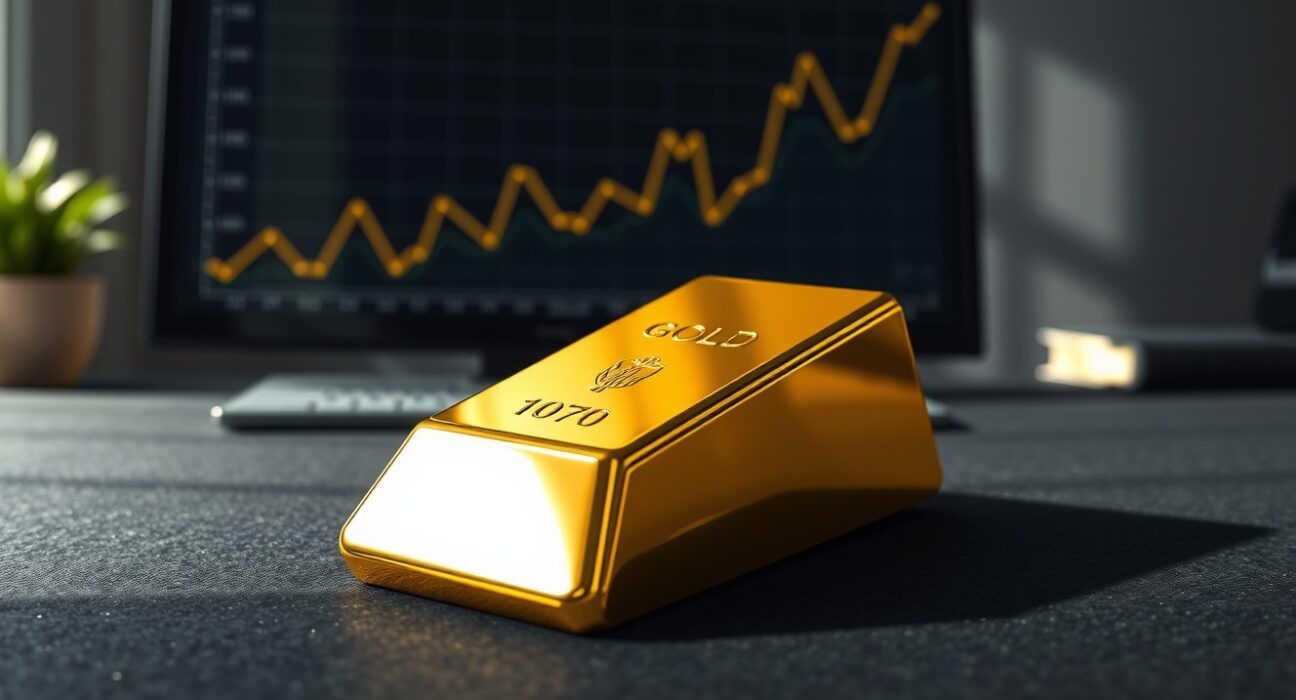
LONDON, March 21, 2025 – The gold price demonstrates remarkable resilience today, clinging to significant gains near a two-week peak firmly above the $4,700 per ounce threshold. This sustained rally occurs primarily amid a pronounced weakening of the US Dollar Index (DXY), which has retreated from recent highs. Consequently, market analysts are scrutinizing this dynamic interplay between the traditional safe-haven asset and global currency markets.
Gold Price Analysis and Current Market Drivers
The spot gold price currently trades at $4,712 per ounce, marking a 1.8% increase over the past five trading sessions. This movement represents the most substantial weekly gain since mid-February. Market data reveals consistent buying pressure during Asian and European trading hours. Several interconnected factors are propelling this upward trajectory.
Firstly, the US dollar serves as the primary catalyst. The DXY, which measures the greenback against a basket of major currencies, has declined by 0.9% this week. Historically, gold exhibits a strong inverse correlation with the dollar. A weaker dollar makes dollar-denominated gold cheaper for holders of other currencies, thereby stimulating international demand. Secondly, subdued US Treasury yields have removed a traditional headwind for non-yielding bullion. Finally, positioning data indicates that managed money funds have begun to reduce their short bets on gold futures, suggesting a shift in sentiment.
Technical and Fundamental Perspectives
From a chart perspective, gold has convincingly broken above its 50-day moving average, a key technical level watched by traders. This breach signals potential for further short-term gains toward the $4,750 resistance zone. Fundamentally, central bank demand remains a robust underlying support. According to the World Gold Council, global central banks added a net 42 tonnes to official reserves in January, continuing a multi-year trend of diversification away from traditional fiat currencies.
The US Dollar’s Role in Commodity Markets
The recent depreciation of the US dollar stems from recalibrated market expectations regarding Federal Reserve monetary policy. Recent economic indicators, including softer retail sales and manufacturing data, have led investors to price in a higher probability of interest rate cuts later in 2025. Lower interest rates typically diminish the dollar’s yield advantage and can fuel inflation expectations, both conditions historically favorable for gold.
Furthermore, comparative currency strength plays a role. The euro and British pound have gained ground against the dollar this week following more hawkish-than-anticipated commentary from the European Central Bank and Bank of England. This relative shift in global monetary policy outlook directly pressures the DXY and indirectly supports dollar-priced commodities like gold. The following table illustrates the recent correlation:
| Asset | 5-Day Performance | Primary Driver |
|---|---|---|
| Gold (XAU/USD) | +1.8% | USD Weakness, Technical Breakout |
| US Dollar Index (DXY) | -0.9% | Dovish Fed Expectations |
| Euro (EUR/USD) | +1.2% | Hawkish ECB Stance |
Broader Market Impacts and Flows
The gold rally is influencing related asset classes. Mining equities, as tracked by the NYSE Arca Gold Miners Index, have outperformed the broader equity market this week. Additionally, flows into physically-backed gold exchange-traded funds (ETFs) have turned positive after months of outflows, indicating renewed interest from institutional and retail investors. This shift often signals a more sustained change in market posture rather than short-term speculative trading.
Historical Context and Gold as a Strategic Asset
Gold’s current performance revisits its classic role during periods of monetary uncertainty. Analysts often reference the 2008 financial crisis and the 2020 pandemic market turmoil, where gold initially sold off in a liquidity scramble but then staged powerful rallies as central banks unleashed unprecedented stimulus. The present environment shares similarities, with markets transitioning from a phase of aggressive monetary tightening to an anticipated easing cycle.
Key strategic functions of gold in a portfolio include:
- Inflation Hedge: Historically preserves purchasing power over long periods.
- Portfolio Diversifier: Exhibits low correlation to stocks and bonds.
- Safe-Haven Asset: Tends to attract capital during geopolitical or financial stress.
- Currency Hedge: Acts as an alternative to fiat currency holdings.
Market participants are now assessing whether the current move is a tactical rebound or the start of a new strategic uptrend. Evidence from futures market commitment of traders reports shows commercial hedgers (often producers) are near neutral positioning, which typically does not present a major contrarian sell signal.
Expert Analysis and Forward Outlook
Senior commodity strategists at major financial institutions provide measured commentary. “The breakout above $4,680 was technically significant,” notes a strategist from a leading Swiss bank. “However, conviction for a sustained move toward $5,000 will require confirmation from physical market demand, particularly in key consuming regions like Asia.” Another analyst from a US investment firm highlights macro conditions: “A scenario of a slowing US economy paired with a cautious Fed is nearly ideal for gold. The key risk is a re-acceleration of growth that prompts the Fed to delay cuts, potentially reviving the dollar.”
Conclusion
The gold price is firmly holding gains above $4,700, driven decisively by a weaker US dollar and shifting interest rate expectations. This movement underscores the metal’s enduring sensitivity to global macro-financial conditions. While technical indicators suggest room for further advancement, the sustainability of the rally will depend on forthcoming economic data and central bank policy signals. For investors, the current gold price action reinforces the asset’s role as a critical barometer of currency and monetary policy trends, offering both tactical trading opportunities and long-term strategic portfolio benefits.
FAQs
Q1: Why does a weaker US dollar cause the gold price to rise?
A weaker US dollar makes gold cheaper to purchase for investors using other currencies like the euro or yen. This increased affordability typically boosts international demand, pushing the dollar-denominated price higher.
Q2: What is the US Dollar Index (DXY)?
The US Dollar Index is a measure of the value of the United States dollar relative to a basket of six major world currencies: the euro, Japanese yen, British pound, Canadian dollar, Swedish krona, and Swiss franc. It is a key benchmark for the dollar’s international strength.
Q3: Are rising interest rates always bad for gold?
Generally, yes. Higher interest rates increase the opportunity cost of holding gold, which pays no yield. They also tend to strengthen the dollar. However, if rate hikes are driven by high inflation that erodes currency value, gold can still perform well as an inflation hedge.
Q4: What other factors can influence the gold price besides the dollar?
Major drivers include geopolitical tensions, global inflation expectations, central bank buying or selling activity, mining supply dynamics, demand from key markets like India and China, and overall risk sentiment in financial markets.
Q5: How can ordinary investors gain exposure to gold?
Common methods include buying physical bullion (bars or coins), investing in shares of gold mining companies, purchasing units in physically-backed gold Exchange-Traded Funds (ETFs), or trading gold futures and options contracts (for advanced investors).
Disclaimer: The information provided is not trading advice, Bitcoinworld.co.in holds no liability for any investments made based on the information provided on this page. We strongly recommend independent research and/or consultation with a qualified professional before making any investment decisions.
