

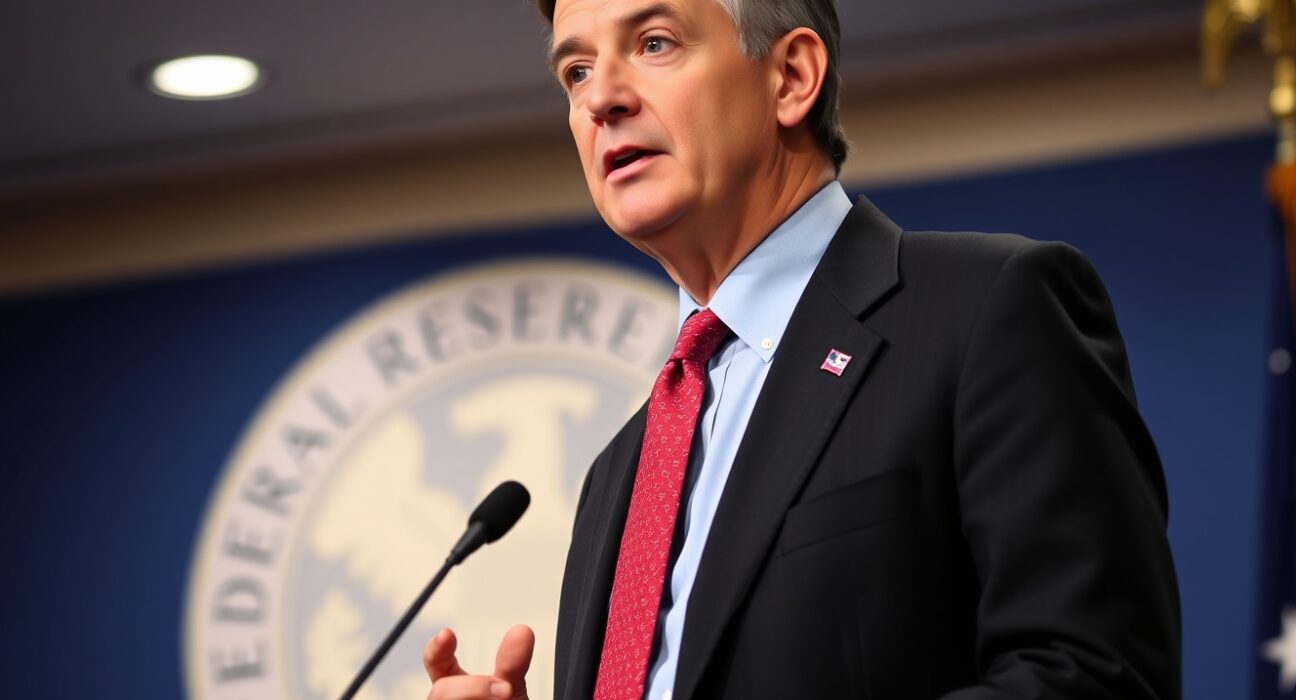
Federal Reserve Bank of Richmond President Thomas Barkin delivered a crucial message to financial markets this week, asserting that inflation expectations show no signs of breaking out despite persistent price pressures in certain sectors of the economy. Speaking at the Economic Club of New York on Tuesday, November 18, 2025, the influential policymaker provided detailed analysis of current economic indicators while offering reassurance about the central bank’s ability to maintain price stability. His comments come at a critical juncture for monetary policy as the Federal Reserve navigates the final stages of its inflation-fighting campaign while avoiding unnecessary economic disruption.
Federal Reserve’s Inflation Assessment and Economic Context
Thomas Barkin’s remarks arrive during a period of heightened scrutiny for the Federal Reserve’s inflation management strategy. The central bank has maintained its benchmark interest rate at 5.25-5.50% since July 2024, marking the longest pause in the current tightening cycle. Recent Consumer Price Index data shows headline inflation at 2.8% year-over-year, while core inflation excluding food and energy remains slightly higher at 3.1%. These figures represent significant progress from the peak inflation rates exceeding 9% in mid-2022, yet they still exceed the Fed’s 2% target.
Market participants closely monitor inflation expectations because they influence actual price-setting behavior throughout the economy. When businesses and consumers expect higher future inflation, they frequently adjust their pricing and wage demands accordingly. This adjustment can create a self-fulfilling prophecy that makes controlling inflation substantially more difficult for central bankers. Consequently, Barkin’s assessment that expectations remain anchored provides important validation for the Federal Reserve’s current policy stance.
Key Indicators Supporting Barkin’s Assessment
Several data sources support President Barkin’s conclusion about stable inflation expectations. The University of Michigan’s Survey of Consumers shows one-year inflation expectations at 2.9% in November 2025, virtually unchanged from the 3.0% reading six months earlier. Similarly, the Federal Reserve Bank of New York’s Survey of Consumer Expectations reports median one-year ahead inflation expectations at 3.1%, representing only a marginal increase from 3.0% in May. Professional forecasters surveyed by the Federal Reserve Bank of Philadelphia project inflation will average 2.4% over the next ten years, indicating remarkable long-term stability in expectations.
Financial market indicators provide additional confirmation. Break-even inflation rates derived from Treasury Inflation-Protected Securities (TIPS) show five-year expectations at approximately 2.3% and ten-year expectations around 2.2%. These market-based measures have remained within a narrow range throughout 2025, demonstrating investor confidence in the Federal Reserve’s inflation-fighting credibility. Furthermore, inflation swaps pricing indicates limited concern about runaway price growth despite ongoing geopolitical tensions and supply chain adjustments.
Monetary Policy Implications for 2025 and Beyond
President Barkin’s comments carry significant implications for the Federal Reserve’s upcoming policy decisions. The Federal Open Market Committee will convene for its final meeting of 2025 on December 16-17, with markets currently pricing in a 65% probability of a 25 basis point rate cut. Barkin’s assessment suggests the central bank may have greater flexibility to begin normalizing policy without triggering concerns about abandoning its inflation mandate. However, policymakers remain cautious about declaring premature victory, particularly given the historical difficulty of reducing inflation from current levels to the 2% target.
The Federal Reserve faces a complex balancing act between several competing priorities:
- Price stability maintenance while avoiding unnecessary economic damage
- Labor market preservation as unemployment remains near historic lows at 4.0%
- Financial stability protection amid elevated commercial real estate vulnerabilities
- Global economic coordination with other major central banks pursuing divergent paths
Barkin emphasized that monetary policy operates with considerable lags, meaning today’s decisions will influence economic conditions six to eighteen months into the future. This reality necessitates forward-looking analysis rather than reactive policymaking. The Richmond Fed president noted that the Federal Reserve must remain data-dependent while acknowledging that economic indicators sometimes provide conflicting signals about the appropriate policy path.
Historical Context and Inflation Psychology
Understanding Barkin’s reassurance requires examining historical inflation episodes. During the 1970s and early 1980s, the Federal Reserve struggled to control inflation partly because expectations became unanchored. Businesses and consumers began anticipating ever-higher price increases, creating a wage-price spiral that required dramatically higher interest rates and severe economic contraction to break. By contrast, the current episode shows remarkable stability in long-term expectations despite significant short-term price pressures.
This stability reflects several structural changes in the economy since the high-inflation era:
| Factor | 1970s Environment | 2025 Environment |
|---|---|---|
| Central Bank Independence | Limited operational independence | Strong institutional independence |
| Inflation Targeting | No explicit inflation target | Clear 2% symmetric target |
| Communication Strategy | Limited public guidance | Extensive forward guidance |
| Global Competition | Protected domestic markets | Intense global price competition |
| Technology Impact | Limited productivity growth | Digital transformation and automation |
These structural differences help explain why inflation expectations have remained anchored despite the largest price surge in four decades. The Federal Reserve’s enhanced credibility, developed through decades of consistent inflation management, provides a crucial buffer against expectation-driven inflation spirals. Additionally, increased global economic integration creates competitive pressures that limit domestic pricing power for many businesses.
Economic Outlook and Risk Assessment
Looking ahead to 2026, several factors will influence whether inflation expectations remain anchored. The labor market represents a primary concern, as wage growth at 4.2% year-over-year continues to exceed productivity gains. While this supports consumer spending and economic growth, it also creates potential for sustained inflationary pressures if not balanced by productivity improvements. Barkin noted that the Federal Reserve monitors wage trends carefully but sees limited evidence of a wage-price spiral developing.
Geopolitical developments present additional uncertainty. Ongoing conflicts in multiple regions continue to disrupt supply chains for critical commodities, particularly energy and agricultural products. However, diversification of supply sources and strategic reserves have mitigated the inflationary impact compared to initial disruptions in 2022. The transition to renewable energy sources has also reduced economy-wide sensitivity to fossil fuel price fluctuations over time.
Demographic trends create conflicting inflationary pressures. Aging populations in advanced economies typically reduce inflationary pressures through decreased consumption and increased savings. Conversely, shrinking workforces in many countries create upward pressure on wages that could translate to higher prices for services. The Federal Reserve must balance these structural forces when formulating monetary policy for the coming years.
Expert Perspectives on Monetary Policy Direction
Economic analysts generally agree with Barkin’s assessment of anchored inflation expectations while highlighting remaining challenges. Former Federal Reserve Vice Chair Richard Clarida recently noted that “the Fed has successfully avoided the worst-case scenario of de-anchored expectations, but the last mile to 2% inflation may prove most difficult.” Similarly, Harvard economist and former Treasury Secretary Lawrence Summers cautioned that “premature declaration of victory could undermine the credibility painstakingly rebuilt over the past three years.”
Market participants appear cautiously optimistic about the inflation outlook. Bond market pricing suggests investors expect the Federal Reserve to achieve its 2% target by late 2026, with gradual rate reductions beginning in early 2026. Equity markets have responded positively to reduced inflation uncertainty, with the S&P 500 reaching new highs in recent weeks. However, volatility indicators suggest investors remain attentive to potential surprises in economic data or geopolitical developments.
Conclusion
Federal Reserve President Thomas Barkin’s reassurance about anchored inflation expectations provides crucial stability for financial markets and economic planning. His assessment reflects careful analysis of multiple data sources showing remarkable resilience in long-term inflation psychology despite recent price pressures. The Federal Reserve’s enhanced credibility and communication strategy have successfully prevented expectation-driven inflation spirals that complicated previous disinflation episodes. As monetary policymakers navigate the final stages of returning inflation to target, maintaining this expectation stability will remain paramount. The coming months will test whether current policy settings can complete the disinflation process without triggering unnecessary economic disruption or financial instability.
FAQs
Q1: What did Federal Reserve President Thomas Barkin say about inflation expectations?
Thomas Barkin stated that inflation expectations show no signs of breaking out despite ongoing price pressures in certain economic sectors. He emphasized that long-term expectations remain well-anchored around the Federal Reserve’s 2% target.
Q2: Why are inflation expectations important for monetary policy?
Inflation expectations influence actual price-setting behavior throughout the economy. When businesses and consumers expect higher future inflation, they adjust pricing and wage demands accordingly, potentially creating self-fulfilling inflationary spirals that complicate central bank efforts to maintain price stability.
Q3: What data supports Barkin’s assessment of anchored expectations?
Multiple surveys show stable inflation expectations, including the University of Michigan Survey of Consumers (2.9% one-year expectations) and the Federal Reserve Bank of New York Survey (3.1% one-year expectations). Market-based measures from TIPS securities show five-year expectations around 2.3% and ten-year expectations near 2.2%.
Q4: How does the current situation differ from the high-inflation era of the 1970s?
The Federal Reserve now operates with greater independence, follows an explicit 2% inflation target, provides extensive forward guidance, and benefits from global competitive pressures that limit domestic pricing power. These structural differences help anchor expectations despite significant price pressures.
Q5: What are the implications for Federal Reserve policy in 2026?
Anchored inflation expectations provide the Federal Reserve with greater flexibility to adjust monetary policy as needed. Markets currently anticipate gradual rate reductions beginning in 2026, though policymakers emphasize remaining data-dependent and avoiding premature declarations of victory over inflation.
Disclaimer: The information provided is not trading advice, Bitcoinworld.co.in holds no liability for any investments made based on the information provided on this page. We strongly recommend independent research and/or consultation with a qualified professional before making any investment decisions.
