

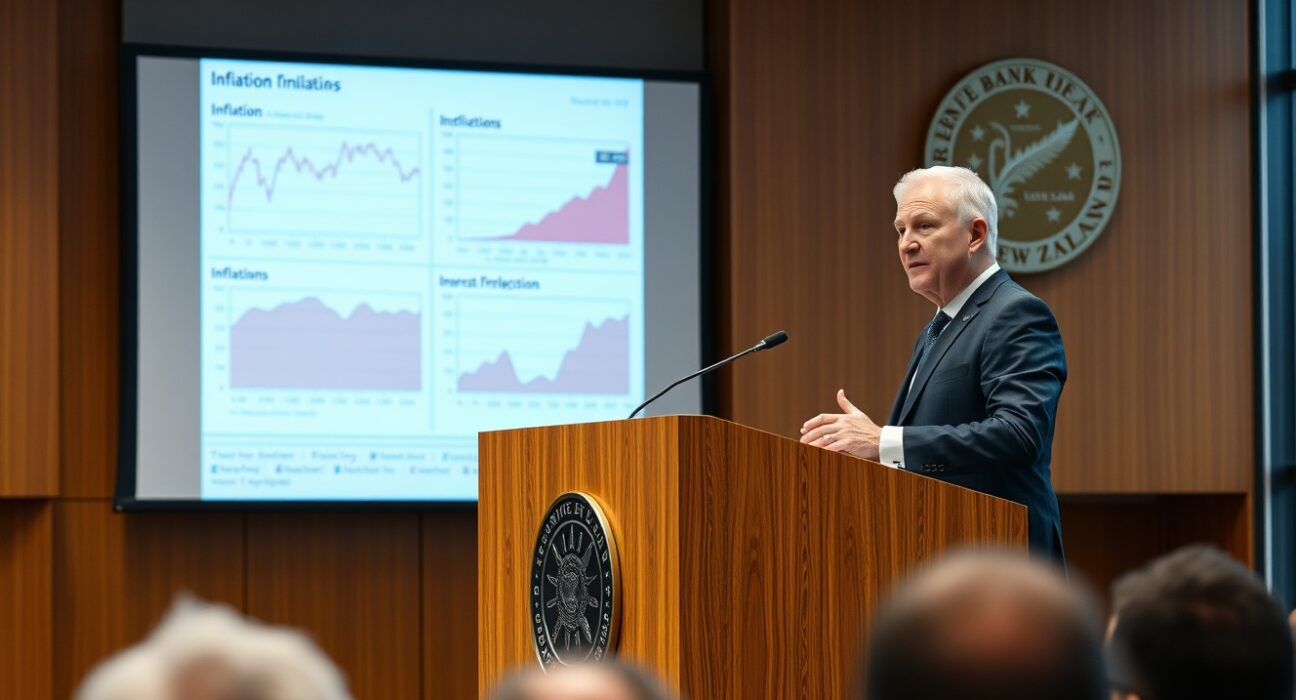
WELLINGTON, New Zealand – February 2025: Reserve Bank of New Zealand Governor Breman delivered a pivotal speech today that provided critical clarity on the nation’s inflation trajectory and interest rate outlook. His address, supported by detailed economic charts, outlined the central bank’s current assessment and forward guidance for monetary policy throughout 2025.
RBNZ Governor Breman’s Inflation Assessment and Projections
Governor Breman began his address by presenting updated inflation charts showing New Zealand’s progress since the peak inflationary period. The data revealed a gradual but persistent decline in consumer price increases across multiple sectors. Specifically, the charts demonstrated how imported inflation pressures have eased significantly while domestic service inflation remains more stubborn.
The RBNZ’s core inflation measures, which exclude volatile items, showed particular improvement in recent quarters. However, Breman emphasized that inflation remains above the bank’s 1-3% target band. He highlighted how housing-related costs continue to exert upward pressure, though at a moderating pace compared to previous years.
Breman presented comparative charts showing New Zealand’s inflation performance relative to other advanced economies. These visualizations revealed that while New Zealand experienced higher peak inflation than many counterparts, its disinflation path has followed a similar trajectory to Australia and Canada. The governor noted that global commodity price developments continue to influence domestic inflation outcomes significantly.
Interest Rate Outlook and Monetary Policy Framework
The second portion of Breman’s speech focused on the interest rate outlook, supported by forward-looking charts projecting various economic scenarios. He explained how the Official Cash Rate (OCR) path depends on incoming data and evolving risks. The charts illustrated multiple potential trajectories based on different inflation and employment outcomes.
Breman emphasized that monetary policy remains restrictive and will stay that way until the RBNZ sees convincing evidence that inflation will return sustainably to target. He presented historical charts showing how current OCR settings compare to previous tightening cycles. The data revealed that while rates have increased substantially, real interest rates remain only moderately restrictive given current inflation levels.
The governor outlined three key factors that will determine future interest rate decisions:
- Inflation expectations: Survey-based measures of household and business expectations
- Capacity pressures: Labor market tightness and output gap estimates
- Global developments: International interest rate trends and exchange rate impacts
Economic Context and Historical Comparisons
Breman placed current policy challenges within historical context, showing charts comparing the post-pandemic inflation episode to previous inflationary periods. The data revealed that while the initial inflation surge was more rapid than historical precedents, the policy response has been similarly aggressive. He noted that the transmission of monetary policy appears to be operating with normal lags despite initial concerns about pandemic-related distortions.
The governor referenced the bank’s dual mandate of price stability and maximum sustainable employment, showing how current settings balance these sometimes competing objectives. Charts illustrated the trade-offs between bringing inflation down more quickly versus maintaining employment levels. Breman emphasized that a gradual approach to returning inflation to target helps minimize unnecessary volatility in output and employment.
Chart Analysis: Key Economic Indicators and Trends
The speech featured several specific charts that warrant detailed analysis. First, the inflation decomposition chart showed how different components contribute to overall price increases. This visualization revealed that non-tradable inflation (domestically generated) remains the primary concern, while tradable inflation (imported) has normalized considerably.
Second, the monetary conditions index chart illustrated how interest rates and exchange rates combine to influence the economy. This measure showed that monetary conditions have tightened substantially but have eased slightly in recent months due to exchange rate movements. Breman noted that the RBNZ considers both interest rates and exchange rates when assessing overall monetary settings.
Third, the household debt service ratio chart demonstrated the impact of higher interest rates on mortgage holders. This data revealed that debt servicing costs have increased significantly but remain below previous peaks as a percentage of disposable income. The governor acknowledged that this metric requires careful monitoring given its implications for consumption patterns.
International Influences and Exchange Rate Considerations
Breman dedicated significant attention to international factors, presenting charts showing how New Zealand’s monetary policy stance compares to major trading partners. The data revealed that interest rate differentials have narrowed recently as other central banks approach the end of their tightening cycles. This development has implications for the New Zealand dollar and, consequently, for imported inflation.
The governor explained how exchange rate movements create competing effects on inflation. A weaker dollar increases imported inflation but supports export competitiveness. Conversely, a stronger dollar reduces imported inflation but hurts exporters. Breman noted that the RBNZ does not target a specific exchange rate level but considers its effects when setting monetary policy.
Global commodity price charts showed mixed trends, with some key import prices declining while others remain elevated. Breman highlighted that global supply chain normalization has helped reduce cost pressures but warned that geopolitical risks continue to create uncertainty. He emphasized that the RBNZ must remain alert to international developments that could affect domestic inflation.
Forward Guidance and Policy Communication Strategy
In the final section of his speech, Breman discussed the RBNZ’s communication approach and forward guidance framework. He presented charts showing how market expectations of future interest rates have evolved in response to previous communications. The data revealed that market pricing has become better aligned with the RBNZ’s projections over time, suggesting improved communication effectiveness.
The governor explained that the bank provides forward guidance not to commit to a specific policy path but to help anchor expectations. He emphasized that all policy decisions remain data-dependent and subject to change based on new information. However, clear communication helps reduce unnecessary market volatility and supports economic decision-making by households and businesses.
Breman outlined several principles guiding the RBNZ’s communication strategy:
- Transparency: Explaining the rationale behind policy decisions
- Clarity: Using plain language accessible to non-experts
- Consistency: Maintaining coherent messaging across different forums
- Proportionality: Focusing communication on the most important developments
Conclusion
Governor Breman’s speech provided crucial insights into the RBNZ’s thinking on inflation and interest rates for 2025. The detailed charts presented during his address offered visual evidence supporting the bank’s assessment that inflation is gradually declining but remains above target. The interest rate outlook suggests a cautious approach to policy normalization, with decisions remaining data-dependent. As New Zealand navigates the final stages of returning inflation to target, the RBNZ’s clear communication and evidence-based approach will continue to guide monetary policy decisions affecting all sectors of the economy.
FAQs
Q1: What was the main message from RBNZ Governor Breman’s speech?
Governor Breman emphasized that while inflation is gradually declining, it remains above the RBNZ’s target band. Monetary policy will stay restrictive until there is convincing evidence that inflation will return sustainably to the 1-3% target range.
Q2: What do the charts show about New Zealand’s inflation trajectory?
The charts presented during the speech show that imported inflation has eased significantly while domestic service inflation remains more persistent. Overall inflation has declined from its peak but continues to exceed the RBNZ’s target range.
Q3: When might the RBNZ begin cutting interest rates?
Governor Breman indicated that interest rate cuts will depend on incoming data showing sustained progress on inflation. The RBNZ needs to see convincing evidence that inflation will return to target before considering policy easing.
Q4: How does New Zealand’s inflation compare to other countries?
The comparative charts show that New Zealand experienced higher peak inflation than many advanced economies but is following a similar disinflation path to countries like Australia and Canada.
Q5: What factors will influence future interest rate decisions?
Three key factors will guide decisions: inflation expectations among households and businesses, capacity pressures in the labor market, and global developments including international interest rate trends and exchange rate movements.
Disclaimer: The information provided is not trading advice, Bitcoinworld.co.in holds no liability for any investments made based on the information provided on this page. We strongly recommend independent research and/or consultation with a qualified professional before making any investment decisions.
