

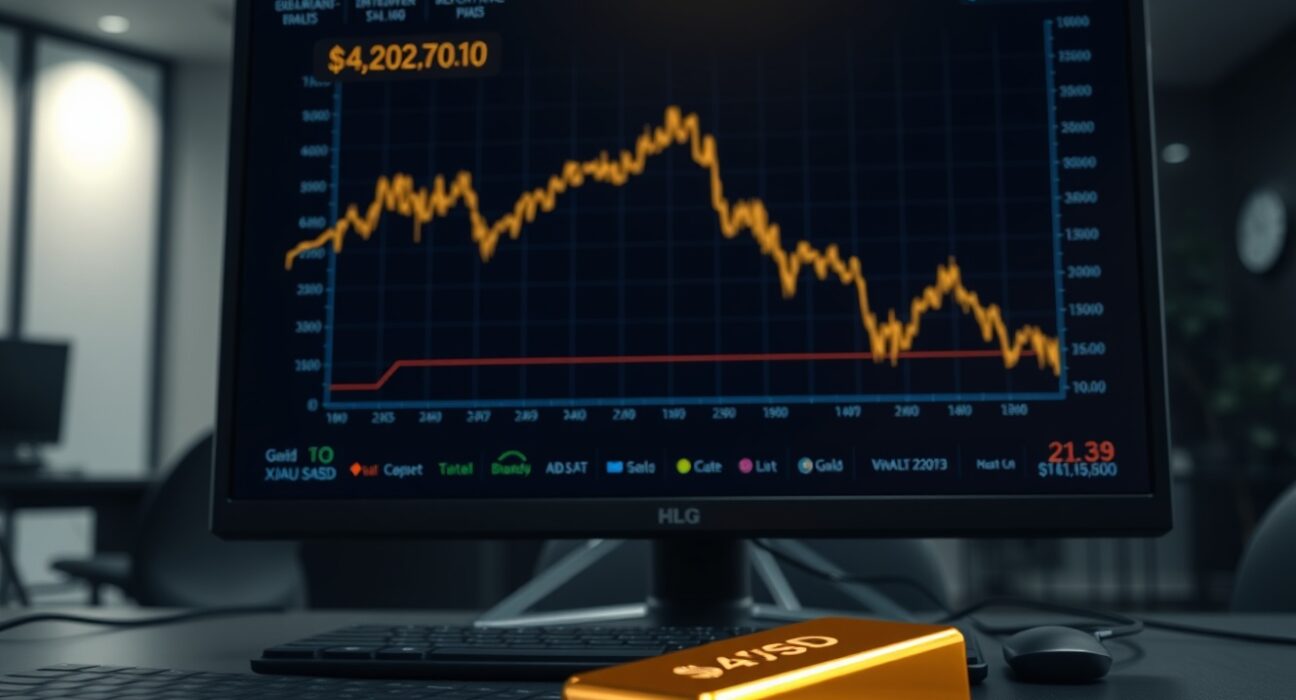
Gold prices have plunged to near $4,750 per ounce in global markets this week, a significant retreat driven by mounting concerns over oil-fueled inflation and intense anticipation for the upcoming US Consumer Price Index (CPI) report. This move underscores the precious metal’s complex role as both an inflation hedge and a dollar-denominated asset sensitive to interest rate expectations. Market analysts are closely monitoring the interplay between surging energy costs and Federal Reserve policy signals, which are currently dictating the trajectory for bullion and broader commodity markets. The pre-data anxiety reflects a pivotal moment for investors gauging the persistence of inflationary pressures.
Gold Price Decline and the Oil Inflation Conundrum
The recent sell-off in gold directly correlates with a sharp rally in global crude oil benchmarks. Brent and West Texas Intermediate (WTI) futures have surged over 15% in the past month, primarily due to geopolitical tensions in key producing regions and deliberate supply constraints from the OPEC+ alliance. Consequently, rising energy costs are reigniting fears of broader, stickier inflation, often referred to as a ‘cost-push’ scenario. This environment typically creates a paradox for gold. While historically an inflation hedge, gold faces immediate pressure from the resultant rise in Treasury yields and a stronger US dollar, as markets price in a potentially more aggressive Federal Reserve response. The metal’s failure to rally amid these inflation signals highlights the overwhelming dominance of rate expectations in the current market calculus.
Furthermore, the correlation between oil and gold has entered a notably volatile phase. Analysis of the 50-day rolling correlation shows it flipping between positive and negative territory, indicating market confusion. This instability makes predicting gold’s path based solely on energy markets exceptionally challenging. Market technicians point to the breach of several key support levels around $4,800 as a technically significant event, potentially inviting further selling pressure if the $4,750 level does not hold. The trading volume during this decline has been substantially above average, confirming strong conviction among sellers.
US CPI Data: The Paramount Market Catalyst
All eyes are now fixed on the imminent release of the US Consumer Price Index data, scheduled for Thursday. This report is universally regarded as the most critical piece of economic data for the month, capable of reshaping interest rate forecasts for the remainder of the year. Economists’ consensus, as polled by major financial institutions, anticipates a monthly increase of 0.4% for both the headline and core (excluding food and energy) indices. A print at or above this level would likely validate market fears of persistent inflation, potentially triggering a further sell-off in gold as bets on sustained higher interest rates solidify. Conversely, a softer-than-expected reading could provide a lifeline for bullion, easing fears of additional monetary tightening.
The specific components within the CPI report warrant close scrutiny. While energy prices will be a major contributor, the market will dissect the trends in shelter costs and core services, which the Federal Reserve emphasizes. The trajectory of these ‘sticky’ categories will offer deeper insight into the underlying inflation trend beyond volatile energy moves. Historical data analysis reveals that gold has experienced an average intraday volatility spike of ±2.5% on CPI release days over the past year, compared to a typical day’s range of ±1.2%. This quantifies the heightened risk and opportunity surrounding the event.
Expert Analysis on Fed Policy and Gold’s Path
Leading market strategists from institutions like Goldman Sachs and J.P. Morgan provide critical context. “Gold is caught in a tug-of-war,” notes Dr. Anya Sharma, Head of Commodity Strategy at Global Markets Research. “The inflationary impulse from oil is bullish in theory, but the reflexive hawkish Fed repricing it triggers is overwhelmingly bearish in the current environment. The market is prioritizing the policy response over the inflation cause.” This expert perspective underscores the nuanced dynamics at play. Sharma further points to real yields—the inflation-adjusted return on Treasury bonds—as the most reliable short-term driver for gold. As nominal yields rise on inflation fears, and if inflation expectations do not rise in tandem, real yields increase, directly increasing the opportunity cost of holding non-yielding gold.
Additionally, analysis of Commitment of Traders (COT) reports from the Commodity Futures Trading Commission (CFTC) shows that managed money funds have significantly reduced their net-long positions in gold futures over the past three weeks. This reduction in speculative bullish bets has removed a key source of support and made the market more vulnerable to downward moves. The current positioning suggests the market is leaning bearish but not excessively so, leaving room for a sharp repositioning in either direction post-CPI.
Broader Commodity Market Impacts and Historical Context
The pressure on gold is not occurring in isolation. The entire commodity complex is reacting to the shifting macro landscape. Industrial metals like copper have also faced headwinds from a stronger dollar, while agricultural commodities exhibit more mixed performance, tied closely to specific supply dynamics. This divergence highlights that the current market phase is primarily a macro-financial event rather than a broad-based commodity boom. The table below illustrates the recent performance of key assets:
| Asset | 1-Month Performance | Primary Driver |
|---|---|---|
| Gold (XAU/USD) | -5.2% | Rising yields & dollar strength |
| Brent Crude Oil | +16.8% | Geopolitics & supply cuts |
| US Dollar Index (DXY) | +3.1% | Hawkish Fed expectations |
| 10-Year Treasury Yield | +40 bps | Inflation repricing |
Historically, periods where oil surges due to supply shocks have led to initial gold weakness, followed by a recovery as the inflation hedge characteristic reasserts itself over a longer horizon. The stagflationary episodes of the 1970s serve as a classic, though extreme, example. The current situation differs due to the Federal Reserve’s strong credibility and explicit commitment to restoring price stability, a tool not available fifty years ago. This historical lens is crucial for understanding potential medium-term pathways.
Conclusion
The gold price decline to the $4,750 threshold is a direct reflection of financial markets recalibrating for a potentially prolonged period of higher interest rates, fueled by oil-driven inflation worries. The immediate fate of bullion hinges almost entirely on the nuances of the upcoming US CPI data release, which will either validate or alleviate these intense fears. While the long-term case for gold as a portfolio diversifier and store of value remains intact, its short-term path is dominated by Treasury yields and the dollar’s strength. Investors should prepare for significant volatility as the market digests the inflation report and subsequent commentary from Federal Reserve officials, which will collectively chart the course for the precious metal and broader financial markets in the weeks ahead.
FAQs
Q1: Why is gold falling if inflation fears are rising?
Gold is falling because the market expects rising inflation, particularly from oil, to force the Federal Reserve to maintain higher interest rates for longer. Higher rates boost the US dollar and Treasury yields, increasing the opportunity cost of holding gold, which offers no yield. This financial market reaction is currently overpowering gold’s traditional role as an inflation hedge.
Q2: What is the most important number in the upcoming CPI report for gold traders?
While the headline number matters, gold traders will scrutinize the core CPI (excluding food and energy) most closely. A high core reading suggests inflation is broad-based and sticky, increasing the likelihood of a persistently hawkish Fed—a negative for gold. They will also watch shelter inflation, a major component that has been slow to decline.
Q3: Could rising oil prices eventually help gold prices?
Yes, but with a lag. If high oil prices lead to entrenched inflation expectations that outpace the rise in interest rates, real yields (nominal yield minus inflation) could fall or turn more negative. This environment is historically bullish for gold. However, this transition requires the market to believe the Fed is losing control of the inflation narrative, which is not the current dominant view.
Q4: What key price level are technical analysts watching for gold?
Technical analysts are closely watching the $4,750 level as immediate support. A sustained break below could open the path toward $4,680. On the upside, a recovery above $4,850 is needed to signal a potential reversal and ease the immediate downward pressure.
Q5: How are other precious metals like silver performing in this environment?
Silver is typically experiencing even greater volatility than gold. It is facing the same macro headwinds from rates and the dollar but is also influenced by industrial demand expectations. Its recent underperformance relative to gold, as shown by a rising Gold/Silver Ratio, often reflects a risk-off or deflationary scare mood in markets, adding another layer of complexity to the current commodity sell-off.
Disclaimer: The information provided is not trading advice, Bitcoinworld.co.in holds no liability for any investments made based on the information provided on this page. We strongly recommend independent research and/or consultation with a qualified professional before making any investment decisions.
