

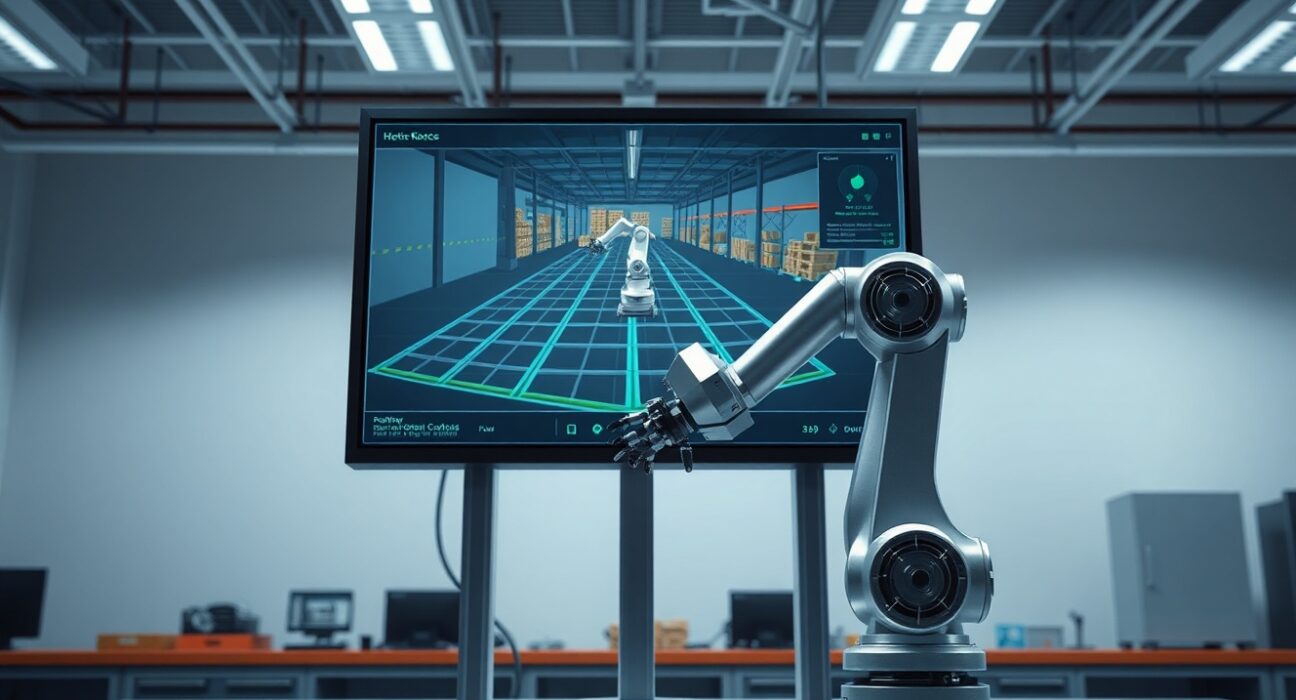
In a significant move for the robotics industry, simulation startup Antioch has announced an $8.5 million seed funding round to tackle one of physical AI’s most persistent challenges: the sim-to-real gap. This substantial investment, led by venture firms A* and Category Ventures, underscores the growing consensus that high-fidelity virtual environments are critical for scaling autonomous systems. The New York-based company, founded in May 2023, aims to become the essential development platform for engineers building robots for the physical world, fundamentally changing how they train and test their machines.
Bridging the Physical AI Simulation Gap
The core promise of physical AI—programming robots and autonomous agents with the same ease as software—remains hampered by a critical data shortage. Currently, companies often resort to building expensive mock-up warehouses or deploying extensive sensor arrays in real-world settings to collect training data. This process is notoriously slow, costly, and difficult to scale. Consequently, simulation has emerged as a vital alternative. By creating detailed digital twins of real environments, developers can generate vast amounts of synthetic data and safely test edge cases that would be dangerous or impractical in reality.
However, the effectiveness of this approach hinges on a concept known as the sim-to-real gap. This term describes the discrepancy between a virtual simulation and the physical world. If the simulation’s physics, lighting, or sensor noise does not accurately mirror reality, a robot trained in the digital realm will fail when deployed. Antioch’s entire mission focuses on minimizing this gap. “How can we do the best possible job reducing that gap, to make simulation feel just like the real world from the perspective of your autonomous system?” CEO Harry Mellsop explained in an exclusive statement. The company’s $60 million post-money valuation reflects investor confidence in their technical approach to this complex problem.
The Antioch Platform and Its Strategic Vision
Antioch executives position their product as the “Cursor for physical AI,” referencing the popular AI-powered software development tool. Their platform allows robotics teams to create multiple digital instances of their hardware. These virtual robots connect to simulated sensors that replicate the precise data streams—like lidar point clouds or camera images—the robot’s software would encounter in the field. This setup enables developers to perform reinforcement learning, test thousands of scenario variations, and generate novel training datasets on demand.
The company’s technical strategy involves building upon existing simulation models from leaders like Nvidia and World Labs. Antioch then develops domain-specific libraries and tools to make these powerful engines accessible and usable for robotics teams. A key advantage, according to the company, is its multi-customer approach. Working with various clients across different applications—from autonomous vehicles to agricultural drones—provides Antioch with a broader context for refining its simulations than any single company could achieve internally.
Industry Validation and High-Stakes Development
The need for advanced simulation is not theoretical; it’s operational. Major players like Waymo already use world models from Google DeepMind to test and evaluate their self-driving algorithms, significantly reducing the cost and time required to scale to new cities. Antioch aims to democratize this capability for smaller startups and companies that lack the capital to build massive physical test tracks or drive millions of real-world miles.
Çağla Kaymaz, a partner at investor Category Ventures, highlighted the elevated stakes. “We do a lot of work on dev tools… but the challenges are different. With software, you can have these bad coding tools, and the risk is generally pretty contained to the digital world. In the physical world, the stakes are much higher.” A failure in a physical AI system can have real-world safety consequences, making rigorous simulation not just a convenience but a necessity for validation and safety certification.
Market Traction and Future Applications
While Antioch’s primary pitch targets capital-constrained startups, some of its earliest customers are large multinational corporations with established robotics divisions. This early traction suggests a broad market need for specialized simulation tools. Currently, Antioch concentrates on sensor and perception systems, which are crucial for most commercial robotics applications in logistics, construction, and automotive sectors.
The long-term vision, however, extends further. Researchers are already experimenting with using Antioch’s platform in novel ways. David Mayo at MIT’s CSAIL lab, for instance, is employing it to evaluate large language models (LLMs) by having them design robots and then testing those designs in the simulator. This creates a realistic sandbox for benchmarking AI creativity and problem-solving in physical domains. Adrian Macneil, founder of robotics data tool company Foxglove and an angel investor in Antioch, envisions a future where a full suite of off-the-shelf tools, akin to the GitHub and Stripe ecosystems in software, empowers the entire physical AI industry.
Conclusion
The $8.5 million seed round for Antioch marks a pivotal step in the maturation of physical AI development. By directly addressing the sim-to-real gap with a dedicated platform, the startup is tackling a fundamental bottleneck in robotics. As CEO Harry Mellsop predicts, the industry is moving toward a future where autonomous systems are primarily developed and iterated upon in software. Success in this endeavor could unlock a powerful data flywheel for robotics companies, accelerating innovation and making advanced physical AI more accessible. For an industry poised for massive growth, effective physical AI simulation tools may well become the most critical infrastructure of all.
FAQs
Q1: What is the “sim-to-real gap” in robotics?
The sim-to-real gap is the performance difference observed when an AI or robot trained in a simulation is deployed in the real world. It occurs because virtual environments cannot perfectly replicate the complexity, physics, and noise of physical reality.
Q2: How does Antioch’s simulation platform work?
Antioch provides tools for creating high-fidelity digital twins of robots and their environments. Developers can run thousands of virtual tests, using simulated sensor data to train the robot’s AI software, significantly reducing the need for costly and time-consuming physical testing.
Q3: Why is simulation so important for physical AI development?
Simulation allows for rapid, safe, and scalable testing. It enables developers to train AI on rare “edge case” scenarios (like adverse weather or system failures), perform reinforcement learning at high speed, and generate synthetic data to supplement limited real-world datasets.
Q4: Who are Antioch’s target customers?
While initially focused on startups building autonomous systems, Antioch also engages with large enterprises in automotive, logistics, and manufacturing that are investing heavily in robotics and need efficient testing tools.
Q5: What is the significance of Antioch’s funding and valuation?
The $8.5 million seed round at a $60 million valuation signals strong investor belief in the market need for specialized simulation software. It provides the capital necessary to refine their technology, expand their team, and scale their platform to meet growing industry demand.
Disclaimer: The information provided is not trading advice, Bitcoinworld.co.in holds no liability for any investments made based on the information provided on this page. We strongly recommend independent research and/or consultation with a qualified professional before making any investment decisions.
