

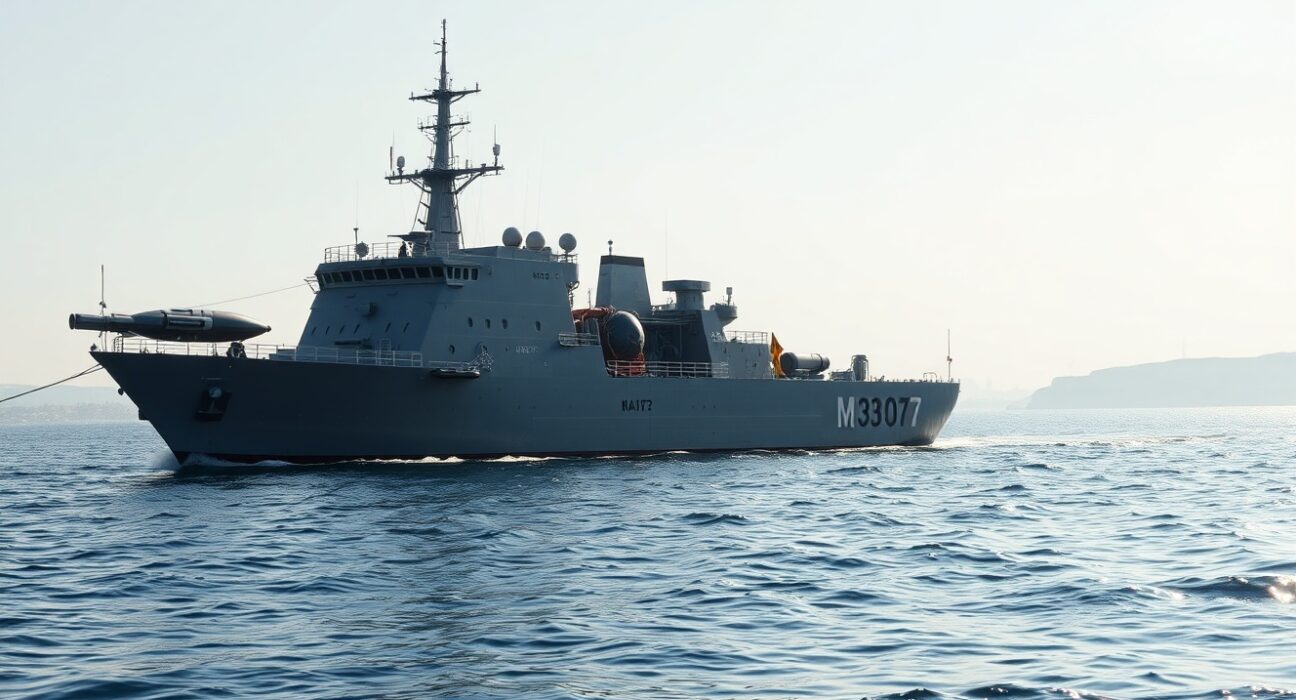
In a significant development for global maritime security, President Donald Trump stated that Iran has removed, or is actively removing, all of its sea mines with direct assistance from the United States. This announcement, made from the White House on Tuesday, marks a potential turning point in the tense security situation surrounding the vital Strait of Hormuz. Consequently, this cooperative effort could signal a de-escalation in a region that has witnessed numerous confrontations over the past several years. The strategic waterway is a crucial chokepoint for global oil shipments, making its security a paramount international concern.
Analyzing the Trump Announcement on Iran Sea Mines
President Trump’s statement represents a notable shift in public discourse regarding U.S.-Iranian interactions in the Persian Gulf. Previously, the relationship has been characterized by mutual accusations and military posturing. Specifically, the U.S. Fifth Fleet, based in Bahrain, has repeatedly accused Iranian forces of provocative actions, including the alleged laying of mines. Therefore, the claim of cooperative mine clearance introduces a new, collaborative dimension to the narrative. Maritime security experts immediately began scrutinizing the operational details, which remain partially undisclosed. The process likely involves specialized naval assets from both nations, operating under a carefully negotiated protocol.
Historically, sea mines are a persistent, low-cost asymmetric threat. They can disrupt shipping lanes for extended periods without a clear attribution of responsibility. The U.S. Navy maintains dedicated mine countermeasure (MCM) forces, including ships, helicopters, and unmanned systems. For instance, the Avenger-class minesweepers and MH-53E Sea Dragon helicopters are specifically designed for this complex task. Conversely, Iran possesses a large inventory of naval mines, which it has historically acquired and produced domestically. A joint operation to locate and neutralize these weapons is a technically demanding and politically sensitive undertaking.
The Strategic Context of the Strait of Hormuz
The Strait of Hormuz is arguably the world’s most important maritime chokepoint. Through it flows about 21% of global petroleum liquid consumption. Any threat to free navigation triggers immediate volatility in energy markets and alarms international stakeholders. Over the past decade, the region has seen tanker seizures, attacks on commercial vessels, and direct engagements between U.S. and Iranian military forces. For example, in 2019, multiple oil tankers were damaged by mysterious explosions and mine-like devices near the Strait. The U.S. blamed Iran’s Islamic Revolutionary Guard Corps (IRGC) Navy for these attacks, a charge Tehran consistently denied.
This backdrop makes the current announcement particularly consequential. If verified, the clearance operation could reduce the immediate risk of accidental escalation or a catastrophic blockage. However, analysts caution that the underlying geopolitical tensions remain unresolved. The joint mine-clearing effort may serve as a confidence-building measure, but it does not address core disputes over Iran’s nuclear program or regional activities. Nevertheless, it establishes a rare channel of direct military-to-military communication, which can help prevent misunderstandings at sea.
Technical and Diplomatic Process of Mine Clearance
The actual work of finding and neutralizing sea mines is a meticulous, dangerous process. It typically follows a multi-stage procedure. First, surveillance assets map suspected areas using sonar and magnetic anomaly detection. Next, identification platforms, often remotely operated vehicles (ROVs), visually confirm objects on the seabed. Finally, disposal teams neutralize the ordnance using controlled detonations or other methods. U.S. assistance likely provides advanced sensing technology and operational expertise that significantly accelerates this process.
From a diplomatic standpoint, the arrangement implies a level of tacit agreement and coordination previously unseen. It suggests that behind-the-scenes communications, possibly through intermediaries like Oman or Switzerland, have been more productive than public rhetoric indicated. The table below outlines the key components involved in a modern maritime mine clearance operation:
| Component | Primary Function | Example Systems |
|---|---|---|
| Detection | Locate potential mine-like objects | Side-scan sonar, laser scanners |
| Classification | Identify objects as mines or debris | Remotely Operated Vehicles (ROVs) |
| Neutralization | Render mines safe or destroy them | Disposal charges, robotic manipulators |
| Command & Control | Coordinate all assets and ensure safety | Integrated naval operation centers |
This technical cooperation requires sharing sensitive data about seabed topography and, potentially, mine signatures. Therefore, the operation itself is a substantial gesture of pragmatic, if limited, trust. Regional partners, including the Gulf Cooperation Council (GCC) states, will watch closely for any tangible improvement in shipping security. Insurance premiums for vessels transiting the Strait, which rose sharply after past incidents, may see downward pressure if the operation is perceived as successful and lasting.
Potential Impacts on Regional Security and Global Markets
The immediate impact of successful mine clearance is enhanced safety for commercial shipping. This outcome benefits the global economy by ensuring the reliable flow of oil and gas. However, the longer-term strategic impacts are more complex. On one hand, reduced mine threats lower the probability of a triggering incident that could spiral into broader conflict. On the other hand, it does not remove other tools of hybrid warfare, such as fast boat swarms or coastal defense missiles, from Iran’s arsenal.
Key implications for stakeholders include:
- For Global Shippers: A safer transit corridor could lower risk assessments and associated costs.
- For the U.S. Navy: Resources dedicated to escort and patrol missions might be partially reallocated.
- For Iran: The action could be framed domestically as a responsible move to ensure regional stability, or conversely, criticized as capitulation.
- For Regional Rivals: Nations like Saudi Arabia and Israel may view any U.S.-Iran cooperation with deep skepticism.
Energy market analysts note that while the physical threat may diminish, the underlying geopolitical risk premium in oil prices will persist. Markets have grown accustomed to the “Hormuz premium” over years of tension. A sustained period of calm and verified cooperation would be necessary to materially alter that calculus. Furthermore, the announcement’s timing may intersect with other diplomatic efforts, such as indirect talks on reviving the Joint Comprehensive Plan of Action (JCPOA), commonly known as the Iran nuclear deal.
Expert Perspectives on the Development
Security analysts emphasize the need for verification. “Statements about mine clearance are positive, but they require on-the-water verification by neutral parties,” notes a former commander of U.S. Naval Forces Central Command. “The proof will be in a prolonged absence of incidents and increased transparency in the waterway.” Independent monitoring of shipping traffic and incident reports in the coming months will provide the most reliable data.
Furthermore, historians of the region point to precedents. During the 1980s “Tanker War,” both Iran and Iraq mined shipping lanes. A massive, international mine-clearing effort followed, led primarily by U.S. and European navies. That operation, however, occurred after the conflict had concluded, not as a cooperative measure during ongoing tensions. The current situation is therefore somewhat novel as a potential de-escalatory step taken mid-stride.
Conclusion
President Trump’s announcement regarding Iran clearing its sea mines with U.S. help presents a potentially significant step toward stabilizing the volatile Strait of Hormuz. While the operational details and long-term verification remain crucial, the move establishes a rare instance of direct security cooperation between the two adversaries. The focus on Iran sea mines addresses a tangible, immediate threat to global commerce. Ultimately, the success of this initiative will depend on continued technical follow-through and its integration into a broader, sustainable diplomatic framework for regional security. The world will be watching to see if this breakthrough in mine clearance leads to a broader thaw or remains an isolated incident of pragmatic cooperation.
FAQs
Q1: What exactly did President Trump announce regarding Iran and sea mines?
President Trump stated that Iran has removed, or is in the process of removing, all of its deployed sea mines in the Persian Gulf region, and that this operation is being conducted with assistance from the United States.
Q2: Why is clearing sea mines in the Strait of Hormuz so important?
The Strait of Hormuz is a critical global chokepoint for oil shipments. Sea mines pose a direct threat to free navigation, can cause environmental disasters, trigger military conflict, and disrupt global energy markets.
Q3: How does the United States assist with mine clearance operations?
The U.S. likely provides advanced technology for detection (like sonar systems), classification (using Remotely Operated Vehicles), and neutralization, along with operational expertise from its dedicated Navy mine countermeasure forces.
Q4: Does this cooperation mean U.S.-Iran relations are improving?
Not necessarily. While security cooperation on a specific issue is significant, it can be a isolated, pragmatic step. Core geopolitical disputes over Iran’s nuclear program and regional influence remain unresolved.
Q5: How can the success of this mine clearance be verified?
Verification comes from independent monitoring of shipping incidents, satellite imagery analysis of naval activity, and potentially increased transparency and data-sharing from the involved nations regarding cleared areas.
Q6: What other security threats persist in the Strait of Hormuz besides sea mines?
Other threats include attacks by fast-attack craft, anti-ship cruise missiles, drone strikes, and the seizure of commercial vessels by military or paramilitary forces.
Disclaimer: The information provided is not trading advice, Bitcoinworld.co.in holds no liability for any investments made based on the information provided on this page. We strongly recommend independent research and/or consultation with a qualified professional before making any investment decisions.
