

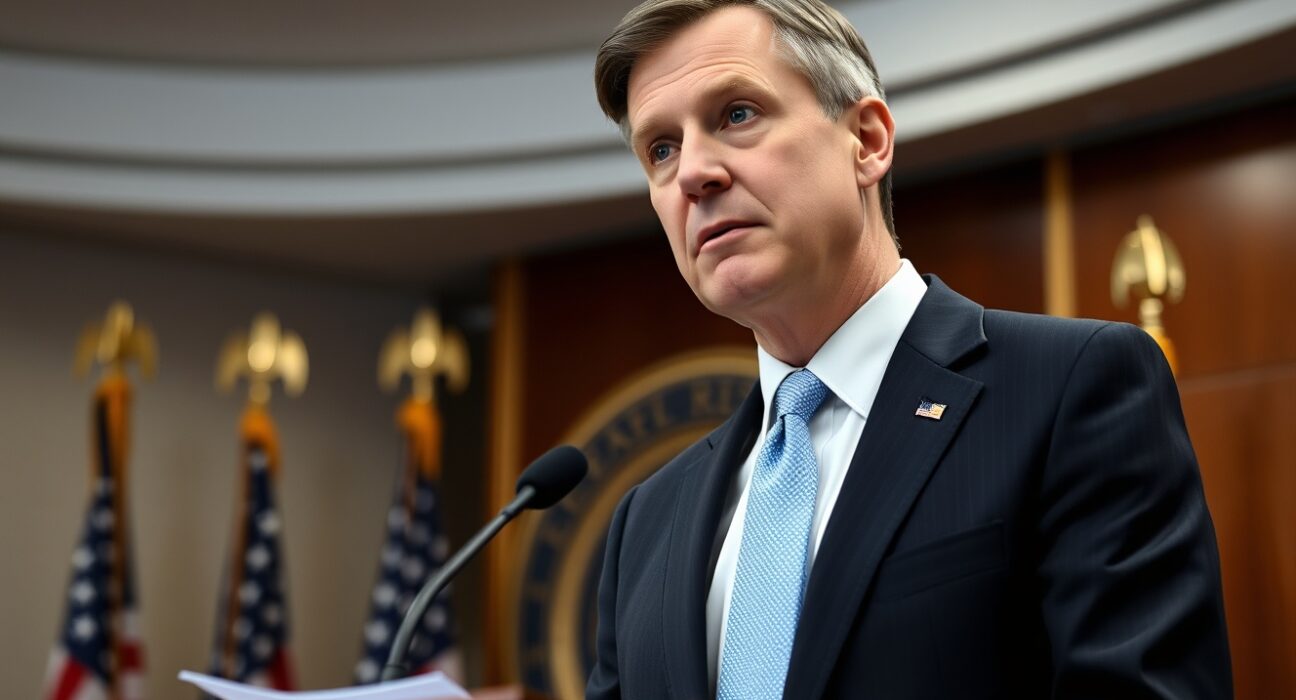
WASHINGTON, D.C. – March 15, 2025 – Federal Reserve Governor Christopher Waller has delivered a significant statement regarding the central bank’s approach to monitoring economic indicators, specifically emphasizing that policymakers will “closely watch jobs data for growing signs of stress” in the coming months. This declaration comes at a crucial juncture for the U.S. economy as it navigates persistent inflationary pressures alongside evolving labor market dynamics. Consequently, Waller’s remarks provide critical insight into the Federal Reserve’s evolving policy framework and its heightened sensitivity to employment metrics as potential early warning signals.
Federal Reserve’s Evolving Focus on Labor Market Indicators
Governor Christopher Waller’s emphasis on jobs data monitoring represents a notable shift in the Federal Reserve’s analytical priorities. Traditionally, the central bank has maintained a dual mandate of price stability and maximum employment. However, Waller’s specific focus on “signs of stress” within employment statistics suggests a more nuanced approach to labor market analysis. This development indicates that Federal Reserve officials are examining not just employment levels but also the underlying quality and sustainability of job creation.
Recent economic data reveals several concerning trends that likely prompted Waller’s statement. For instance, the Bureau of Labor Statistics reported a gradual increase in the duration of unemployment for certain demographic groups. Additionally, wage growth has shown signs of deceleration in specific sectors despite ongoing hiring. These subtle shifts require careful interpretation by policymakers who must distinguish between normal economic cooling and more problematic structural weaknesses.
Understanding the Jobs Data Metrics Under Scrutiny
The Federal Reserve monitors multiple employment indicators beyond the headline unemployment rate. According to Waller’s framework, several specific metrics will receive heightened attention:
- Initial and Continuing Jobless Claims: These weekly reports provide real-time insights into labor market turnover and potential distress
- Labor Force Participation Rate: This measures the percentage of working-age population either employed or actively seeking employment
- Underemployment Rates: These statistics capture workers who are employed part-time but desire full-time positions
- Job Openings and Labor Turnover Survey (JOLTS): This data reveals hiring rates, separation rates, and job vacancy trends
- Average Hourly Earnings Growth: Wage trends indicate labor market tightness and inflationary pressures
Federal Reserve analysts will particularly examine divergences between these indicators. For example, a scenario where unemployment remains low but wage growth stagnates could signal underlying weakness. Similarly, increasing job openings alongside declining hires might indicate skills mismatches or other structural issues. Waller’s statement suggests the Federal Reserve will employ a more sophisticated analytical framework to detect early warning signs before they manifest in broader economic data.
Historical Context and Policy Implications
Waller’s approach reflects lessons learned from previous economic cycles. During the 2008 financial crisis, employment indicators provided crucial early warnings that were initially overlooked. More recently, the pandemic-era labor market disruptions demonstrated how quickly employment conditions can deteriorate. Consequently, the Federal Reserve appears determined to develop more responsive policy frameworks that can address emerging labor market stresses proactively rather than reactively.
This monitoring strategy has direct implications for monetary policy decisions. If jobs data reveals growing stress, the Federal Reserve might consider adjusting its policy trajectory. Potential responses could include modifying the pace of balance sheet normalization or reconsidering the timing of future interest rate adjustments. However, Waller emphasized that any policy changes would remain data-dependent and carefully calibrated to avoid overcorrection.
The Broader Economic Landscape in Early 2025
Waller’s statement occurs within a complex economic environment characterized by several competing trends. Inflation, while moderating from peak levels, remains above the Federal Reserve’s 2% target. Simultaneously, consumer spending shows resilience in some sectors while weakening in others. Global economic conditions, including geopolitical tensions and supply chain reconfigurations, further complicate the domestic outlook.
The labor market itself presents mixed signals. On one hand, many industries continue reporting difficulty finding qualified workers. On the other hand, certain technology and financial sectors have announced hiring slowdowns or restructuring. This bifurcation creates analytical challenges for policymakers who must determine whether specific sectoral adjustments represent isolated developments or early indicators of broader economic softening.
| Indicator | Current Reading | Federal Reserve Threshold for Concern |
|---|---|---|
| Unemployment Rate | 4.1% | Sustained increase above 4.5% |
| Labor Force Participation | 62.7% | Decline below 62.3% |
| Underemployment Rate | 7.4% | Increase above 8.0% |
| Average Hourly Earnings Growth | 3.8% year-over-year | Decline below 3.0% |
| JOLTS Quits Rate | 2.3% | Decline below 2.0% |
Expert Perspectives on Labor Market Monitoring
Economic analysts have largely welcomed Waller’s transparent communication regarding the Federal Reserve’s monitoring priorities. Dr. Sarah Jensen, former Federal Reserve economist and current director of the Economic Policy Institute, notes: “This approach represents sophisticated central banking. By explicitly identifying which labor market signals they’re watching, the Federal Reserve provides valuable guidance to markets while maintaining policy flexibility.”
Similarly, Michael Torres, chief economist at Global Financial Analytics, observes: “Waller’s focus on ‘signs of stress’ rather than just employment levels acknowledges that labor markets can deteriorate in subtle ways before headline numbers reflect the change. This granular approach could help the Federal Reserve implement more timely and measured policy responses.”
These expert assessments highlight the technical sophistication underlying Waller’s statement. Rather than simply reacting to unemployment rate movements, the Federal Reserve appears committed to analyzing the labor market’s multidimensional characteristics. This analytical depth reflects advancements in economic measurement and modeling since previous economic cycles.
Potential Scenarios and Policy Responses
Based on Waller’s framework, several scenarios could trigger heightened Federal Reserve attention. A rapid increase in continuing jobless claims might indicate that unemployed workers face greater difficulty finding new positions. Similarly, a decline in the quits rate from the JOLTS report could suggest reduced worker confidence in alternative employment opportunities. These developments, while potentially subtle initially, could signal deteriorating labor market conditions.
The Federal Reserve’s potential policy responses would likely follow established frameworks while allowing for flexibility. If jobs data reveals moderate stress without accompanying inflationary pressures, policymakers might consider extending the timeline for balance sheet reduction. In more pronounced scenarios, the Federal Open Market Committee could adjust its forward guidance regarding the policy rate path. However, Waller emphasized that any adjustments would remain gradual and data-dependent to avoid market disruption.
Financial markets have generally responded positively to Waller’s transparent communication approach. Equity markets initially showed modest gains following his remarks, while Treasury yields exhibited minimal movement. This muted response suggests investors appreciate the Federal Reserve’s commitment to monitoring economic conditions carefully without predetermined policy trajectories. Market participants particularly value the specificity regarding which indicators will receive heightened scrutiny.
Conclusion
Federal Reserve Governor Christopher Waller’s statement regarding close monitoring of jobs data for signs of stress represents a significant development in central bank communication and policy framework evolution. This approach demonstrates the Federal Reserve’s commitment to sophisticated labor market analysis that extends beyond headline employment statistics. By explicitly identifying specific indicators of concern, policymakers provide valuable transparency while maintaining necessary flexibility. As economic conditions evolve throughout 2025, Waller’s framework will guide the Federal Reserve’s assessment of labor market health and inform subsequent policy decisions. Consequently, market participants, businesses, and policymakers should closely follow the employment metrics Waller highlighted, as they will likely play a crucial role in shaping the monetary policy landscape in the coming months.
FAQs
Q1: What specific jobs data is the Federal Reserve monitoring most closely?
Federal Reserve Governor Christopher Waller highlighted several key indicators including initial and continuing jobless claims, labor force participation rates, underemployment statistics, JOLTS data on hiring and separations, and wage growth trends. These metrics provide insights into labor market quality beyond headline employment numbers.
Q2: Why is the Federal Reserve focusing on “signs of stress” rather than just employment levels?
Employment levels alone don’t capture labor market health comprehensively. Signs of stress—such as increasing duration of unemployment, declining worker mobility, or sector-specific weaknesses—can provide earlier warnings of economic deterioration than aggregate employment statistics.
Q3: How might jobs data influence Federal Reserve policy decisions in 2025?
If jobs data reveals growing stress without corresponding inflationary pressures, the Federal Reserve might adjust the pace of balance sheet normalization or modify forward guidance on interest rates. However, any policy changes would remain gradual and data-dependent to avoid market disruption.
Q4: What constitutes “growing signs of stress” in employment data?
Growing signs of stress include sustained increases in continuing jobless claims, declining labor force participation, rising underemployment, decreasing job-to-job transitions, and wage growth deceleration beyond normal cyclical patterns.
Q5: How does Waller’s approach differ from previous Federal Reserve labor market monitoring?
Waller’s framework emphasizes more granular, real-time indicators and multidimensional analysis rather than focusing primarily on headline unemployment rates. This represents a more sophisticated approach that acknowledges labor markets can deteriorate in subtle ways before aggregate statistics reflect the change.
Disclaimer: The information provided is not trading advice, Bitcoinworld.co.in holds no liability for any investments made based on the information provided on this page. We strongly recommend independent research and/or consultation with a qualified professional before making any investment decisions.
