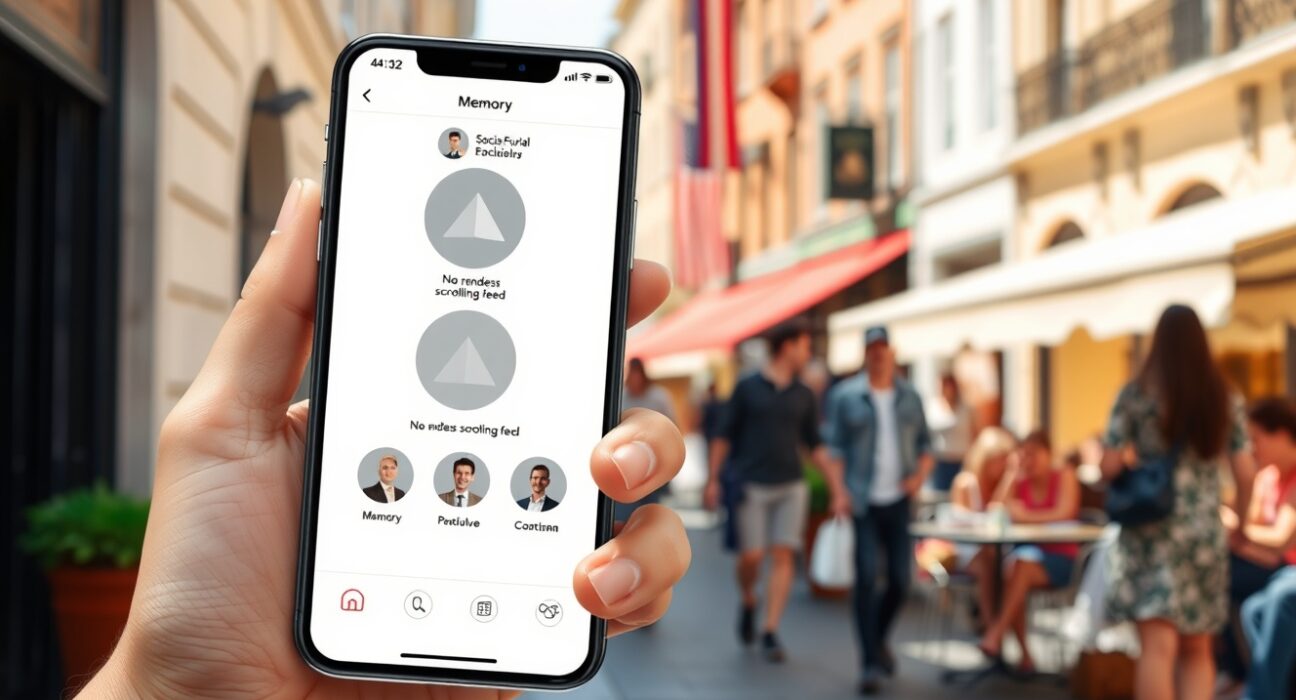
In San Francisco on April 30, a new social media contender named Bond launched with a paradoxical mission: to use artificial intelligence to get users to spend less time on social media. The platform directly challenges the core engagement mechanics of legacy networks by replacing infinite scroll with AI-generated prompts for real-world activities. This launch signals a growing tech sector movement prioritizing digital wellness and intentional platform design over raw user engagement metrics.
Bond Social Media Redefines Platform Purpose
Bond operates on a fundamentally different principle than mainstream social networks. Instead of algorithmically curating content to maximize screen time, Bond’s AI system analyzes user-shared “memories”—posts about past experiences—to generate personalized suggestions for future real-world activities. Co-founder and CEO Dino Becirovic, a veteran of Kleiner Perkins and Index Ventures, states the platform is engineered to counteract the “bed rotting” and “doomscrolling” prevalent on other apps. Consequently, the platform lacks a traditional, endlessly refreshing feed, a design choice that disrupts the habitual scrolling loop engineered by its predecessors.
The platform’s interface clusters user profiles visually, reminiscent of Instagram’s aesthetic, but interaction is purpose-driven. Users click on a profile to view ephemeral “stories” that vanish after 24 hours from public view but archive privately. This structure prioritizes active choice over passive consumption. The founding team leverages significant industry expertise, including alumni from TikTok, Twitter, and Facebook, and founding researcher Arthur Bražinskas, who co-led user signal integration at Google Gemini.
How AI Powers Real-World Recommendations
Bond’s core innovation is its recommendation engine, which functions as a personal concierge trained on a user’s own lived experiences. The system identifies patterns and stated preferences from a user’s memory archive. For example, frequent posts about enjoying pho could trigger a suggestion for a highly-rated local Vietnamese restaurant. Similarly, indicated interest in heavy metal might prompt a notification about an upcoming concert. The AI’s effectiveness scales with user participation; more shared memories yield more accurate and personalized suggestions.
The Data and Privacy Framework
Bond’s proposed business model diverges sharply from the ad-based revenue of legacy platforms. Becirovic outlines a future where users could license their own anonymized memory data to AI companies for model training, with Bond taking a minor licensing fee. An alternative path involves using aggregated, opt-in data to power product recommendation tools for e-commerce partners. The company explicitly rules out selling user data for advertising. Currently, user data is stored securely, with end-to-end encryption listed as a near-future priority post-launch. Users retain control, able to delete memories via a dedicated tab or natural language commands.
The Broader Shift in Social Media Design
Bond enters a market increasingly aware of the psychological costs of traditional social media. A 2023 study by the Stanford Social Media Lab found a direct correlation between passive scrolling and increased feelings of envy and reduced well-being. In response, a niche of “anti-addictive” platforms has emerged. These include:
- Platforms with intentional friction: Apps that limit daily use or require conscious actions to continue browsing.
- Experience-focused networks: Services designed around planning and sharing IRL activities rather than digital content consumption.
- Subscription-based models: Networks that forgo ads and data sales, funded directly by users.
Bond synthesizes these approaches, using AI as the bridge between digital sharing and physical action.
| Feature | Bond | Traditional Model (e.g., Meta, TikTok) |
|---|---|---|
| Primary Goal | Prompt real-world activity | Maximize in-app engagement |
| Core Interface | Memory archive & profile clusters | Algorithmically sorted infinite feed |
| Revenue Model | Future data licensing / e-commerce | Targeted advertising |
| Data Use | Train user-specific AI for recommendations | Train broad AI for ad targeting & content ranking |
| Content Lifespan | Stories expire; memories archive privately | Permanent, searchable public posts |
Challenges and Future Trajectory
Bond’s success hinges on achieving critical mass. A recommendation network requires substantial user data to function effectively, creating a classic cold-start problem. Furthermore, monetization remains a long-term vision. Becirovic acknowledges that “monetization is not a short-term priority,” focusing first on delivering user value. The platform must also navigate complex user trust issues around data licensing, despite its privacy pledges. Its evolution will be a key case study in whether a social platform can thrive by prioritizing user well-being over engagement metrics, a challenge that has eluded many well-funded predecessors.
Conclusion
The launch of Bond social media represents a significant experiment in recalibrating the relationship between users, AI, and social platforms. By leveraging artificial intelligence to encourage offline experiences rather than prolong online engagement, Bond challenges the fundamental business logic of the social media industry. Its long-term viability will test whether a market exists for a genuinely assistive, rather than addictive, digital social layer. As the digital wellness conversation intensifies, Bond’s AI-driven approach to crushing doomscrolling habits will be closely watched by users and industry analysts alike.
FAQs
Q1: How does Bond make money if it doesn’t show ads?
Bond’s proposed future revenue models include allowing users to license their anonymized memory data to AI companies for a fee, or acting as an opt-in recommendation engine for e-commerce. Currently, monetization is not the immediate focus.
Q2: Is my data private on Bond?
According to CEO Dino Becirovic, Bond does not sell user data for advertising. Users can delete memories or their entire profile. Data is stored securely, with end-to-end encryption planned as a priority post-launch.
Q3: What happens to the “stories” I post after 24 hours?
Stories disappear from your public profile after a day but are saved to your private memory archive. You can search and revisit these memories at any time.
Q4: How does the AI know what to recommend to me?
The AI analyzes the content of your posted “memories”—text, photos, videos—about your experiences. It identifies your interests and preferences to suggest relevant local activities, events, or places.
Q5: Who created Bond?
Bond was co-founded by Dino Becirovic (CEO) and includes a team with experience from major tech firms like TikTok, Twitter, Facebook, and Google. Founding researcher Arthur Bražinskas worked on Google Gemini’s user signal integration.
Disclaimer: The information provided is not trading advice, Bitcoinworld.co.in holds no liability for any investments made based on the information provided on this page. We strongly recommend independent research and/or consultation with a qualified professional before making any investment decisions.