

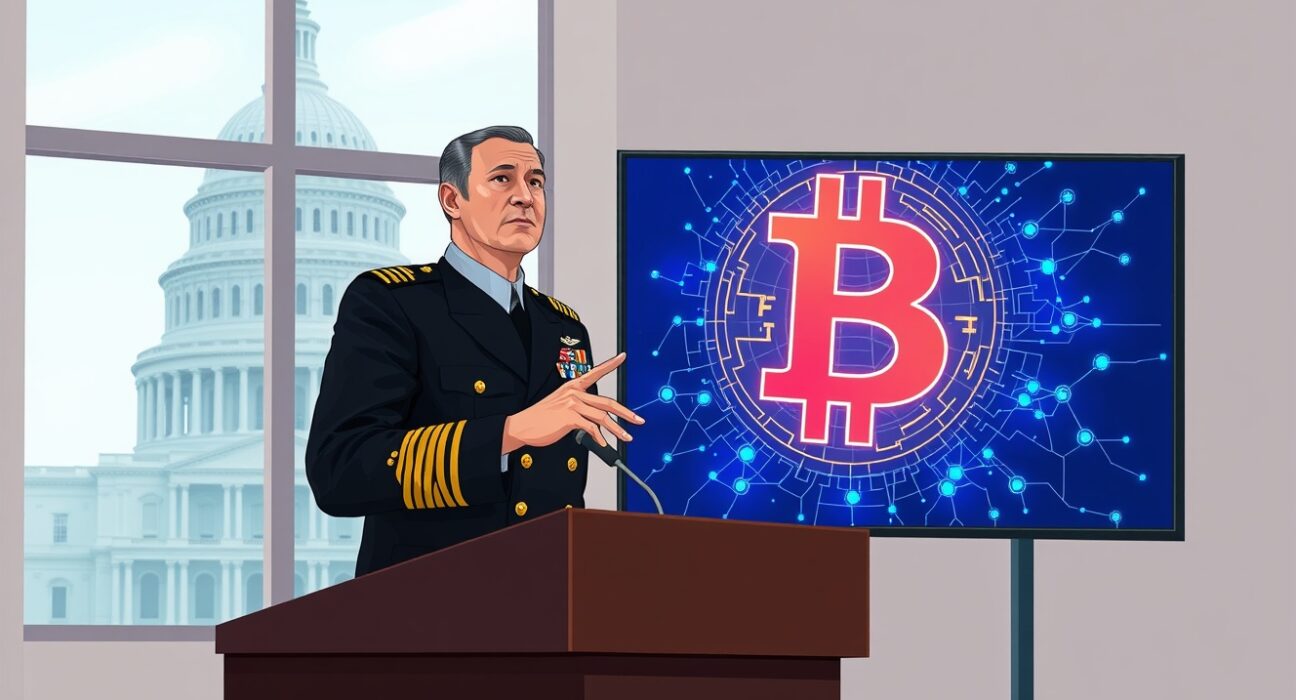
A senior US military commander has publicly acknowledged Bitcoin as a valuable tool for national security. Admiral Samuel Paparo, head of the U.S. Indo-Pacific Command, testified before the Senate Armed Services Committee on April 21. He described Bitcoin as a ‘valuable computer science tool’ with significant applications beyond finance. His remarks mark a notable shift in how top defense officials view digital assets.
Bitcoin National Security Applications in Cybersecurity
Admiral Paparo specifically highlighted Bitcoin’s Proof-of-Work (PoW) technology. He explained that PoW imposes high computational costs on potential attackers. This mechanism, he argued, gives Bitcoin a unique role in cybersecurity. Unlike traditional systems, Bitcoin’s network requires immense energy to attack, making it costly and impractical for adversaries. This property, known as ‘cost to attack,’ is central to its security value.
The admiral’s comments directly link Bitcoin’s technical design to national defense. He characterized Bitcoin as a peer-to-peer, trustless method for value transfer. This trustless nature reduces reliance on intermediaries, which can be vulnerable to compromise. For military and intelligence operations, such a system offers resilience. It allows value transfer without central points of failure, a critical feature in contested environments.
Senator Tommy Tuberville posed the question that prompted these remarks. He noted that even China’s top monetary policy think tank now views Bitcoin as a strategic asset. This observation underscores a global trend. Nations are increasingly recognizing Bitcoin’s potential beyond investment. The senator asked how the U.S. should respond to this shift. Admiral Paparo’s answer was clear: he welcomes any technology that supports U.S. national power.
Proof-of-Work as a Defensive Mechanism
Bitcoin’s Proof-of-Work consensus mechanism requires miners to solve complex mathematical problems. This process consumes significant energy and computing power. The same energy cost protects the network. An attacker would need to control more than 50% of the network’s hashing power, a feat costing billions of dollars. This economic barrier makes Bitcoin one of the most secure digital networks in existence.
Admiral Paparo’s recognition of this property is significant. It moves the conversation from Bitcoin as a speculative asset to Bitcoin as a strategic technology. For national security agencies, securing communication and value transfer networks is paramount. Bitcoin offers a decentralized alternative that is inherently resistant to censorship and seizure. These characteristics align with military requirements for resilient infrastructure.
The admiral’s testimony also touched on ‘power projection.’ In military terms, power projection refers to a nation’s ability to deploy and sustain forces globally. Bitcoin, as a global, permissionless network, enables value transfer across borders without traditional banking systems. This capability could support logistics, intelligence funding, or humanitarian aid in regions with weak financial infrastructure.
Global Context: China’s Shift on Bitcoin
Senator Tuberville’s reference to China’s think tank adds a geopolitical dimension. The People’s Bank of China has historically been hostile to cryptocurrencies. Yet its research arm now considers Bitcoin a strategic asset. This shift mirrors broader global trends. Countries like El Salvador have adopted Bitcoin as legal tender. Others, including the United States, are exploring central bank digital currencies (CBDCs).
China’s stance is particularly relevant given its competition with the U.S. in the Indo-Pacific region. Admiral Paparo’s command oversees this area. His endorsement of Bitcoin as a tool for national power suggests a strategic calculus. The U.S. cannot afford to ignore a technology that rivals are exploring. The admiral’s comments may signal a broader policy reassessment within the Department of Defense.
Table: Key Statements from Admiral Paparo’s Testimony
| Topic | Statement |
|---|---|
| Bitcoin’s Nature | A valuable computer science tool |
| Cybersecurity | PoW imposes high costs on attackers |
| Value Transfer | Peer-to-peer, trustless method |
| National Power | Welcomes any technology supporting U.S. power |
Expert Perspectives on Bitcoin’s Defense Value
Cybersecurity experts have long argued for Bitcoin’s defensive applications. The network’s immutability ensures that once a transaction is recorded, it cannot be altered. This feature is crucial for audit trails and supply chain integrity. For military logistics, tracking equipment and funds through an immutable ledger reduces fraud and errors.
Admiral Paparo’s background adds weight to his statements. He commands the largest U.S. combatant command, covering 36 nations. His experience in the Pacific theater gives him firsthand knowledge of emerging threats. His endorsement of Bitcoin is not theoretical. It reflects practical considerations about how the U.S. can maintain technological superiority.
Critics argue that Bitcoin’s energy consumption is a liability. However, proponents counter that this energy is a feature, not a bug. The cost secures the network. Moreover, Bitcoin mining increasingly uses renewable energy. The Bitcoin Mining Council reports that the network’s sustainable energy mix exceeds 58%. This aligns with military goals for energy efficiency and resilience.
Implications for U.S. Policy
Admiral Paparo’s testimony could influence defense policy. The Department of Defense has already explored blockchain for supply chain management. The admiral’s comments may accelerate these efforts. They also provide political cover for lawmakers to support Bitcoin-friendly legislation. Senator Tuberville, who asked the question, has been a vocal advocate for digital assets.
The hearing occurred amid broader debates about cryptocurrency regulation. The U.S. Securities and Exchange Commission has taken an enforcement-heavy approach. Yet defense perspectives like Paparo’s highlight Bitcoin’s strategic importance. This could shift the narrative from consumer protection to national security. Such a reframing might lead to more favorable policies.
- Resilience: Bitcoin’s decentralized network has no single point of failure.
- Cost: Attacking Bitcoin requires billions of dollars in computing power.
- Global Reach: Bitcoin operates 24/7 across borders without intermediaries.
- Transparency: All transactions are public and verifiable on the blockchain.
Historical Context: Military Interest in Bitcoin
This is not the first time military officials have shown interest in Bitcoin. In 2021, the U.S. Air Force awarded a contract to explore blockchain for data security. The Defense Advanced Research Projects Agency (DARPA) has also funded blockchain research. Admiral Paparo’s public endorsement, however, is the highest-level acknowledgment to date.
The timeline of Bitcoin’s adoption by defense communities is accelerating. Early adopters were primarily financial speculators. Now, technologists and strategists see its utility. The Senate hearing marks a turning point. It signals that Bitcoin’s national security applications are being taken seriously at the highest levels of government.
Conclusion
Admiral Samuel Paparo’s testimony represents a significant milestone for Bitcoin’s national security role. He explicitly linked Bitcoin’s Proof-of-Work technology to cybersecurity and power projection. His comments reflect a growing recognition that Bitcoin is more than a financial asset. It is a strategic tool with applications in defense, logistics, and resilience. As global rivals explore similar technologies, the U.S. military’s embrace of Bitcoin could shape the future of national security policy. The admiral’s message is clear: Bitcoin is not just a currency; it is a capability.
FAQs
Q1: What did Admiral Paparo say about Bitcoin’s national security applications?
A: He described Bitcoin as a valuable computer science tool, highlighting its Proof-of-Work technology for cybersecurity and its role as a trustless, peer-to-peer value transfer method for power projection.
Q2: How does Bitcoin’s Proof-of-Work enhance cybersecurity?
A: PoW imposes high computational and energy costs on attackers, making it economically impractical to compromise the network. This creates a strong defensive barrier against cyber threats.
Q3: Why did Senator Tuberville ask about Bitcoin during the hearing?
A: Senator Tuberville noted that China’s top monetary policy think tank now views Bitcoin as a strategic asset. He asked how the U.S. should respond to this geopolitical development.
Q4: What does ‘power projection’ mean in this context?
A: Power projection refers to a nation’s ability to deploy and sustain military forces globally. Bitcoin’s permissionless, borderless nature enables value transfer in regions with weak financial infrastructure, supporting logistics and operations.
Q5: Could this testimony lead to changes in U.S. cryptocurrency policy?
A: Yes, it may shift the policy narrative from consumer protection to national security. This could encourage more favorable regulations for Bitcoin and blockchain technologies within defense and intelligence communities.
Disclaimer: The information provided is not trading advice, Bitcoinworld.co.in holds no liability for any investments made based on the information provided on this page. We strongly recommend independent research and/or consultation with a qualified professional before making any investment decisions.
