

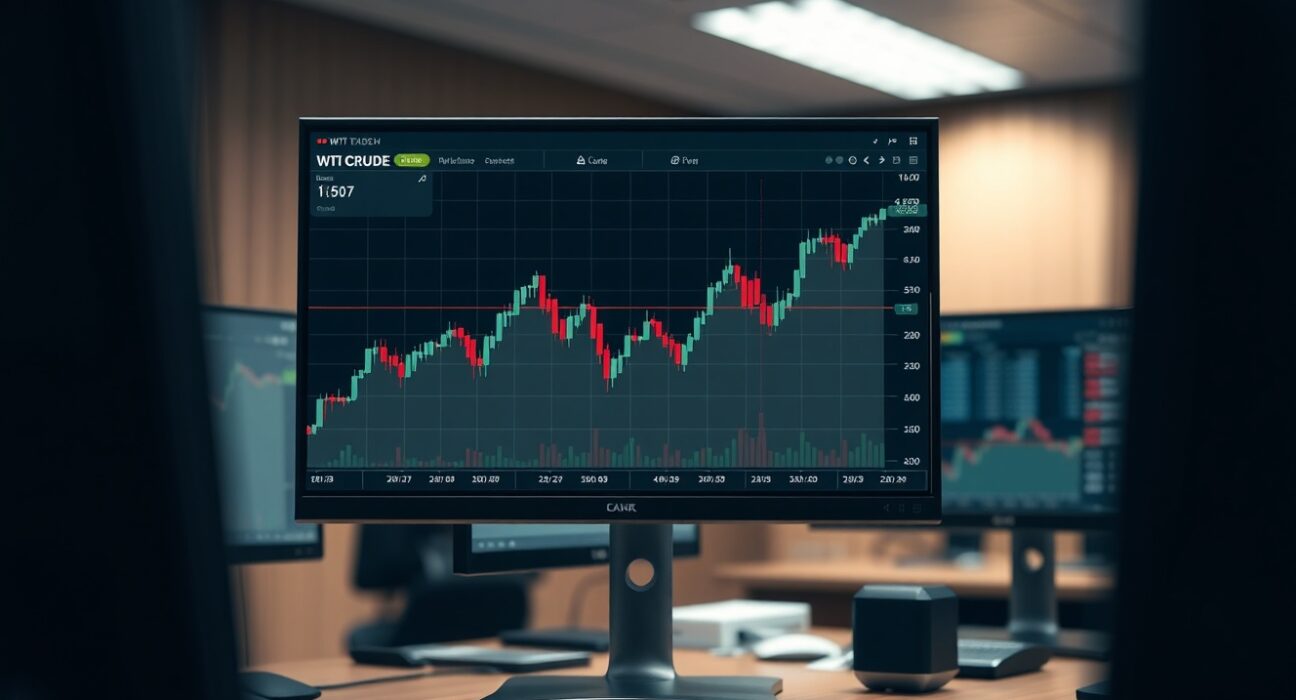
In a notable display of resilience, the benchmark West Texas Intermediate (WTI) crude oil futures contract staged a significant intraday recovery during the early March 2025 trading session. After initially shedding value, the commodity found strong buying interest, striving decisively to return above its technically crucial 20-day Exponential Moving Average (EMA). This price action underscores the ongoing tug-of-war between bullish and bearish forces in the global energy complex, set against a backdrop of shifting supply dynamics and persistent geopolitical tensions.
WTI Price Forecast: Technical Battle at the 20-Day EMA
The 20-day Exponential Moving Average represents a vital short-term sentiment gauge for traders and analysts. Consequently, a sustained break above this level often signals strengthening bullish momentum, while failure can indicate continued near-term pressure. The recent recovery attempt follows a period of consolidation, where prices tested lower support levels. Market participants are now closely monitoring whether this rebound possesses the volume and conviction needed for a confirmed breakout.
Technical indicators provide a mixed but evolving picture. For instance, the Relative Strength Index (RSI), a key momentum oscillator, has moved away from oversold territory. Furthermore, trading volume patterns during the recovery phase will be critical for validation. Several key technical levels now define the immediate WTI price forecast:
- Resistance: The 20-day EMA, followed by the recent swing high near $82.50 per barrel.
- Support: The session’s intraday low, aligned with the 50-day Simple Moving Average around $78.00.
- Key Zone: The $80.00 psychological level remains a focal point for market sentiment.
Fundamental Drivers Behind Crude Oil’s Volatility
The technical struggle mirrors a complex fundamental landscape. Firstly, the Organization of the Petroleum Exporting Countries and allies (OPEC+) has maintained its production discipline into 2025. However, market concerns linger regarding potential compliance slippage and increased output from non-OPEC producers. Secondly, global inventory data, particularly from the U.S. Energy Information Administration (EIA), continues to show unpredictable weekly draws and builds, injecting volatility.
Moreover, demand-side factors exert significant influence. Economic data from major consumers like China, the United States, and the European Union directly impacts the WTI price forecast. Recent manufacturing PMI figures and central bank policy statements regarding inflation and growth are carefully scrutinized. Additionally, the gradual energy transition affects long-term demand projections, even as short-term consumption remains robust in key sectors.
Geopolitical Risk Premiums and Supply Chain Factors
Geopolitical tensions in key oil-producing regions consistently embed a risk premium into crude prices. Any escalation in conflict or disruption to maritime transit chokepoints can trigger rapid price spikes. Conversely, diplomatic progress or a perceived reduction in supply risks can quickly erase that premium. Simultaneously, logistical factors, including refinery maintenance schedules and pipeline capacity, create regional price disparities that influence the broader WTI benchmark.
The U.S. strategic petroleum reserve (SPR) policy also remains a market factor. Government statements about replenishment or potential releases are monitored for their impact on domestic supply. Furthermore, the relative strength of the U.S. dollar, as oil is priced in dollars globally, creates an inverse relationship; a stronger dollar makes oil more expensive for holders of other currencies, potentially dampening demand.
Comparative Analysis: WTI vs. Other Global Benchmarks
WTI’s performance does not occur in isolation. Its price action is frequently compared to other major benchmarks like Brent Crude and Dubai/Oman. The spread between WTI and Brent, for example, reflects differences in regional supply-demand balances, quality, and transportation costs. Recently, this spread has remained within a historically narrow range, indicating a relatively balanced Atlantic Basin market.
| Benchmark | Key Trading Hub | Recent Price (approx.) | Primary Driver |
|---|---|---|---|
| WTI Cushing | Cushing, Oklahoma, USA | $80.50/bbl | US inventory, pipeline flows |
| Brent Dated | North Sea | $84.00/bbl | Global supply, geopolitical risk |
| Dubai Crude | Middle East | $83.20/bbl | Asian demand, OPEC+ policy |
Expert Market Sentiment and Trader Positioning
According to weekly Commitments of Traders (COT) reports published by the Commodity Futures Trading Commission (CFTC), managed money positions—often representing hedge funds and other large speculators—have shown a cautious but not bearish stance. A reduction in net-long positions preceded the recent dip, but the data does not yet show a massive build in net-short bets. This positioning suggests a market that is waiting for a clearer fundamental or technical catalyst before committing to a sustained directional trend.
Investment bank analysts have issued a range of WTI price forecasts for 2025, with year-end targets generally clustered between $75 and $90 per barrel. Their models weigh variables like expected GDP growth, OPEC+ behavior, and non-OPEC supply growth. The consensus view highlights balanced risks, with potential upside linked to unexpected supply outages and downside linked to a sharper-than-expected global economic slowdown.
Conclusion
The immediate WTI price forecast hinges on the commodity’s ability to secure a daily close above the 20-day EMA. While the early March 2025 recovery is a positive technical development, it requires confirmation. The broader trajectory will ultimately be dictated by the interplay of disciplined OPEC+ supply management, the health of the global economy, and unforeseen geopolitical events. Market participants should prepare for continued volatility, using key moving averages like the 20-day EMA as important, but not sole, indicators of near-term trend direction.
FAQs
Q1: What does the 20-day EMA represent in oil trading?
The 20-day Exponential Moving Average (EMA) is a technical indicator that smooths out price data over the last 20 days, giving more weight to recent prices. It acts as a dynamic support or resistance level, helping traders identify the short-term trend direction and potential reversal points for WTI crude oil.
Q2: Why did WTI crude oil prices fall initially in this session?
Initial losses can be attributed to a combination of factors, including a stronger U.S. dollar, which makes oil more expensive for foreign buyers, bearish weekly inventory data from a private industry report, or profit-taking following a prior rally. The specific catalyst often emerges from real-time news flow.
Q3: How do geopolitical events affect the WTI price forecast?
Geopolitical tensions in major oil-producing regions (like the Middle East) or along critical shipping routes (like the Strait of Hormuz) create a “risk premium.” This premium is an additional amount added to the oil price due to fears of potential supply disruptions, causing prices to rise on escalation and fall on de-escalation.
Q4: What is the difference between WTI and Brent crude oil?
WTI (West Texas Intermediate) is a lighter, sweeter crude oil primarily produced in the U.S. and priced at the Cushing, Oklahoma hub. Brent is a blend from North Sea fields and serves as the global benchmark. The price difference, or spread, reflects transportation costs, quality differentials, and regional supply-demand balances.
Q5: Where can I find reliable data for my own WTI price analysis?
Key sources include the U.S. Energy Information Administration (EIA) for official inventory and production data, the Commodity Futures Trading Commission (CFTC) for trader positioning reports, and trading platforms for real-time price charts and technical indicators. Major financial news outlets also provide analysis and context.
Disclaimer: The information provided is not trading advice, Bitcoinworld.co.in holds no liability for any investments made based on the information provided on this page. We strongly recommend independent research and/or consultation with a qualified professional before making any investment decisions.
