

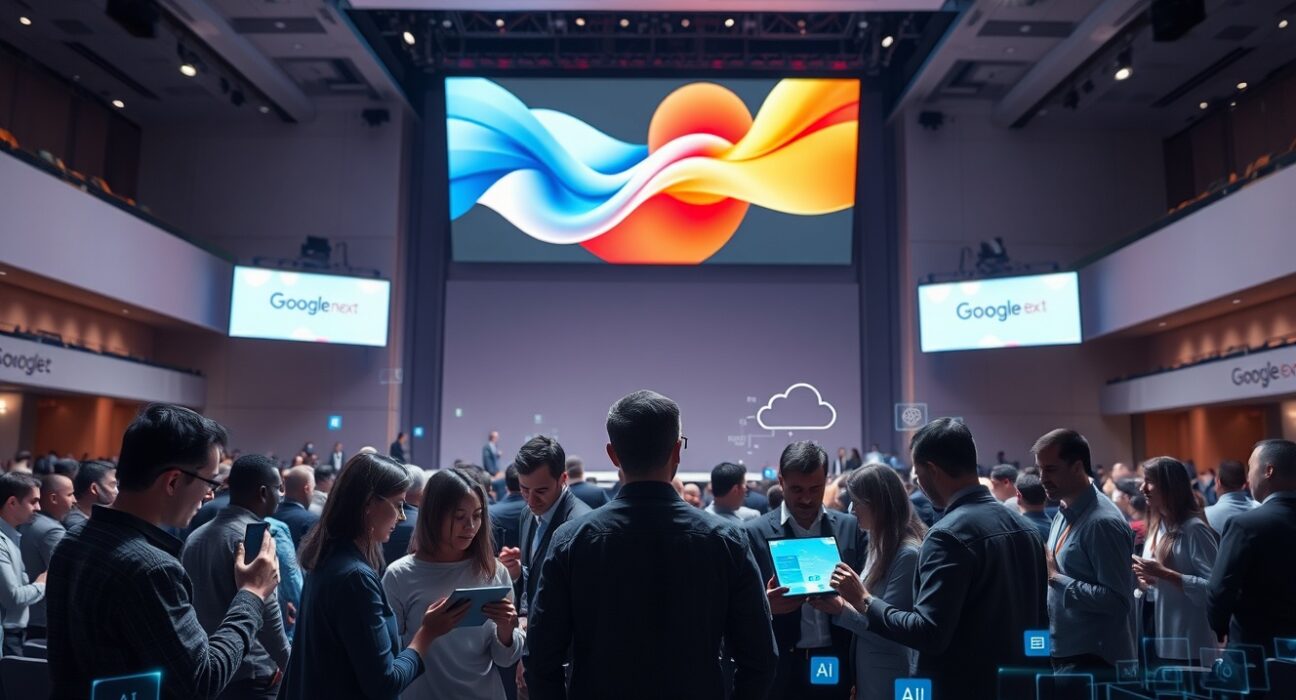
LAS VEGAS, NV — April 30, 2026 — The opening day of Google Cloud Next 2026 delivered a powerful and unambiguous message to the enterprise technology world. Consequently, Google is aggressively courting artificial intelligence startups to build and scale on its cloud platform. Furthermore, the tech giant announced a substantial new $750 million fund specifically designed to accelerate enterprise adoption of AI agents built by its partners.
Google Cloud Next 2026: A Strategic Bet on AI Startup Ecosystems
Google Cloud Next, the annual flagship conference for Google’s cloud division, has consistently served as a barometer for the company’s strategic priorities. This year’s event, however, marks a significant escalation. The newly announced $750 million partner fund represents a direct investment in the sales and deployment pipeline for AI solutions. Moreover, this capital is available to a wide range of partners, from emerging startups to established global systems integrators.
Partners can utilize the funding for several critical purposes. These include covering costs for Gemini proof-of-concept projects, engaging Google forward-deployed engineers for integration support, accessing cloud credits, and receiving rebates on deployment. This initiative clearly aims to lower the barrier for enterprises to pilot and implement sophisticated AI agent technology. Therefore, it directly addresses a common friction point in enterprise sales cycles.
The Financial Mechanics of Google’s AI Push
Analysts view the $750 million fund as a multi-pronged strategic move. Primarily, it incentivizes partners to build solutions on Google Cloud’s AI stack, which includes its Gemini models and Vertex AI platform. Subsequently, it stimulates demand for Google’s underlying compute and storage services. Finally, it positions Google Cloud as the most supportive platform for the next generation of AI-native companies, creating a powerful network effect.
Showcasing the Next Generation of AI Startups at Google Cloud Next
Beyond the financial commitment, Google dedicated significant stage time to highlighting a curated list of startups currently expanding their use of Google Cloud. These companies, spanning productivity, developer tools, healthcare, and logistics, exemplify the practical application of advanced AI in 2026.
- Lovable: This “vibe coding” startup, which reported being on a $400 million annual recurring revenue (ARR) track earlier this year, is launching a new coding agent via Google’s enterprise marketplace. Its expansion signifies the maturation of AI-assisted software development.
- Notion: The highly valued productivity platform, now worth approximately $11 billion, is leveraging Gemini models to power its AI text and image generation features. This integration enhances its core document and knowledge management offerings.
- Gamma: Positioned as an AI-powered alternative to traditional presentation software, Gamma utilizes Google’s state-of-the-art image model, Nano Banana 2. The startup’s $2.1 billion valuation underscores the market demand for AI-driven content creation tools.
- Inferact: Founded by the creators of the popular vLLM open-source project, this commercial inference startup accesses high-performance Nvidia GPUs through Google Cloud. It also integrates deeply with Google’s full AI infrastructure stack.
Diverse AI Applications Across Enterprise Verticals
The breadth of startups recognized at Google Cloud Next 2026 illustrates the pervasive reach of AI. For instance, ExaCare AI develops software for post-acute medical care, while Insilica generates regulatory-compliant chemical safety reports. Similarly, Optii focuses on hotel operations, and Proximal Health automates insurance claims adjudication.
Other notable companies include Parallel AI, which builds search APIs for AI agents, and Vapi, which creates tools for conversational voice agents. Additionally, Stylitics provides AI image generation for retail styling, and Watershed helps enterprises manage sustainability reporting. This diversity proves that AI innovation is no longer confined to a single sector.
The Infrastructure and Developer Tools Backbone
Critical to this ecosystem are the infrastructure and tooling startups. ComfyUI, the open-source multimedia creation tool, offers access to Google’s Nano Banana 2 model. Temporal provides a cloud environment designed to prevent system failures. Furthermore, ChorusView uses AI-powered smart tags for real-time logistics tracking, demonstrating AI’s impact on physical supply chains.
Analysis: Google’s Position in the 2026 Cloud AI Race
The announcements at Google Cloud Next 2026 must be viewed within the context of intense competition with Amazon Web Services (AWS) and Microsoft Azure. Google’s strategy appears focused on capturing the developer and startup mindshare early in the AI application lifecycle. By providing generous funding, cutting-edge models like Gemini and Nano Banana 2, and a highlighted platform for visibility, Google aims to become the default choice for ambitious AI ventures.
Industry experts note that the success of this strategy hinges on execution. The ease of use of Google’s AI tools, the performance of its models, and the real-world cost-effectiveness for startups will be the ultimate determinants. However, the sheer scale of the financial commitment announced this week sends a strong signal of Google’s serious intent.
Conclusion
Google Cloud Next 2026 has definitively outlined Google’s roadmap for the coming years: dominate the AI startup ecosystem to drive enterprise cloud adoption. The $750 million partner fund and the spotlight on innovative companies like Lovable, Notion, and Gamma represent a cohesive dual strategy. Ultimately, Google is not just selling infrastructure; it is actively investing in and cultivating the next wave of applications that will run on it. The startups showcased this week provide a compelling preview of that AI-driven future.
FAQs
Q1: What was the main announcement for startups at Google Cloud Next 2026?
Google announced a new $750 million fund to help its cloud partners, including startups, sell AI agent solutions to enterprises. The funding covers costs for proofs-of-concept, engineering support, and cloud credits.
Q2: Which AI startups were highlighted by Google at the event?
Google showcased numerous startups, with standout mentions including Lovable (vibe coding), Notion (productivity), Gamma (presentations), and Inferact (commercial AI inference). The list spanned healthcare, logistics, developer tools, and retail.
Q3: How is Notion using Google Cloud’s AI?
Notion is utilizing Google’s Gemini large language models to power its AI text and image generation features within its popular document and workspace platform.
Q4: What is the purpose of Google’s $750 million AI partner fund?
The fund is designed to accelerate enterprise adoption of AI agents by reducing the financial and technical barriers to deployment. It aims to incentivize partners to build on Google Cloud and make it easier for large companies to pilot and scale AI solutions.
Q5: What does this signal about Google Cloud’s strategy for 2026 and beyond?
The announcements signal a strategic focus on capturing the AI-native startup ecosystem. By supporting these companies early with capital, technology, and visibility, Google aims to secure their long-term growth on its cloud platform, driving future enterprise revenue.
Disclaimer: The information provided is not trading advice, Bitcoinworld.co.in holds no liability for any investments made based on the information provided on this page. We strongly recommend independent research and/or consultation with a qualified professional before making any investment decisions.
