

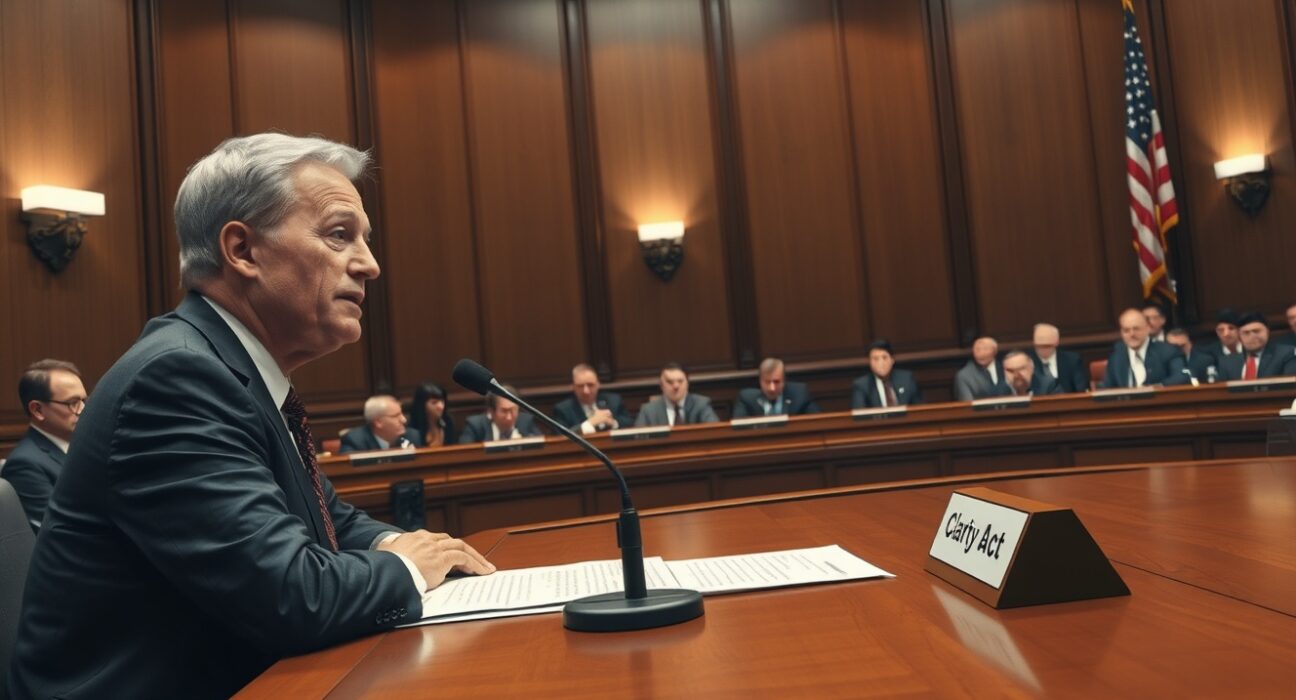
In a pivotal Senate hearing on May 15, 2025, U.S. Treasury Secretary Scott Bessent delivered a forceful argument for legislative action, urging Congress to pass the long-debated Clarity Act—a comprehensive cryptocurrency market structure bill. This urgent plea underscores a critical juncture for American financial policy as global competition in digital assets intensifies. Consequently, the call for regulatory clarity represents more than domestic policy; it is a strategic move to secure the United States’ position at the forefront of the next financial era.
The Clarity Act: A Foundational Crypto Market Structure Bill
Secretary Bessent’s testimony before the Senate Appropriations Committee centered on the proposed Clarity Act. This legislation aims to establish a definitive regulatory framework for digital assets. Specifically, the bill seeks to delineate clear jurisdictional boundaries between the Securities and Exchange Commission (SEC) and the Commodity Futures Trading Commission (CFTC). For instance, it proposes criteria to determine when a digital asset constitutes a security versus a commodity. Furthermore, the act would create federal standards for cryptocurrency exchanges, custody services, and stablecoin issuers. This structured approach intends to replace the current patchwork of state regulations and regulatory guidance with coherent federal law. The need for such a framework has grown increasingly apparent as the crypto market’s complexity and scale have expanded globally.
Bessent’s Case for American Financial Leadership
During his remarks, Secretary Bessent framed the issue in stark geopolitical terms. He asserted that American leadership in finance—spanning traditional banking, securities markets, and now digital assets—remains non-negotiable. Historically, other nations have modeled their financial systems on U.S. frameworks. Therefore, ceding leadership in cryptocurrency innovation and regulation could have profound consequences. Bessent explicitly connected U.S. dominance in the crypto field to the ongoing global supremacy of the dollar. A robust, innovation-friendly regulatory environment, he argued, would attract capital and talent, thereby reinforcing the dollar’s role as the world’s primary reserve currency. Conversely, regulatory uncertainty or hostility risks driving development and investment to more welcoming jurisdictions like the European Union, Singapore, or the United Arab Emirates.
The Global Regulatory Race and Its Stakes
The context for this hearing is a rapidly evolving international landscape. Notably, the European Union’s Markets in Crypto-Assets (MiCA) regulation is fully operational, providing a comprehensive rulebook for its 27 member states. Similarly, the United Kingdom and Japan have advanced their own tailored regulatory regimes. This global activity creates a competitive pressure for the United States. Analysts from institutions like the Brookings Institution and the Atlantic Council have repeatedly warned that U.S. hesitancy could result in a “regulatory vacuum.” This vacuum allows other nations to set the de facto global standards, potentially disadvantaging American companies and diminishing U.S. influence over the future financial system. Bessent’s testimony directly addresses this strategic concern, positioning the Clarity Act as a necessary tool for engagement rather than isolation.
Historical Context and the Path to the Clarity Act
The push for a crypto market structure bill is not new. Legislative efforts have circulated in Congress for several years, often stalling due to jurisdictional disputes between committees and agencies. Previous proposals, like the Digital Commodities Consumer Protection Act and the Responsible Financial Innovation Act, laid important groundwork. However, the Clarity Act represents a more consolidated effort, reportedly incorporating lessons from these earlier drafts. The Biden Administration’s 2022 Executive Order on Ensuring Responsible Development of Digital Assets also catalyzed a whole-of-government approach, leading to reports from the Treasury, SEC, CFTC, and Federal Reserve. These reports collectively highlighted the risks of the status quo and the benefits of a clear federal framework, creating a documented evidence base that supporters like Bessent now cite.
Key provisions expected in the Clarity Act include:
- Jurisdictional Clarity: A formal test to classify digital assets as securities or commodities.
- Exchange Registration: Mandatory federal registration for trading platforms, with requirements for consumer protection, cybersecurity, and conflict-of-interest management.
- Stablecoin Oversight: Federal rules for payment stablecoin issuers, likely involving bank charters or similar stringent requirements.
- Consumer Disclosure: Standardized disclosure rules for asset sales and trading.
Potential Impacts on Markets and Innovation
Passage of the Clarity Act would likely trigger significant shifts within the cryptocurrency industry. Firstly, it would reduce legal uncertainty for established firms, potentially encouraging greater institutional investment. Major asset managers and banks have cited regulatory ambiguity as a primary barrier to deeper engagement with crypto assets. Secondly, clear rules could accelerate innovation by providing a known framework within which entrepreneurs can build. This contrasts with the current environment, where developers may inadvertently violate unclear regulations. However, the bill would also impose new compliance costs, potentially consolidating the industry around larger, well-capitalized players. Market analysts predict that following enactment, a period of mergers and acquisitions would occur as companies adapt to the new standards.
Expert Perspectives on Regulatory Necessity
Financial policy experts largely agree on the need for a framework, though opinions differ on the specifics. Dr. Sarah Bloom Raskin, former Deputy Secretary of the Treasury, has noted that coherent regulation can mitigate systemic risks like those seen in the 2022 market downturn. Meanwhile, innovation advocates like Perianne Boring of the Chamber of Digital Commerce argue that the U.S. is in a “race for technological sovereignty.” They contend that without action, the core infrastructure of finance—payments, asset custody, trading—will be built on offshore protocols outside U.S. regulatory reach. This expert consensus on the *need* for action forms the bedrock of Bessent’s public argument, even as debates on the bill’s details continue behind the scenes.
Political Landscape and Legislative Prospects
The bill’s fate rests in a politically divided Congress. While there is bipartisan interest in cryptocurrency regulation, consensus on the approach remains elusive. Key committees—including Senate Banking, House Financial Services, and both Agriculture Committees (due to the CFTC’s role)—must reconcile their views. Secretary Bessent’s appeal to the Appropriations Committee is strategic, highlighting the economic and leadership implications that resonate across party lines. Supporters hope that framing the issue as one of national economic competitiveness, rather than purely technical financial regulation, can build a broader coalition. The upcoming election cycle adds urgency, as a pending bill could lapse if not passed before the end of the current session.
| Jurisdiction | Regulatory Framework | Key Agency/ies | Status |
|---|---|---|---|
| European Union | Markets in Crypto-Assets (MiCA) | European Securities and Markets Authority (ESMA) | Fully Implemented |
| United Kingdom | Financial Services and Markets Act 2023 | Financial Conduct Authority (FCA) | Phased Implementation |
| Singapore | Payment Services Act | Monetary Authority of Singapore (MAS) | Active |
| United States | Proposed Clarity Act / Existing State Laws | SEC, CFTC, State Regulators | Pending Federal Legislation |
Conclusion
U.S. Treasury Secretary Scott Bessent’s urgent testimony represents a defining moment for cryptocurrency policy. His call to pass the Clarity Act, a comprehensive crypto market structure bill, transcends typical regulatory debate. It is a strategic argument for maintaining American financial leadership and dollar supremacy in an increasingly digital global economy. The path forward requires Congress to navigate complex technical details and political divisions. However, the core message is clear: inaction carries significant strategic costs. As other nations advance their regulatory regimes, the United States faces a critical choice—shape the future of digital finance or cede that power to others. The outcome will resonate through markets and geopolitics for decades to come.
FAQs
Q1: What is the Clarity Act?
The Clarity Act is a proposed U.S. federal bill designed to create a comprehensive regulatory framework for cryptocurrency and digital asset markets. It aims to clarify which agencies regulate different types of assets and establish rules for exchanges, stablecoins, and consumer protection.
Q2: Why did Treasury Secretary Bessent emphasize U.S. leadership?
Bessent argued that American leadership in setting financial standards is crucial for maintaining the global role of the U.S. dollar and ensuring U.S. companies remain competitive. He warned that without clear federal rules, other countries will set the global standards, potentially marginalizing U.S. influence.
Q3: How does this bill differ from current U.S. cryptocurrency regulation?
Currently, U.S. regulation is a patchwork of state laws, SEC enforcement actions, CFTC guidance, and court rulings. The Clarity Act would establish a unified, federal statutory framework, reducing ambiguity for businesses and investors.
Q4: What are the main hurdles for the Clarity Act in Congress?
The main hurdles include reconciling differing views between congressional committees, reaching bipartisan agreement on the specifics of agency jurisdiction (particularly between the SEC and CFTC), and finding time for debate in a crowded legislative calendar.
Q5: How do other countries’ regulations compare to the proposed U.S. approach?
Many major economies, including the EU and UK, have already implemented comprehensive crypto regulations. The U.S. proposal shares similarities, like licensing exchanges and regulating stablecoins, but its unique structure aims to fit within the existing U.S. regulatory architecture involving multiple federal agencies.
Disclaimer: The information provided is not trading advice, Bitcoinworld.co.in holds no liability for any investments made based on the information provided on this page. We strongly recommend independent research and/or consultation with a qualified professional before making any investment decisions.
