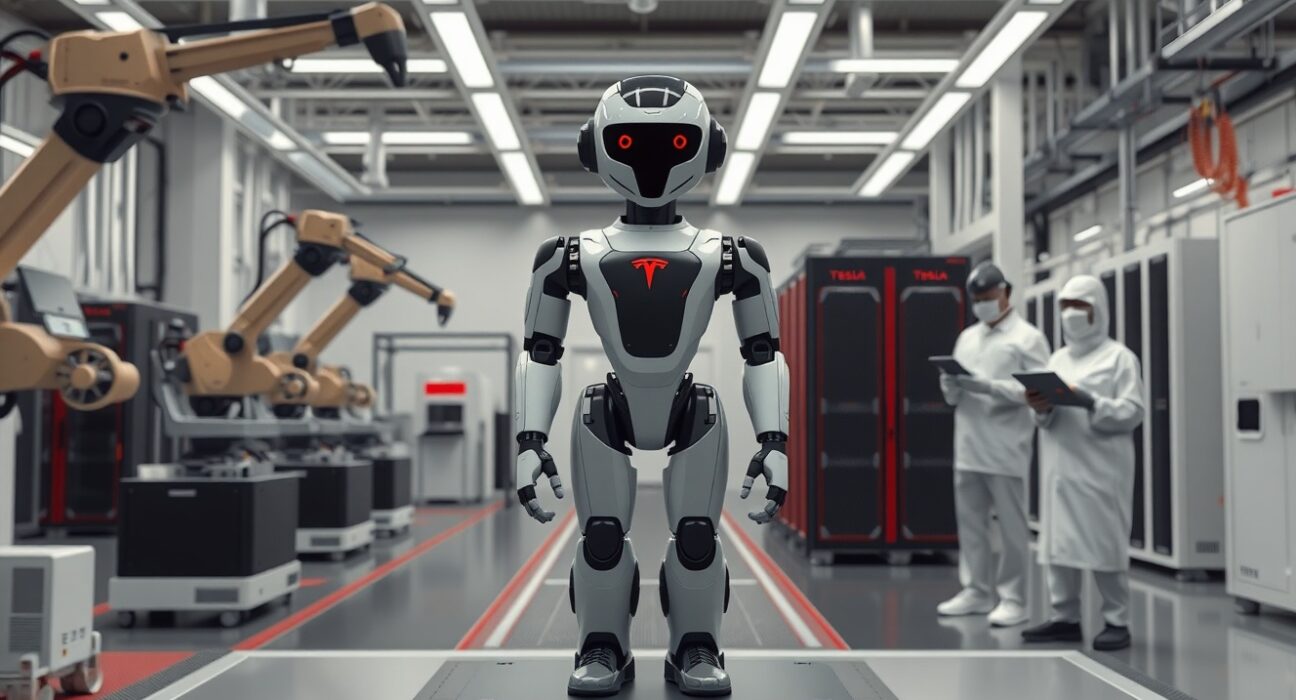
In a bold strategic shift that signals Tesla’s transformation from an electric vehicle manufacturer to a comprehensive technology company, CEO Elon Musk announced during Wednesday’s first-quarter earnings call that the company will increase its capital expenditures to $25 billion in 2026. This staggering figure represents a nearly threefold increase from previous annual spending levels and positions Tesla among the world’s most aggressive technology investors. The announcement, made from Tesla’s Austin headquarters on April 30, 2025, immediately impacted investor sentiment and highlighted the company’s ambitious pivot toward artificial intelligence, robotics, and next-generation manufacturing.
Tesla’s Capital Expenditure Historical Context and 2026 Projection
Tesla’s planned $25 billion capital expenditure for 2026 represents a dramatic acceleration in investment compared to recent years. For context, the company spent $8.9 billion in 2023, $11.3 billion in 2024, and $8.5 billion in 2025 on capital expenditures. This progressive increase reflects Tesla’s evolving priorities beyond electric vehicle production. The $25 billion figure exceeds the company’s January 2025 guidance, which projected expenditures “in excess of $20 billion.” This $5 billion upward revision suggests accelerating timelines or expanded scope for Tesla’s most ambitious projects.
During the earnings call, Musk framed this increased spending as essential for future growth. “With 2026 we’re going to be substantially increasing our investments in the future,” Musk stated. “So you should expect to see significant, a very significant increase in capital expenditures, but I think well justified for a substantially increased future revenue stream.” This perspective positions the spending not as a cost but as an investment in Tesla’s next growth phase.
Where Tesla’s $25 Billion Capital Expenditure is Allocated
Tesla’s massive capital expenditure budget will flow toward several strategic initiatives that collectively represent the company’s technological ambitions. According to Musk and Chief Financial Officer Vaibhav Taneja, the allocation breaks down across multiple priority areas.
Artificial Intelligence Infrastructure and Compute
A substantial portion of the capital expenditure will fund Tesla’s artificial intelligence initiatives. This includes investments in compute infrastructure, data centers, and AI training capabilities. Tesla requires immense computational power for its autonomous driving development, humanoid robot training, and other AI applications. The company plans to invest in custom chip design and manufacturing capabilities to reduce dependence on external suppliers and optimize performance for its specific AI workloads.
Musk noted that Tesla’s AI ambitions require infrastructure on a scale comparable to leading technology companies. “We’re building what amounts to an AI supercomputer specifically tuned for our applications,” Musk explained during the call. This investment aligns with Tesla’s broader strategy to develop vertically integrated technology solutions.
Robotics and Humanoid Manufacturing Expansion
The Optimus humanoid robot program represents another major recipient of capital expenditure funding. Tesla has cleared ground outside its Austin factory for a dedicated Optimus manufacturing facility and will convert portions of its Fremont, California factory from Model S and Model X production to Optimus manufacturing. The company plans to increase internal production of Optimus robots for testing with the goal of making them “useful outside of Tesla sometime next year,” according to Musk.
This manufacturing expansion requires specialized equipment, testing facilities, and production lines designed for humanoid robotics rather than automotive manufacturing. The scale of this investment suggests Tesla views robotics as a potentially transformative business segment rather than merely a research project.
Manufacturing Capacity and Supply Chain Strengthening
Tesla will allocate significant capital toward expanding and upgrading its manufacturing capabilities across multiple product lines. This includes battery production facilities, vehicle assembly lines, and energy product manufacturing. Musk emphasized the need to strengthen Tesla’s supply chain “across the board,” particularly for batteries, energy storage components, and AI silicon.
The company’s new semiconductor research and development facility in Austin will also receive funding from the capital expenditure budget. This facility represents Tesla’s effort to develop custom silicon optimized for its electric vehicles, AI systems, and robotics applications, reducing reliance on external chip manufacturers.
Financial Implications and Market Context
Tesla’s aggressive capital expenditure plan comes with significant financial implications. CFO Vaibhav Taneja acknowledged that the spending will push Tesla into negative free cash flow territory later in 2025, despite the company’s strong cash position of $44.7 billion at the end of the first quarter. “While this may seem like a lot, and we will have the impact of negative free cash flow for the rest of the year, we believe this is the right strategy to position the company for the next era,” Taneja stated.
The market reaction was mixed following the announcement. Tesla shares initially gained 4% due to better-than-expected first-quarter free cash flow of $1.4 billion but erased those gains during after-hours trading as investors digested the capital expenditure guidance. This pattern suggests investor uncertainty about the timing and potential returns from Tesla’s massive investments.
Tesla’s capital expenditure plans place it among technology giants making similar investments. Amazon has projected $200 billion in capital expenditures for 2026 across AI, chips, robotics, and satellite initiatives. Google plans to spend between $175 billion and $185 billion, up from $91.4 billion the previous year. This context positions Tesla’s spending as part of a broader industry trend toward massive technology infrastructure investment.
Strategic Rationale Behind the Capital Expenditure Surge
Several strategic factors drive Tesla’s decision to dramatically increase capital expenditures. First, the company faces intensifying competition in both electric vehicles and emerging technology sectors. Chinese manufacturers continue to advance in EV technology and production efficiency, while technology companies like Apple and Google develop competing autonomous systems and AI platforms.
Second, Tesla’s transformation into what Musk calls “an AI and robotics company” requires fundamentally different capabilities than automotive manufacturing. AI training demands immense computational resources, while robotics development requires specialized manufacturing and testing facilities. These capabilities cannot be developed incrementally but require substantial upfront investment.
Third, Tesla aims to establish first-mover advantages in several emerging markets. The company’s early investment in autonomous driving technology, though slower to mature than initially projected, positions it ahead of many traditional automakers. Similarly, Tesla’s humanoid robot development places it among the first major companies pursuing general-purpose robotics at scale.
Timeline and Implementation Challenges
Tesla’s capital expenditure plan spans multiple years, with the $25 billion figure representing the peak investment year of 2026. Taneja indicated that elevated spending levels would continue for “a couple of years” as Tesla builds out its new capabilities. This timeline suggests that investors should not expect immediate returns from these investments but rather gradual capability development over several years.
The implementation faces several challenges. First, Tesla must manage the transition from negative to positive free cash flow as investments begin generating returns. Second, the company must successfully execute across multiple complex technology domains simultaneously—from semiconductor design to humanoid robotics. Third, Tesla must navigate potential supply chain constraints for specialized components and manufacturing equipment.
Despite these challenges, Musk expressed confidence in Tesla’s execution capabilities, citing the company’s track record of overcoming manufacturing obstacles during its vehicle production ramp-ups. “We’ve done this before with the Model 3 production hell,” Musk noted. “The difference is now we’re applying those lessons to multiple technology fronts simultaneously.”
Conclusion
Tesla’s $25 billion capital expenditure plan for 2026 represents one of the most aggressive investment strategies in the technology sector. The spending will fund Tesla’s transformation from an electric vehicle manufacturer to a diversified technology company with major positions in artificial intelligence, robotics, and advanced manufacturing. While this investment will pressure Tesla’s near-term financial metrics, particularly free cash flow, company leadership believes it positions Tesla for substantial future revenue streams across multiple emerging technology markets. The success of this capital expenditure strategy will depend on Tesla’s ability to execute across complex technology domains and generate returns from investments that currently represent aspirations rather than proven businesses. As Musk concluded during the earnings call, “This isn’t spending for spending’s sake. Every dollar is targeted at capabilities that will define transportation, manufacturing, and artificial intelligence in the coming decade.”
FAQs
Q1: How does Tesla’s $25 billion capital expenditure compare to previous years?
Tesla’s $25 billion capital expenditure for 2026 represents a nearly threefold increase from recent years. The company spent $8.9 billion in 2023, $11.3 billion in 2024, and $8.5 billion in 2025. This dramatic increase reflects Tesla’s strategic pivot toward artificial intelligence and robotics.
Q2: What specific areas will receive funding from Tesla’s capital expenditure?
The capital expenditure will fund artificial intelligence infrastructure including compute and data centers, robotics manufacturing facilities for the Optimus humanoid robot, semiconductor research and development, manufacturing capacity expansion, and supply chain strengthening across batteries, energy storage, and AI silicon.
Q3: How will Tesla’s increased capital expenditure affect its financial position?
CFO Vaibhav Taneja stated that the increased spending will push Tesla into negative free cash flow territory later in 2025, despite the company’s strong cash position of $44.7 billion. The company believes this temporary negative cash flow is justified to position Tesla for future growth.
Q4: How does Tesla’s capital expenditure compare to other technology companies?
Tesla’s $25 billion capital expenditure places it among aggressive technology investors but below the largest spenders. Amazon has projected $200 billion in capital expenditures for 2026, while Google plans to spend between $175 billion and $185 billion. Tesla’s spending is notable given its smaller revenue base compared to these companies.
Q5: What is the timeline for returns on Tesla’s capital expenditure investments?
Tesla’s capital expenditure investments are long-term in nature, with significant returns likely taking several years to materialize. The company has indicated that elevated spending will continue for “a couple of years” as it builds out new capabilities in AI, robotics, and manufacturing.
Disclaimer: The information provided is not trading advice, Bitcoinworld.co.in holds no liability for any investments made based on the information provided on this page. We strongly recommend independent research and/or consultation with a qualified professional before making any investment decisions.