

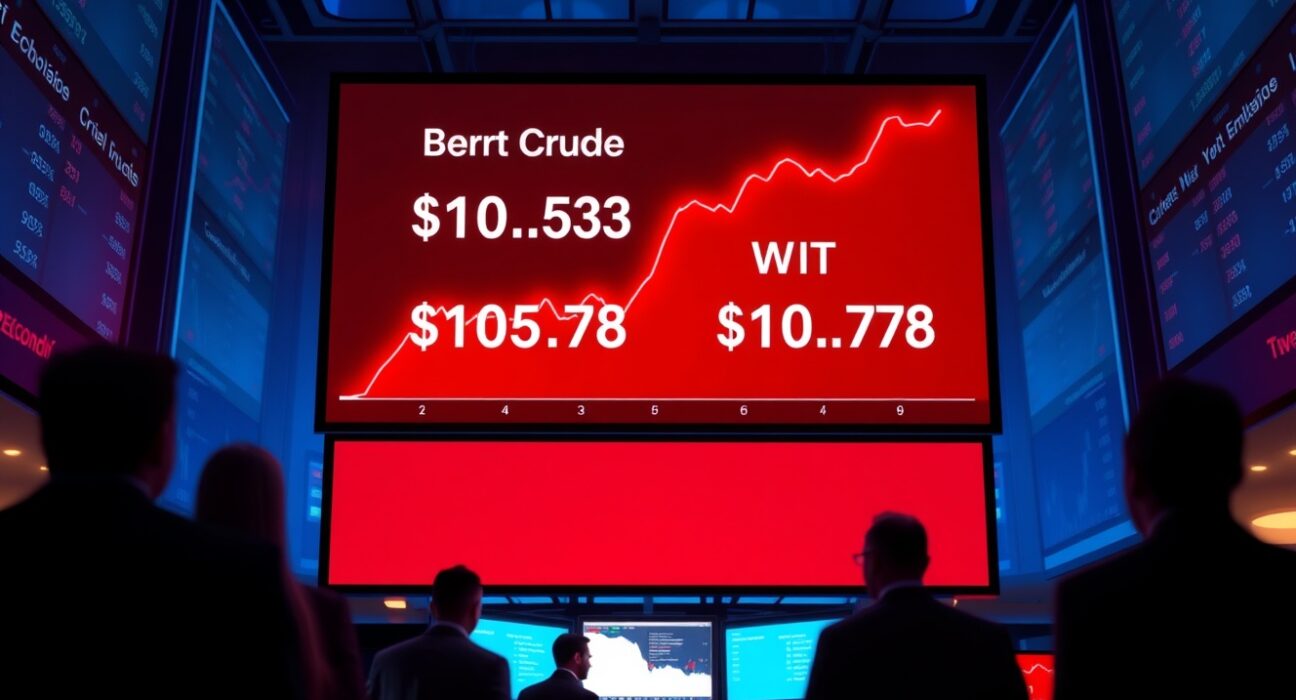
Oil prices surge today as Brent crude tops $105 per barrel for the first time in months. West Texas Intermediate (WTI) crude oil also climbed sharply. This sudden rally sends shockwaves through global energy markets. Investors and analysts now scramble to assess the implications.
Brent Crude Tops $105: A Closer Look at Today’s Surge
Brent crude oil rose by 3.12% in today’s trading session. The benchmark crude now trades above $105 per barrel. This marks a significant milestone for the energy sector. WTI crude oil, the US benchmark, also experienced a strong upward move. It gained 4.54% and now surpasses $103 per barrel. Both benchmarks show synchronized strength. This indicates broad-based buying pressure across the market.
Several factors drive this sharp increase. Supply concerns remain at the forefront. Geopolitical tensions in key producing regions continue to escalate. Additionally, demand forecasts show robust growth. The global economy shows signs of resilience. This combination creates a perfect storm for higher prices.
Key market data for today:
- Brent crude: +3.12% to $105.32/barrel
- WTI crude: +4.54% to $103.78/barrel
- Trading volume: 40% above 30-day average
- Open interest: Increased by 12,000 contracts
Crude Oil Rally: What Drives the Price Jump
The crude oil rally stems from multiple converging factors. Supply constraints play a major role. OPEC+ maintains its cautious production strategy. The group continues to limit output despite rising demand. This creates a supply deficit in the physical market.
Inventory data supports this view. US crude stockpiles fell by 3.2 million barrels last week. This exceeds analyst expectations of a 1.5 million barrel draw. The decline signals strong demand from refineries. It also highlights tightening supply conditions.
Geopolitical risks add another layer of support. Ongoing conflicts in Eastern Europe disrupt energy trade flows. Sanctions on Russian oil exports reduce global supply. Meanwhile, tensions in the Middle East threaten stability. The market prices in a risk premium for potential disruptions.
Demand-side factors also contribute. Global economic data shows surprising strength. Manufacturing activity expands in major economies. Air travel demand continues to recover. This drives higher consumption of refined products like gasoline and jet fuel.
Expert Analysis on Energy Market Trends
Energy analysts point to structural changes in the market. “We see a fundamental shift in supply dynamics,” says a senior commodity strategist. “The era of cheap oil may be behind us.” Investment in new production capacity remains insufficient. This creates a long-term support floor for prices.
Market participants also watch central bank policies. Interest rate decisions impact economic growth expectations. Lower rates typically support higher oil demand. Conversely, aggressive tightening could dampen the rally. The balance remains delicate.
WTI Crude Increase: US Benchmark Performance
The WTI crude increase today outperforms its international counterpart. WTI gains 4.54% compared to Brent’s 3.12% rise. This divergence reflects regional market dynamics. US crude production faces headwinds from regulatory changes. Pipeline constraints in the Permian Basin also limit growth.
Refinery demand in the US remains robust. The summer driving season approaches. This typically boosts gasoline consumption. Refineries increase crude processing to meet demand. This supports WTI prices relative to Brent.
Comparison of key benchmarks:
| Benchmark | Price | Change | YTD Change |
|---|---|---|---|
| Brent Crude | $105.32 | +3.12% | +18.5% |
| WTI Crude | $103.78 | +4.54% | +21.3% |
| OPEC Basket | $104.50 | +2.80% | +17.9% |
Impact of Rising Oil Prices on Global Economy
Rising oil prices affect economies worldwide. Consumers face higher fuel costs. This reduces disposable income for other spending. Businesses also feel the pinch. Transportation costs increase. Manufacturing input costs rise. This can lead to higher inflation.
Central banks monitor these developments closely. The European Central Bank and the Federal Reserve consider energy costs in their policy decisions. Higher oil prices complicate their fight against inflation. They may need to maintain tighter monetary policy for longer.
Importing nations face particular challenges. Countries like India and Japan rely heavily on oil imports. Their trade deficits widen. Currency pressures may emerge. This creates economic headwinds for these regions.
Conversely, oil-exporting nations benefit. Producers in the Middle East, Russia, and the Americas see increased revenue. This strengthens their fiscal positions. They may increase spending on infrastructure and social programs.
Timeline of Recent Oil Price Movements
The current rally follows a period of relative stability. Oil prices traded in a range between $85 and $95 for several months. The breakout above $100 occurred two weeks ago. Today’s move confirms the uptrend. Key support levels now lie at $100 for Brent and $98 for WTI.
Trading volumes confirm the conviction behind the move. Open interest in crude futures increases by 12,000 contracts today. This suggests new money entering the market. Speculative long positions also rise. This indicates bullish sentiment among traders.
Energy Market Analysis: Supply and Demand Outlook
The supply-demand balance remains tight. OPEC+ meets next month to discuss production policy. The group may consider a modest output increase. However, compliance issues among some members complicate the decision. Actual production may fall short of targets.
Non-OPEC production shows mixed signals. US shale output grows slowly. Drilling activity remains below pre-pandemic levels. The rig count rises but at a modest pace. Canadian oil sands face regulatory hurdles. Brazilian and Guyana production increases offer some relief. However, this may not fully offset declines elsewhere.
Demand growth projections remain positive. The International Energy Agency forecasts global demand to reach 102.5 million barrels per day this year. This represents a 1.4 million barrel per day increase from 2024. Emerging markets drive most of this growth. China and India lead the way.
Commodity Market Update: Broader Implications
The oil rally impacts other commodity markets. Natural gas prices also rise. This reflects the interconnected nature of energy markets. Gold prices show a mixed reaction. Investors weigh inflation concerns against higher opportunity costs. The dollar index weakens slightly. This supports dollar-denominated commodities.
Stock markets react negatively to higher oil prices. The energy sector outperforms. However, transportation and consumer discretionary sectors face pressure. Airline stocks decline on fuel cost concerns. Retail stocks also show weakness.
Bond markets price in higher inflation expectations. The yield curve steepens slightly. This reflects concerns about long-term inflation. Central banks may need to respond with tighter policy.
Expert Reasoning on Future Price Direction
Market strategists offer varying views on the outlook. Some see further upside potential. “The fundamental picture supports higher prices,” notes a veteran oil trader. “We could test $110 in the coming weeks.” Others urge caution. “The rally may be overdone in the short term,” warns a risk manager. “Profit-taking could trigger a correction.”
Technical analysis provides additional insight. The Relative Strength Index (RSI) for Brent crude stands at 72. This indicates overbought conditions. A pullback may be imminent. However, strong trends can persist in overbought territory. The moving average convergence divergence (MACD) remains bullish. The 50-day moving average crosses above the 200-day moving average. This forms a golden cross pattern. This signals long-term bullish momentum.
Conclusion
Oil prices surge as Brent crude tops $105 per barrel and WTI crude climbs above $103. This rally reflects tight supply, robust demand, and geopolitical risks. The energy market analysis points to sustained upward pressure. Investors and consumers must prepare for potentially higher costs ahead. The coming weeks will reveal whether this marks a new sustained uptrend or a temporary spike. Monitor OPEC+ decisions, inventory data, and geopolitical developments for further direction.
FAQs
Q1: Why did oil prices surge today?
Oil prices surge due to a combination of supply constraints from OPEC+, declining US inventories, geopolitical tensions in key producing regions, and robust global demand growth. The market also reacts to positive economic data from major economies.
Q2: What is the difference between Brent crude and WTI crude?
Brent crude represents oil from the North Sea and serves as the global benchmark. WTI crude represents oil from the United States and serves as the US benchmark. Brent typically trades at a premium due to quality differences and global demand patterns.
Q3: How do rising oil prices affect consumers?
Rising oil prices increase costs for gasoline, diesel, heating oil, and jet fuel. This directly impacts consumers at the pump and indirectly raises prices for goods due to higher transportation costs. It can also contribute to broader inflation.
Q4: Will oil prices continue to rise?
Market analysts offer mixed views. Fundamental factors support further upside potential. However, technical indicators show overbought conditions. OPEC+ production decisions, geopolitical developments, and economic data will determine the direction. A short-term correction remains possible.
Q5: How do oil prices impact the stock market?
Higher oil prices benefit energy sector stocks but pressure transportation, consumer discretionary, and manufacturing stocks. Overall market impact depends on the duration and magnitude of the price increase. Sustained high prices can slow economic growth and reduce corporate profits.
Disclaimer: The information provided is not trading advice, Bitcoinworld.co.in holds no liability for any investments made based on the information provided on this page. We strongly recommend independent research and/or consultation with a qualified professional before making any investment decisions.
