

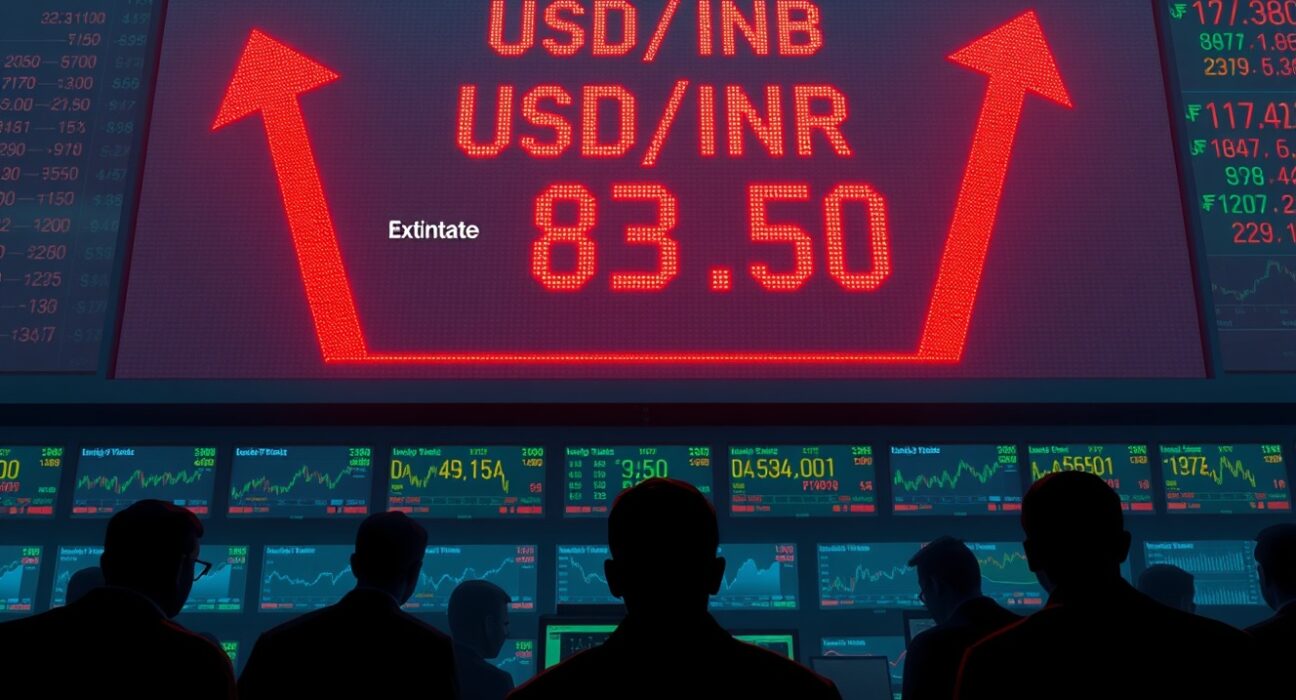
The Indian rupee continues its downward trajectory as the USD/INR pair approaches an all-time high. Persistent selling by foreign institutional investors (FIIs) and surging global crude oil prices drive this sharp depreciation. The rupee now trades near the psychologically crucial 83.50 mark against the US dollar. Market participants closely monitor these developments for further directional cues.
USD/INR Approaches All-Time High: Key Drivers Behind the Rupee’s Fall
The USD/INR pair inches closer to its record high of 83.55, recorded in October 2023. Several interconnected factors fuel this relentless pressure on the Indian currency. Higher oil prices directly impact India’s import bill. India imports over 85% of its crude oil requirements. A sustained rise in Brent crude above $90 per barrel strains the current account deficit. Consequently, the rupee faces increased selling pressure.
Simultaneously, FII selling in Indian equity markets accelerates. Foreign portfolio investors have pulled out significant capital in recent weeks. Data from the National Securities Depository Limited (NSDL) shows net outflows exceeding $2 billion in the last month. This capital flight weakens the rupee further. The Reserve Bank of India (RBI) intervenes occasionally through state-run banks to curb excessive volatility. However, these measures only provide temporary relief.
Impact of Higher Oil Prices on the Indian Rupee
India remains one of the world’s largest crude oil importers. Every $10 per barrel increase in oil prices widens the trade deficit by approximately $12 billion. This directly translates to higher demand for US dollars. Higher oil prices thus create a structural imbalance in the forex market.
The current geopolitical landscape exacerbates this situation. Ongoing tensions in the Middle East, coupled with production cuts by OPEC+, keep crude prices elevated. Brent crude futures consistently trade above $90 per barrel. This environment leaves the rupee vulnerable. Analysts at leading financial institutions predict further depreciation if oil prices remain elevated.
| Oil Price Scenario | Impact on USD/INR |
|---|---|
| Brent at $85/barrel | USD/INR stabilizes near 83.00 |
| Brent at $95/barrel | USD/INR tests 83.80-84.00 |
| Brent above $100/barrel | USD/INR breaches all-time high |
FII Selling Intensifies: A Major Headwind for the Rupee
FII selling emerges as a second powerful force driving the USD/INR higher. Foreign investors have adopted a risk-off stance globally. The US Federal Reserve’s hawkish commentary on interest rates strengthens the US dollar index (DXY). A stronger dollar makes emerging market assets less attractive.
India’s equity markets, particularly the Nifty 50 and Sensex, witness sustained outflows. FIIs sold Indian equities worth over ₹15,000 crore in the current month alone. This capital repatriation requires converting rupees into dollars. The resultant demand for the greenback pushes the USD/INR pair upward.
Expert Analysis: Rupee Depreciation Outlook
Market strategists at major investment banks offer a cautious outlook. “The USD/INR approaches all-time high territory, and the path of least resistance remains upward,” notes a senior currency analyst at a Mumbai-based brokerage. “The twin shocks of elevated oil prices and persistent FII outflows create a perfect storm for the rupee.”
The RBI’s intervention strategy also comes under scrutiny. The central bank likely defends the 83.50 level through dollar sales. However, its ability to stem the tide remains limited given the global dollar strength. India’s foreign exchange reserves, currently at $600 billion, provide a cushion. Yet, sustained pressure could erode these reserves over time.
Broader Economic Implications of a Weaker Rupee
A depreciating rupee carries mixed consequences for the Indian economy. On the positive side, export-oriented sectors benefit. IT services, pharmaceuticals, and textile exporters gain from higher rupee realizations. However, the negative effects dominate.
- Higher import costs: Crude oil, edible oils, and electronics become more expensive. This fuels domestic inflation.
- Increased fiscal burden: The government’s subsidy bill for fertilizers and cooking gas rises.
- Corporate earnings pressure: Companies with high foreign currency debt face margin compression.
- Student and traveler impact: Education abroad and international travel become costlier.
The RBI’s monetary policy committee (MPC) faces a tough balancing act. It must manage inflation without stifling growth. A weaker rupee complicates this task. Imported inflation adds to headline consumer price index (CPI) figures. This reduces the scope for interest rate cuts.
Technical Analysis: USD/INR Chart Patterns
From a technical perspective, the USD/INR approaches all-time high resistance zone. The pair trades above all major moving averages. The 50-day exponential moving average (EMA) at 83.10 provides immediate support. The relative strength index (RSI) hovers near 65, indicating bullish momentum but not yet overbought territory.
Key levels to watch include:
- Support: 83.00, 82.80, 82.50
- Resistance: 83.55 (all-time high), 83.80, 84.00
A decisive break above 83.55 could trigger a sharp move toward 84.00. Conversely, a reversal below 83.00 would signal a temporary reprieve. Traders should monitor oil price movements and FII flow data for near-term direction.
Conclusion
The USD/INR approaches all-time high territory, driven by the dual pressures of higher oil prices and sustained FII selling. This combination creates significant headwinds for the Indian rupee. Market participants expect further volatility in the near term. The RBI’s intervention provides some stability, but structural factors remain unfavorable. Investors and businesses should hedge their currency exposure accordingly. The rupee’s trajectory will depend on global oil price dynamics, US Federal Reserve policy, and the pace of capital flows into emerging markets.
FAQs
Q1: What is the current USD/INR exchange rate?
The USD/INR pair currently trades near 83.40, approaching its all-time high of 83.55. The rate fluctuates based on market conditions and RBI intervention.
Q2: Why does higher oil prices affect the Indian rupee?
India imports most of its crude oil. Higher oil prices increase the import bill, widening the trade deficit. This creates additional demand for US dollars, weakening the rupee.
Q3: How does FII selling impact the USD/INR?
When FIIs sell Indian equities, they convert their rupee proceeds into dollars for repatriation. This increased demand for dollars pushes the USD/INR pair higher.
Q4: Can the RBI prevent the rupee from falling further?
The RBI can intervene by selling dollars from its reserves. However, sustained global pressure limits its effectiveness. The central bank focuses on managing volatility rather than targeting a specific level.
Q5: What is the outlook for the USD/INR in 2025?
Analysts expect the pair to remain elevated due to persistent global dollar strength and India’s import dependency. A break above 83.55 could lead to a test of 84.00 or higher.
Disclaimer: The information provided is not trading advice, Bitcoinworld.co.in holds no liability for any investments made based on the information provided on this page. We strongly recommend independent research and/or consultation with a qualified professional before making any investment decisions.
