

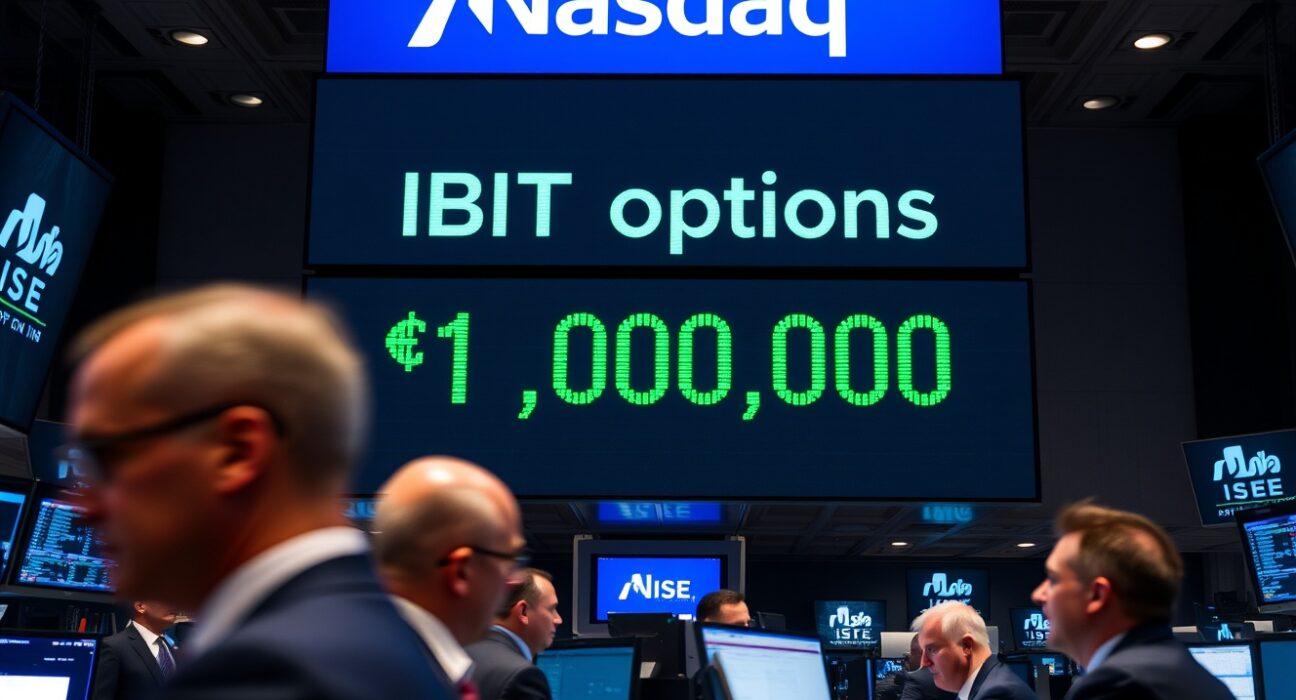
The U.S. Securities and Exchange Commission (SEC) has approved a pivotal rule change for the Nasdaq ISE. This decision dramatically raises the position and exercise limits for options on BlackRock’s spot Bitcoin ETF (IBIT). The new limit jumps from 250,000 to 1 million contracts. According to BlockBeats, this measure applies on a same-side basis. This landmark approval marks a significant expansion in the Bitcoin ETF options market.
Understanding the IBIT Option Position Limit Increase
The SEC’s approval directly addresses a key demand from institutional investors. Previously, a cap of 250,000 contracts limited large-scale hedging and trading strategies. Now, with the limit raised to 1 million contracts, market participants gain far greater flexibility. This change applies to options on the same side of the market. For example, it covers all call options or all put options combined. This rule is designed to prevent market manipulation while allowing for substantial market depth.
What This Means for BlackRock’s IBIT ETF
BlackRock’s IBIT has become a dominant force in the spot Bitcoin ETF space. Since its launch, it has attracted billions in assets under management. The higher position limit directly supports its growing liquidity. Options traders can now execute larger block trades without immediately hitting regulatory ceilings. This fosters a more efficient price discovery mechanism. Consequently, the spread between bid and ask prices may narrow, benefiting all participants.
Impact on Bitcoin ETF Options Market Liquidity
Liquidity is the lifeblood of any options market. By raising the IBIT option position limit, the SEC injects a new level of depth. Market makers can now provide tighter quotes for larger orders. This reduces slippage for institutional clients. Moreover, it encourages the creation of more complex strategies. Investors can now combine options with the underlying ETF shares more effectively. This development aligns with the broader trend of Bitcoin becoming a mainstream asset class.
Comparing Old vs. New Position Limits
To fully grasp the scale of this change, consider the following comparison:
| Metric | Previous Limit | New Limit |
|---|---|---|
| Position Limit (Contracts) | 250,000 | 1,000,000 |
| Same-Side Aggregate Limit | 250,000 | 1,000,000 |
| Potential Notional Value (at $60k BTC) | $15 billion | $60 billion |
This table illustrates a 4x increase in capacity. The potential notional value now reaches $60 billion. This provides a robust framework for large-scale hedging and speculation.
Regulatory Context and SEC’s Rationale
The SEC’s decision did not occur in a vacuum. The agency has consistently monitored the crypto derivatives space. The approval follows a period of extensive public comment and market analysis. Regulators considered the risk of excessive speculation versus the need for market efficiency. By applying the limit on a same-side basis, the SEC maintains a safeguard against concentrated risk. This approach mirrors limits seen in traditional equity options markets. It demonstrates a measured, data-driven regulatory philosophy.
Timeline of Key Events Leading to Approval
- January 2024: SEC approves spot Bitcoin ETFs, including BlackRock’s IBIT.
- March 2024: Nasdaq ISE files proposal to raise IBIT option position limits.
- June 2024: SEC seeks public comment on the proposal.
- September 2024: SEC approves the rule change, effective immediately.
This timeline shows a deliberate, transparent process. The SEC engaged with stakeholders before finalizing the rule.
Institutional Adoption and Market Implications
The raised limit is a strong signal for institutional adoption. Pension funds, endowments, and insurance companies often require deep liquidity. They need to execute large trades without moving the market. The new limit facilitates this. It also enables more sophisticated risk management. For instance, an institution holding a large Bitcoin position can now hedge with a proportional number of put options. This reduces the cost of portfolio protection.
Expert Perspectives on the Rule Change
Market analysts view this as a positive development. James Seyffart, a Bloomberg ETF analyst, noted that the move aligns with the maturation of the crypto ETF ecosystem. He emphasized that higher limits attract more professional capital. Another expert, from the CBOE, highlighted the importance of standardized position limits. They ensure fair access while preventing market abuse. These expert views reinforce the credibility of the SEC’s decision.
Technical Details: Same-Side Basis Explained
The term ‘same-side basis’ requires clarification. It means the limit applies to all contracts with the same underlying direction. For example, all call options count toward the same limit. Similarly, all put options count separately. This prevents traders from circumventing the cap by using different strike prices or expiration dates. It is a common regulatory tool in options markets. This structure maintains market integrity while allowing for growth.
Comparison with Other Bitcoin ETF Options
BlackRock’s IBIT is not the only Bitcoin ETF with options. However, it is the largest. Other ETFs, like Fidelity’s FBTC, may seek similar limit increases. The SEC’s decision sets a precedent. It signals that the agency is willing to accommodate growth in this sector. This could lead to a wave of similar proposals from other exchanges. The competitive landscape will likely shift as a result.
Conclusion
The SEC’s approval to raise the IBIT option position limit to 1 million contracts is a landmark event. It directly enhances liquidity and institutional access in the Bitcoin ETF options market. This decision reflects a mature regulatory approach. It balances risk with the need for market efficiency. As BlackRock’s IBIT continues to grow, this rule change will support its evolution. Investors can now execute larger, more complex strategies with confidence. The future of Bitcoin ETF options looks brighter than ever.
FAQs
Q1: What does the SEC approval for IBIT option position limit mean?
The SEC approved raising the position limit for options on BlackRock’s IBIT ETF from 250,000 to 1 million contracts. This allows traders to hold larger positions, increasing market depth and liquidity.
Q2: Why did the SEC raise the limit to 1 million contracts?
The SEC aimed to accommodate growing institutional demand. A higher limit enables large-scale hedging and trading strategies without regulatory friction. It also aligns with the IBIT ETF’s expanding assets under management.
Q3: How does the same-side basis rule work?
The limit applies separately to all call options and all put options. For example, a trader can hold up to 1 million call contracts and another 1 million put contracts. This prevents manipulation while allowing flexibility.
Q4: What is the impact on Bitcoin ETF options liquidity?
Higher position limits attract more market makers and institutional participants. This leads to tighter spreads, larger trade sizes, and more efficient price discovery. Liquidity improves across the board.
Q5: Will other Bitcoin ETFs get similar limit increases?
It is likely. The SEC’s decision sets a precedent. Other exchanges and ETF issuers may file similar proposals. This could standardize higher position limits across the industry.
Disclaimer: The information provided is not trading advice, Bitcoinworld.co.in holds no liability for any investments made based on the information provided on this page. We strongly recommend independent research and/or consultation with a qualified professional before making any investment decisions.
