

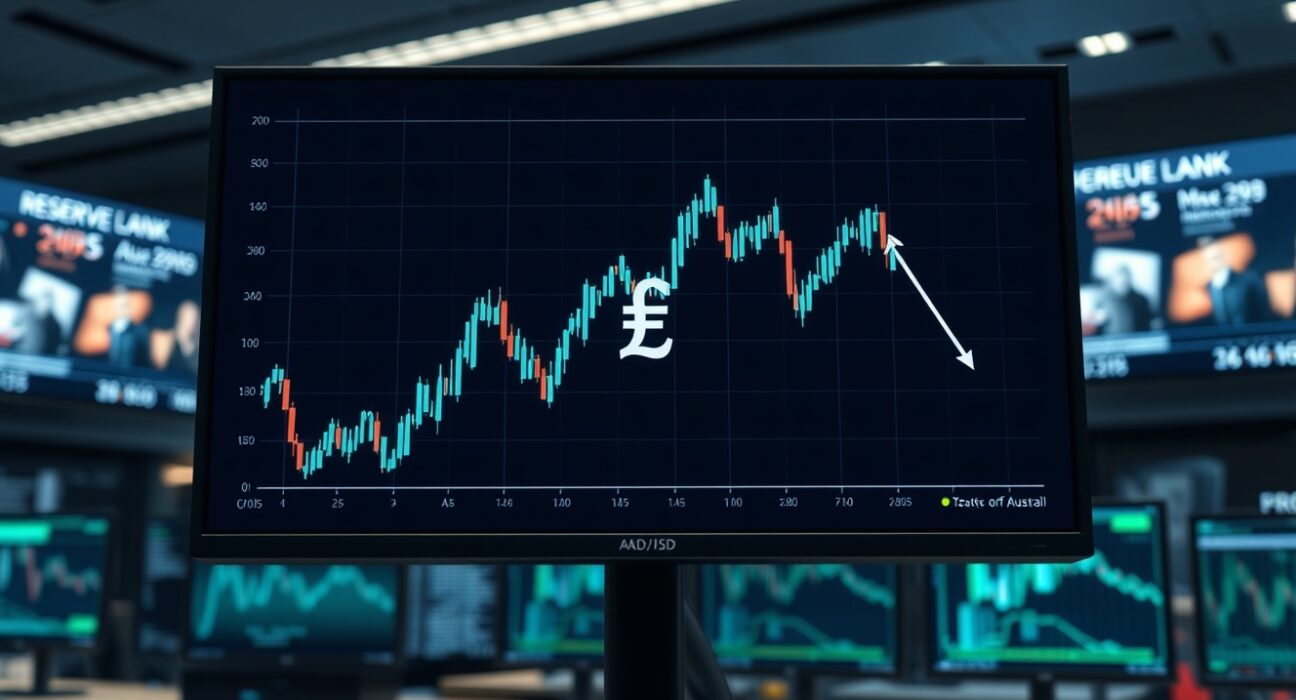
The Australian dollar weakened against the US dollar on Monday, as the AUD/USD falls ahead of the Reserve Bank of Australia’s (RBA) upcoming policy decision. Geopolitical tensions in the Middle East further limited any potential upside for the currency pair.
Traders are now closely watching the RBA’s next move. The central bank is expected to hold interest rates steady. However, any dovish tone could push the pair lower. The Middle East noise adds another layer of uncertainty. Safe-haven flows continue to support the US dollar.
RBA Decision Looms Over AUD/USD Falls
The RBA’s monetary policy meeting is scheduled for Tuesday. Market participants widely expect the bank to keep the cash rate unchanged at 4.35%. This expectation already priced in the recent AUD/USD falls.
Analysts at Westpac note that the RBA faces a delicate balancing act. Inflation remains sticky, but the labor market is cooling. The bank’s statement will be scrutinized for any forward guidance. A cautious tone could accelerate the AUD/USD falls.
Key data points show Australia’s monthly CPI indicator slowed to 3.4% in February. This is down from 3.6% in January. Yet, it remains above the RBA’s target band of 2-3%. The central bank will likely maintain its tightening bias.
Market Expectations and Expert Views
According to a Reuters poll, 90% of economists expect the RBA to hold rates. Only a minority predicts a rate cut in the second half of 2025. This consensus has already contributed to the AUD/USD falls.
“The RBA will likely sound cautious,” says Dr. Sarah Chen, a currency strategist at Commonwealth Bank. “Any hint of easing could trigger further selling in the Australian dollar.”
Short-term interest rate futures indicate a 25% chance of a rate cut by August. This uncertainty keeps the pair under pressure. The AUD/USD falls reflect this market sentiment.
Middle East Tensions Amplify AUD/USD Falls
Geopolitical risks in the Middle East have escalated significantly. Recent clashes between Israel and Iran-backed groups have raised fears of a broader conflict. This noise limits any recovery in the AUD/USD falls.
Safe-haven demand for the US dollar and gold has surged. The US Dollar Index (DXY) rose 0.3% on Monday. This directly weighs on the Australian dollar.
Oil prices also jumped over 2% on supply disruption fears. Australia is a net importer of oil. Higher energy costs could hurt the country’s trade balance. This further contributes to the AUD/USD falls.
Timeline of Recent Events
- April 1: Israel strikes Iranian targets in Syria. Tensions spike.
- April 2: Oil prices hit $90 per barrel. Risk appetite drops.
- April 3: AUD/USD breaks below 0.6500 support level.
- April 4: US non-farm payrolls beat expectations. USD strengthens.
- April 7: AUD/USD falls to 0.6450, a three-week low.
This timeline shows how quickly events unfolded. The AUD/USD falls accelerated after each geopolitical development.
Technical Analysis of AUD/USD Falls
From a technical perspective, the AUD/USD falls have broken key support levels. The pair now trades below the 50-day moving average (0.6520). The next major support sits at 0.6400.
The Relative Strength Index (RSI) stands at 38, indicating bearish momentum. A move below 30 would signal oversold conditions. However, no reversal pattern has formed yet.
Resistance levels are now at 0.6500 and 0.6550. Any bounce may be short-lived due to the prevailing negative sentiment. The AUD/USD falls could extend toward 0.6350 if the RBA disappoints.
| Level | Price | Significance |
|---|---|---|
| Support 1 | 0.6400 | Psychological level |
| Support 2 | 0.6350 | February 2024 low |
| Resistance 1 | 0.6500 | Broken support now resistance |
| Resistance 2 | 0.6550 | 50-day moving average |
These levels provide a clear roadmap for traders. The AUD/USD falls may find temporary support near 0.6400.
Fundamental Drivers Behind AUD/USD Falls
Several fundamental factors are driving the AUD/USD falls. First, the divergence in monetary policy between the RBA and the Federal Reserve is widening. The Fed remains hawkish, while the RBA may pivot to dovish.
Second, China’s economic recovery remains uneven. Australia’s largest trading partner reported mixed manufacturing and services data. This reduces demand for Australian exports.
Third, commodity prices are under pressure. Iron ore, Australia’s top export, fell 5% last week. Copper prices also declined. This weakens Australia’s terms of trade.
Comparison of Central Bank Stances
- Federal Reserve: Held rates at 5.25-5.50%. Signals no cuts until inflation falls.
- RBA: Held at 4.35%. Market expects a cut by year-end.
- European Central Bank: Held at 4.00%. May cut in June.
- Bank of Japan: Raised rates to 0.10%. First hike since 2007.
This comparison shows the RBA is among the most dovish. This perception fuels the AUD/USD falls.
Impact on Australian Economy and Traders
The AUD/USD falls have real-world implications. A weaker Australian dollar makes imports more expensive. This could push inflation higher, complicating the RBA’s task.
Exporters, however, benefit. Mining companies receive more AUD for their USD-denominated sales. Tourism and education sectors also gain as Australia becomes cheaper for foreign visitors.
For forex traders, the AUD/USD falls present both risks and opportunities. Short positions are profitable. But any surprise from the RBA could trigger a sharp reversal.
Expert Advice for Traders
“Traders should set tight stop-losses,” advises Mark Thompson, a senior forex analyst at FXStreet. “The RBA decision could cause high volatility. Managing risk is crucial during the AUD/USD falls.”
Options markets show increased demand for puts. This suggests many traders expect further downside. The risk-reward ratio favors selling rallies.
Conclusion
The AUD/USD falls ahead of the RBA decision reflect a confluence of factors. Monetary policy divergence, Middle East tensions, and weak commodity prices all weigh on the pair. The RBA’s tone on Tuesday will determine the next direction. A dovish stance could push the pair toward 0.6400. A hawkish surprise may trigger a short-covering rally. Traders must stay vigilant. The geopolitical noise will likely persist, keeping the US dollar supported. Understanding these dynamics is essential for navigating the current forex landscape.
FAQs
Q1: Why is AUD/USD falling ahead of the RBA decision?
A: The AUD/USD falls due to expectations that the RBA will maintain a dovish stance, combined with safe-haven demand for the US dollar from Middle East tensions.
Q2: How does the Middle East conflict affect AUD/USD?
A: Middle East noise boosts safe-haven flows into the US dollar and gold, directly pressuring the Australian dollar lower.
Q3: What is the key support level for AUD/USD?
A: The next major support is at 0.6400, a psychological level. A break below could target 0.6350.
Q4: Will the RBA cut interest rates in 2025?
A: Market pricing suggests a 25% chance of a cut by August 2025. Most economists expect the first cut in the second half of the year.
Q5: How should traders prepare for the RBA decision?
A: Traders should use tight stop-losses and consider selling rallies. High volatility is expected around the announcement.
Q6: What impact do falling commodity prices have on AUD/USD?
A: Lower iron ore and copper prices reduce Australia’s export revenue, weakening the Australian dollar and contributing to the AUD/USD falls.
Disclaimer: The information provided is not trading advice, Bitcoinworld.co.in holds no liability for any investments made based on the information provided on this page. We strongly recommend independent research and/or consultation with a qualified professional before making any investment decisions.
