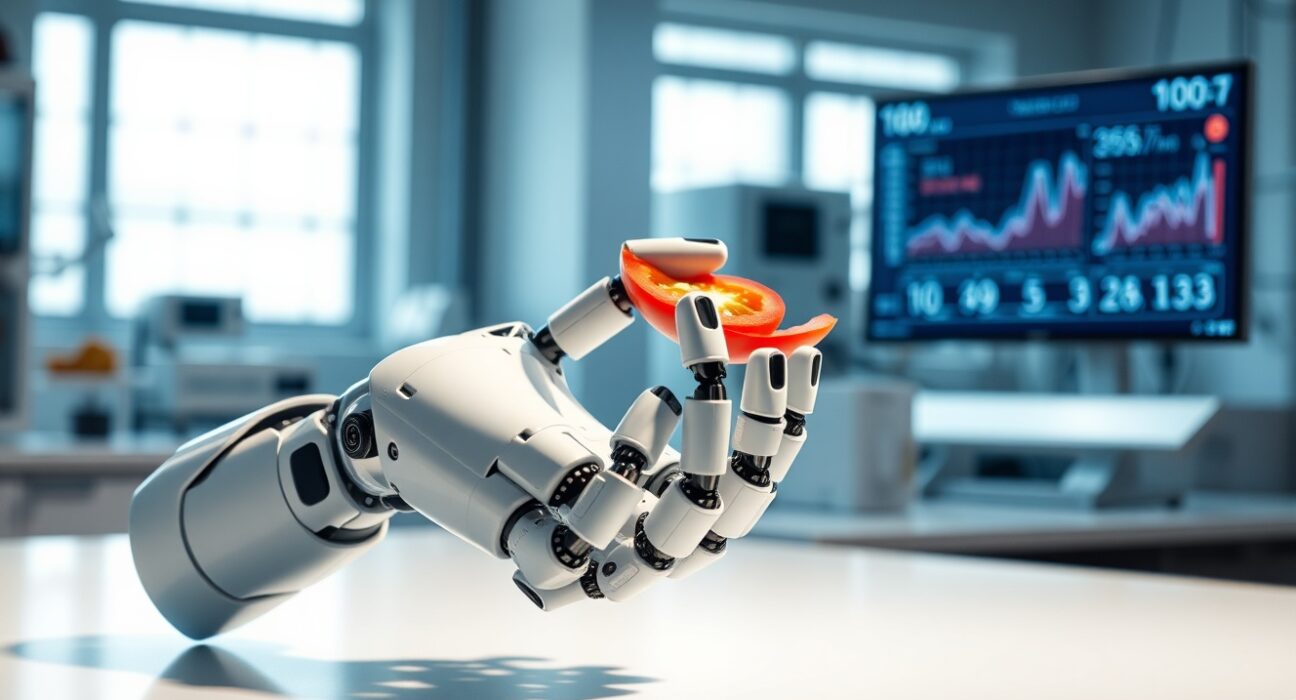
Genesis AI, a startup that emerged from stealth in July 2025 with a $105 million seed round co-led by Eclipse and Khosla Ventures, has unveiled its first foundational model for robotics — and it comes with a surprise: custom-designed robotic hands. The company, which initially set out to build better AI models for robots, has now pivoted to a full-stack approach, designing both the hardware and software in-house.
Why a full-stack robotics approach matters
The startup’s new model, named GENE-26.5 (a reference to its expected release timeline in May 2026), was demonstrated in a video showcasing a range of tasks: cooking, playing the piano, solving a Rubik’s cube, and performing lab work. But the real story is the hardware behind it. Genesis has developed a robotic hand that closely mimics the size, shape, and dexterity of a human hand, rather than relying on the two-finger grippers common in many robotics applications.
Co-founder and CEO Zhou Xian explained that while the model was always the primary goal, the team quickly realized that controlling hardware was essential to achieving better intelligence. “So we decided to go full stack,” he told Bitcoin World. This decision places Genesis alongside other well-funded players like Physical Intelligence and Skild AI, but with a distinct focus on human-like manipulation.
How the robotic hand reduces the embodiment gap
The key innovation, according to co-founder and president Théophile Gervet, is that the robotic hand’s human-like design reduces what researchers call the ’embodiment gap’ — the mismatch between human motion and robotic capability. “That lets us collect a lot more data than was previously possible, to train a model that can do many more tasks,” said Gervet, a former research scientist at Mistral AI.
To further accelerate data collection, Genesis has developed a sensor-loaded glove that acts as a real-world double for its robotic hand. Lightweight and relatively cheap to produce, the glove can be worn during everyday tasks, allowing workers in industries like pharmaceuticals or manufacturing to generate training data without specialized equipment. “For the first time, you can wear the data collection device when you’re doing your daily job,” Gervet noted.
Data collection and the human factor
However, the startup faces a practical and ethical question: will workers be willing to wear gloves and cameras that could train robots to eventually replace them? Gervet acknowledged that compensation and consent will be left to Genesis’ customers and their employees. “We haven’t nailed the details yet,” he said. The company is also exploring third-party data collection partners and has trained its model on “massive amounts of human-based internet videos,” according to a press release.
Beyond data, Genesis has built a simulation system that speeds up model iteration. “The real bottleneck for the iteration speed of the model is evaluation. So this helps us speed up model training a lot,” Xian said. The combination of simulation, human-like hardware, and egocentric video data could lower costs for real-world applications.
What’s next: a full-body robot and European expansion
Genesis has grown from a small team to 60 employees across offices in Paris, California, and London. The company plans to reveal its first general-purpose robot soon — a full-body robot, not just hands. Xian reiterated that the roadmap remains unchanged: “Our goal is to build the most capable robotic system.”
Investors include former Google CEO Eric Schmidt, who called the milestone “important for their team and the robotics industry more broadly.” The startup is currently hiring in all three locations, with roughly half its team based in the U.S. and the rest in Europe.
Conclusion
Genesis AI’s full-stack approach — combining a human-like robotic hand, a data-collection glove, and a powerful new model — represents a significant step in bridging the gap between AI and physical manipulation. While challenges around data ethics and worker acceptance remain, the company’s focus on reducing the embodiment gap could accelerate the development of robots capable of performing complex, real-world tasks. The industry will be watching closely as Genesis moves from demos to deployment.
FAQs
Q1: What is the GENE-26.5 model?
GENE-26.5 is Genesis AI’s first foundational model for robotics, named for its expected release in May 2026. It is designed to control the company’s custom robotic hands and perform complex manipulation tasks.
Q2: How does Genesis’ robotic hand differ from others?
Unlike the two-finger grippers used by many robotics companies, Genesis’ hand mimics the size, shape, and dexterity of a human hand, allowing it to perform a wider range of tasks and collect more training data.
Q3: What is the ’embodiment gap’ in robotics?
The embodiment gap refers to the mismatch between human motion and robotic capability. By designing a hand that closely resembles a human hand, Genesis aims to reduce this gap and unlock the use of human demonstration data for training robots.
Disclaimer: The information provided is not trading advice, Bitcoinworld.co.in holds no liability for any investments made based on the information provided on this page. We strongly recommend independent research and/or consultation with a qualified professional before making any investment decisions.