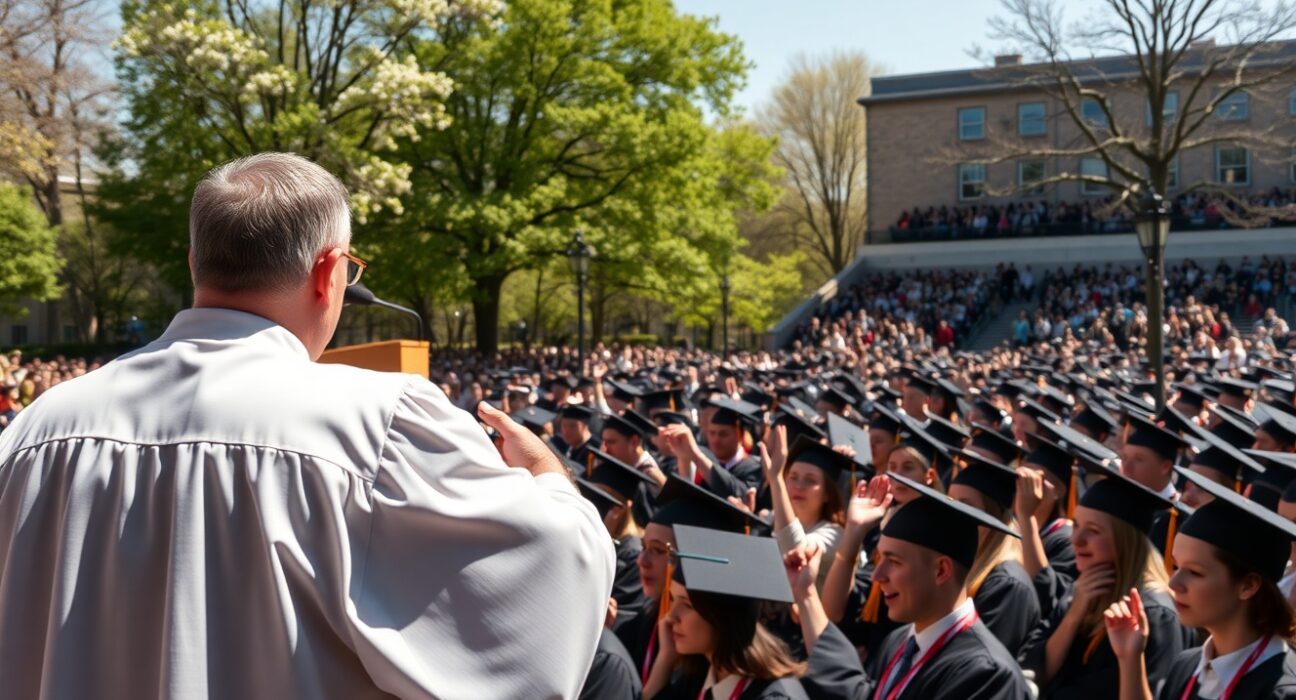
Commencement season at American universities in 2026 has taken an unexpected turn: speakers who bring up artificial intelligence are being met with loud, sustained booing from graduating students. At two separate ceremonies in recent weeks, references to AI as a force for progress triggered audible backlash, highlighting a deep generational anxiety about the technology’s impact on jobs and economic opportunity.
AI as a Lightning Rod at Graduation
At the University of Central Florida, Gloria Caulfield, an executive at real estate firm Tavistock Development Company, told arts and humanities graduates that the rise of AI represents the next industrial revolution. The crowd responded with boos that grew louder until Caulfield paused, chuckled, and asked, “What happened?” She attempted to continue, noting that only a few years ago AI was not a factor in daily life, but the audience interrupted her again — this time with cheers and applause. One graduate, Alexander Rose Tyson, told The New York Times, “It wasn’t one person that really started the booing. It was just sort of like a collective, ‘This sucks.’”
Days later, former Google CEO Eric Schmidt faced a similar reception at the University of Arizona. Schmidt was already a controversial pick due to a sexual assault lawsuit filed by a former girlfriend and business partner, which he has denied. According to local news reports, booing began before Schmidt even reached the stage. When he told students, “You will help shape artificial intelligence,” the noise intensified. Schmidt tried to speak over the crowd, insisting, “When someone offers you a seat on the rocket ship, you do not ask which seat, you just get on.”
Generational Pessimism Meets Economic Reality
The backlash reflects a broader mood among young Americans. A Gallup poll released this spring found that only 43% of people aged 15 to 34 believe it is a good time to find a job locally — a steep drop from 75% in 2022. That pessimism is not solely tied to AI, but the technology has become a visible symbol of economic uncertainty. Journalist and tech industry critic Brian Merchant described AI as “the cruel new face of hyper-scaling capitalism,” adding, “I too would loudly boo at the prospect of this next industrial revolution if I was in my early twenties, unemployed, and had aspirations for my future greater than entering prompts into an LLM.”
Even speakers who avoided direct AI mentions leaned heavily on themes of resilience. Schmidt acknowledged the anxiety directly, telling graduates that there is “a fear in your generation that the future has already been written, that the machines are coming, that the jobs are evaporating, that the climate is breaking, that politics are fractured, and that you are inheriting a mess that you did not create.”
Not Every Audience Reacted the Same Way
The response has not been universal. Nvidia CEO Jensen Huang spoke at Carnegie Mellon’s commencement and received no audible pushback when he said AI has reinvented computing. The difference may lie in the audience: Carnegie Mellon is a technology-focused institution where students are more likely to see AI as a tool they will build rather than a threat to their livelihoods. At UCF, Caulfield was addressing arts and humanities graduates, a group that may feel particularly vulnerable to automation. One student noted that Caulfield had already lost the crowd with what they described as generic praise of corporate executives like Jeff Bezos, before the AI comment turned dissatisfaction into open booing.
Conclusion
The 2026 commencement season has revealed a clear generational fault line. Students are not rejecting technology itself but the framing of AI as an inevitable, positive force at a time when job prospects are dim and economic anxiety is high. For speakers, the lesson is becoming obvious: if you want applause at a graduation ceremony, it may be wiser to leave AI out of the speech entirely. The moment reflects a deeper shift in how young Americans view the promises of the tech industry — and suggests that the next wave of public debate over AI will be shaped by those who feel they have the most to lose.
FAQs
Q1: Why are students booing AI mentions at commencement speeches?
Students are reacting to a combination of economic pessimism, job market anxiety, and a perception that AI is being promoted as inevitable progress without addressing its potential to displace workers. Many graduates feel they are inheriting an uncertain future where automation threatens career opportunities.
Q2: Did every speaker who mentioned AI get booed in 2026?
No. Nvidia CEO Jensen Huang mentioned AI at Carnegie Mellon’s commencement without audible backlash. The reaction appears to depend on the audience’s background — students at tech-focused institutions may view AI more favorably than those in arts and humanities programs.
Q3: What does this trend say about public opinion on AI?
The booing reflects a growing skepticism among younger generations about who benefits from AI development. It signals that public trust in tech leaders and corporate narratives about AI is eroding, especially among those who feel economically vulnerable. This could influence how companies and policymakers communicate about AI in the coming years.
Disclaimer: The information provided is not trading advice, Bitcoinworld.co.in holds no liability for any investments made based on the information provided on this page. We strongly recommend independent research and/or consultation with a qualified professional before making any investment decisions.