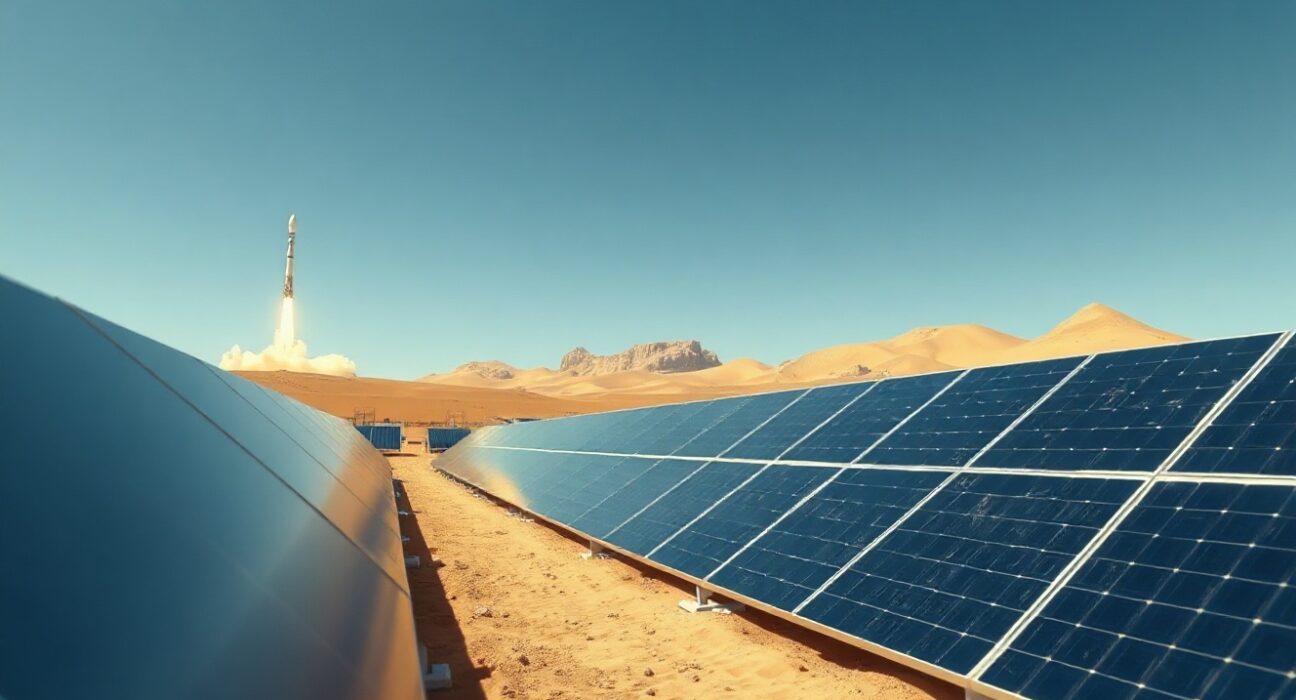
In a development that appears to contradict the foundational promise of Tesla’s Master Plans, Elon Musk’s artificial intelligence company, xAI, is powering its data centers with unregulated natural gas turbines, while SpaceX simultaneously pitches space-based solar as the future of energy. The juxtaposition, revealed in SpaceX’s recent IPO filing, raises questions about the consistency of Musk’s long-stated vision of a solar-powered, electrified economy.
From Master Plan to Natural Gas
Tesla’s first Master Plan, published in 2006, stated that the company’s overarching purpose was to expedite the move from a mine-and-burn hydrocarbon economy toward a solar electric economy. That vision has been a through line across four successive plans. Yet, xAI has deployed dozens of natural gas turbines for its AI computing needs, with plans to purchase an additional $2.8 billion worth of gas-powered equipment. The move effectively cements fossil fuel reliance at the heart of Musk’s AI ambitions, at least for the near term.
SpaceX’s filing reveals that xAI has spent $697 million on Tesla Megapacks — grid-scale battery storage systems — to manage peak loads. But notably, xAI has not purchased a materially significant number of solar panels from Tesla for its terrestrial data centers. Instead, solar power appears in the SpaceX filing primarily as a pitch for space-based arrays, which the company claims can generate more than five times the energy of terrestrial panels due to 24/7 illumination.
The Space-Based Solar Pivot
SpaceX’s filing explicitly contrasts terrestrial solar with its orbital alternative, arguing that space-based arrays avoid the intermittency problems of ground-mounted panels. The company frames this as a solution for AI data centers that are running into opposition from local communities — the so-called NIMBY problem — on Earth. The logic suggests that Musk views xAI’s current gas-powered data centers as temporary stopgaps until SpaceX can loft gigawatts of server capacity into orbit.
However, the economics of space-based data centers remain daunting. Power costs for Starlink satellites are multiples higher than terrestrial alternatives. Protecting sensitive AI chips from radiation and thermal extremes in space is neither easy nor cheap. It is also unclear whether AI training workloads, which require high-bandwidth, low-latency interconnects between thousands of processors, can be effectively distributed across multiple satellites in orbit.
Terawatt-Scale Ambitions and First-Principles Thinking
Musk’s pivot appears driven by a belief that AI compute demand will soon outstrip what Earth can supply. The SpaceX filing references terawatt-scale annual AI compute growth, a figure that would dwarf today’s global data center power consumption of roughly 40 gigawatts. Humanity currently uses about 4 terawatts of continuous energy. Musk’s extrapolation suggests he believes AI alone could demand a terawatt of additional compute capacity each year.
This is classic Musk first-principles thinking: identify a constraint, assume it will become the limiting factor, and work backward to a radical solution. But the assumption that AI compute growth will remain exponential and unconstrained is speculative. Energy demand has risen, and AI is indeed in a phase of rapid expansion, but whether that trajectory continues or levels off is unknown.
What This Means for Clean Energy
The most immediate implication is that one of the world’s most influential clean energy advocates is, at least temporarily, embracing fossil fuels to power his AI operations. For an executive who built his reputation on electrification and solar energy, the decision to use unregulated natural gas turbines is a notable departure from the principles outlined in Tesla’s Master Plan Part 3, released just three years ago, which detailed a plan to eliminate fossil fuels entirely.
The irony is not lost on energy analysts. Shipping solar panels on a flatbed truck uses far less energy than launching them into orbit. Space-ready panels would need to be manufactured at unprecedented scale, and the terrestrial solar industry has barely scratched the surface of its potential. The perfect, in this case, may be distracting from the good.
Conclusion
Elon Musk has not explicitly given up on solar power on Earth, but his actions suggest a strategic pivot. xAI’s natural gas investments and SpaceX’s space-based solar push indicate that Musk is betting on orbital energy as the long-term solution for AI’s power needs, while terrestrial clean energy takes a back seat. Whether this bet pays off depends on solving a cascade of engineering and economic challenges. For now, the clean energy vision that defined Tesla’s early mission appears to be in competition with a more complex, and more fossil-fuel-dependent, reality.
FAQs
Q1: Is Elon Musk abandoning solar power on Earth?
Not entirely, but his actions indicate a strategic shift. xAI is using natural gas for its data centers, and SpaceX is prioritizing space-based solar over terrestrial panels for AI energy needs. Tesla still sells solar products, but they are not being used in xAI’s current operations.
Q2: Why is xAI using natural gas instead of solar?
According to SpaceX’s IPO filing, xAI has purchased Tesla Megapacks for peak load management but has not bought a significant number of solar panels. The company appears to view natural gas as a temporary solution while SpaceX develops orbital data centers powered by space-based solar arrays.
Q3: Is space-based solar power realistic for AI data centers?
The concept faces significant challenges. Power costs in orbit are much higher than on Earth, protecting hardware from space radiation is difficult, and it is unclear whether AI training can be distributed across multiple satellites. SpaceX believes these problems are solvable, but the timeline is uncertain.
Disclaimer: The information provided is not trading advice, Bitcoinworld.co.in holds no liability for any investments made based on the information provided on this page. We strongly recommend independent research and/or consultation with a qualified professional before making any investment decisions.