

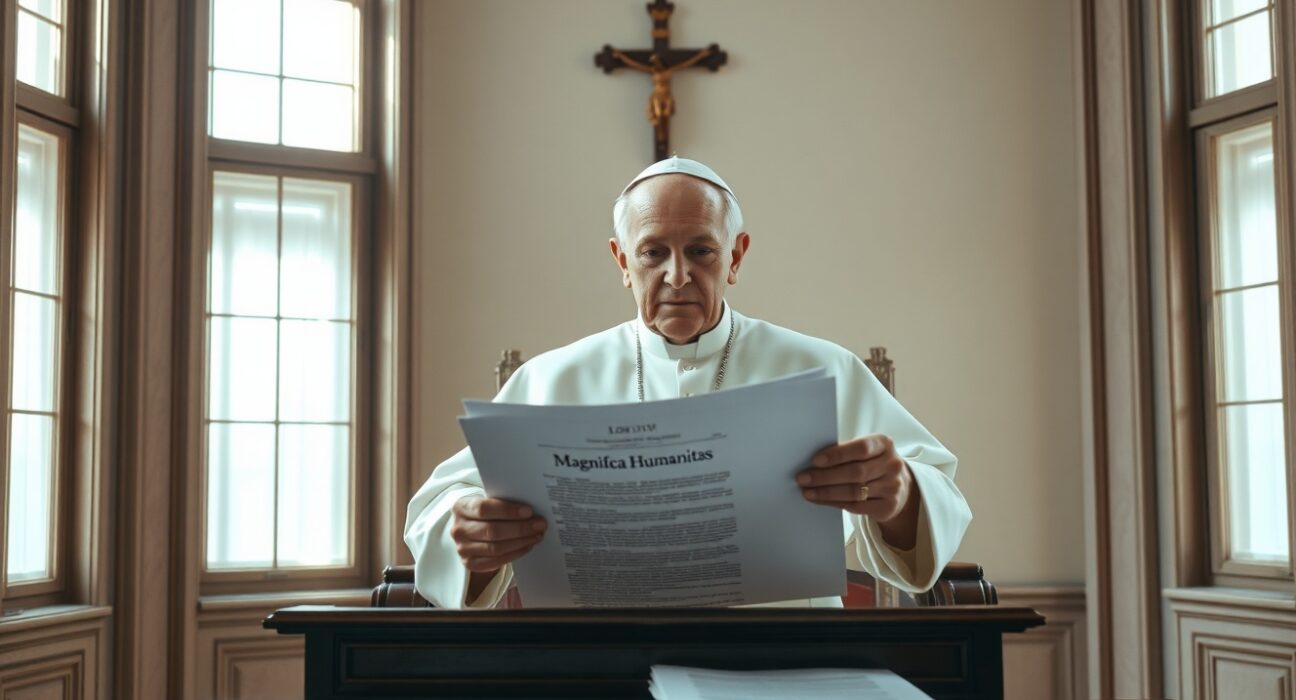
Pope Leo XIV published his first encyclical on Monday, titled Magnifica Humanitas, subtitled “On Safeguarding the Human Person in the Time of Artificial Intelligence.” But despite the title, the document is not primarily a technical treatise on algorithms or machine learning. Instead, it uses AI as a lens to examine older, deeper problems: inequality, war, the erosion of democratic institutions, and the concentration of power among a small elite.
What the Encyclical Actually Argues
Throughout the 200-page document, which the pope presented alongside Anthropic co-founder Chris Olah, Leo argues that technology built and governed by a narrow elite cannot, by definition, serve the common good. “When such power is concentrated in the hands of a few, it tends to become opaque and evade public oversight, increasing the risk of distorted forms of development that give rise to new dependencies, exclusions, manipulations and inequalities,” he writes.
The encyclical continues: “In fact, as with every major technological shift, AI tends to amplify the power of those who already possess economic resources, expertise and access to data.” It highlights concerns that elites can use their power to “shape information and consumption patterns, influence democratic processes and steer economic dynamics to their own advantage.”
Timing and Political Context
The encyclical arrives just days after President Donald Trump delayed signing an executive order on AI that would have given the government oversight over new models before their release. Reports indicate the delay came at the urging of venture capitalist and former White House AI czar David Sacks. Pope Leo called for AI to be guided by “clear criteria and effective oversight” grounded in participation from the communities that will be affected by it.
More concretely, the pope called for an end to the AI arms race “for ever more powerful algorithms and larger datasets” that companies and countries believe will “secure geopolitical or commercial dominance.” He wrote: “To disarm means discrediting the assumption that technical power automatically confers the right to govern.”
Historical Echoes and Modern Parallels
These dynamics predate AI. Pope Leo XIII’s 1891 encyclical Rerum Novarum addressed the same concentration of power during the Industrial Revolution. But modern examples are abundant: Elon Musk’s acquisition of Twitter and use of the platform to help elect Trump; the hundreds of millions flowing from tech elites into super PACs to block AI regulation. The pattern is clear, and the pope’s document is a direct response to it.
Notre Dame Law School professor Paolo Carozza, a member of the Pontifical Academy of Social Sciences and chair of the Meta Oversight Board, told Bitcoin World that AI-driven misinformation and deepfakes have “corroded our capacity to recognize what’s true and what’s not true, and that really has consequences for democratic politics.” The tech industry’s practice of “harvesting and manipulating” human data, he added, poses “fundamental challenges to cognitive freedom.”
Why This Matters
The encyclical’s core argument is that the surreal power and capabilities of today’s AI raise the stakes enormously. The same concentration of economic and political power that concerned earlier popes is now amplified by technology that can shape information, manipulate behavior, and entrench inequality at unprecedented scale. The pope’s intervention is not a technical policy proposal but a moral and political framework for rethinking who governs technology and for what purpose.
Conclusion
Magnifica Humanitas is less about AI itself and more about the human structures that create, control, and deploy it. Pope Leo XIV’s message is that technology built by a few for the benefit of a few cannot serve the common good — and that the solution lies not in better algorithms, but in broader participation, democratic oversight, and a rejection of the assumption that technical power confers moral authority.
FAQs
Q1: What is the main argument of Pope Leo XIV’s encyclical on AI?
The encyclical argues that AI, like previous technologies, tends to concentrate power in the hands of a small elite, exacerbating inequality, eroding democracy, and enabling manipulation. It calls for broader participation and oversight in AI governance.
Q2: Why did the pope present the encyclical with an Anthropic co-founder?
Chris Olah, co-founder of the AI safety company Anthropic, was present to provide technical context and underscore the encyclical’s engagement with real-world AI development. The Vatican sought to ground its moral arguments in current technological realities.
Q3: How does this encyclical relate to previous papal documents?
The encyclical echoes Pope Leo XIII’s 1891 Rerum Novarum, which addressed the concentration of power during the Industrial Revolution. Both documents focus on the moral and social consequences of technological and economic change.
Disclaimer: The information provided is not trading advice, Bitcoinworld.co.in holds no liability for any investments made based on the information provided on this page. We strongly recommend independent research and/or consultation with a qualified professional before making any investment decisions.
