

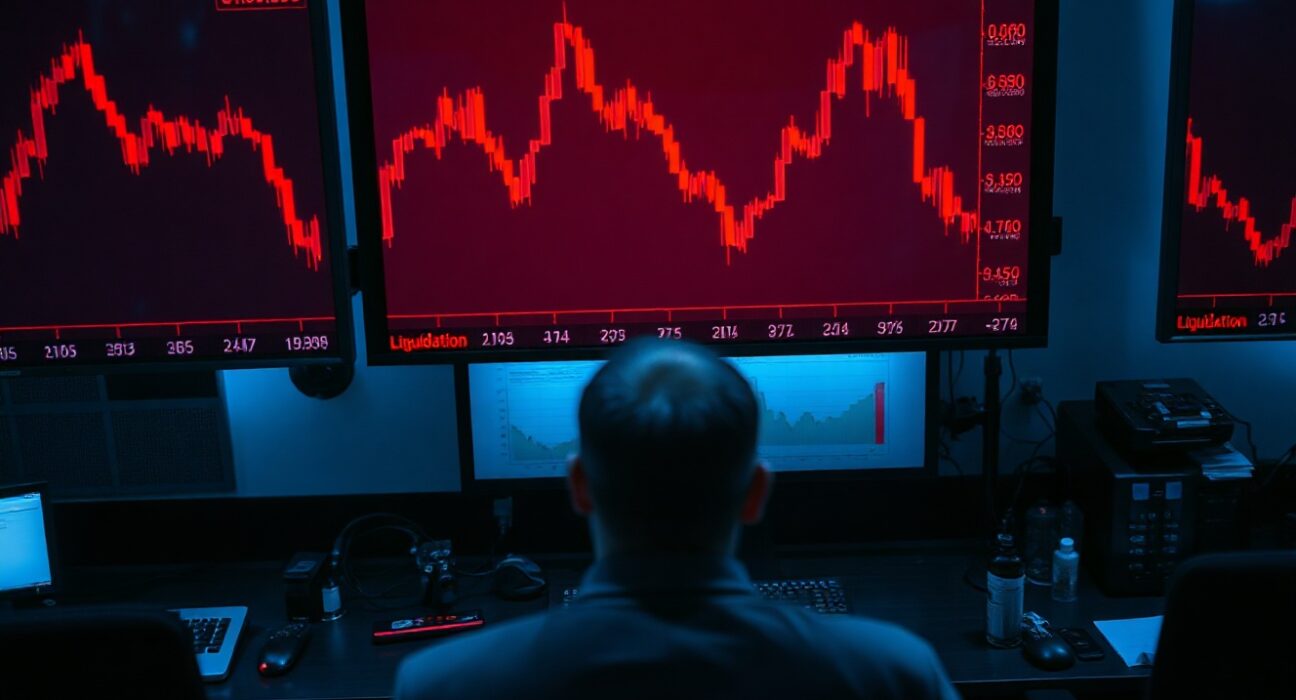
The cryptocurrency market experienced a sudden and severe sell-off today, triggering over $436 million in futures liquidations across major exchanges within a single hour. Data from leading tracking platforms confirms that the rapid deleveraging event pushed the 24-hour liquidation total past the $1.057 billion mark, marking one of the most significant liquidation events in recent months.
What Triggered the Mass Liquidation?
The cascade of liquidations was primarily driven by a sharp and unexpected decline in Bitcoin and Ethereum prices, which fell by more than 5% and 7%, respectively, within a short timeframe. When the price of an asset drops rapidly, leveraged long positions—where traders bet on price increases—are forcibly closed by exchanges to prevent further losses. This forced selling often accelerates the downward move, creating a feedback loop that leads to even more liquidations.
Market analysts point to a combination of factors, including profit-taking after a recent rally, macroeconomic uncertainty from hawkish central bank signals, and a sudden spike in on-chain transaction fees that may have triggered panic selling. However, no single definitive catalyst has been confirmed, and the event appears to be a classic example of a leveraged market correction.
Impact Across Major Exchanges and Assets
Data aggregated from Binance, OKX, Bybit, and other major platforms shows that the majority of liquidations occurred in Bitcoin (BTC) and Ethereum (ETH) perpetual futures contracts. Long positions accounted for over 85% of the total liquidated value, indicating that most traders were caught off guard by the speed of the decline.
The liquidation event was not limited to the top two cryptocurrencies. Altcoins such as Solana (SOL), XRP, and Dogecoin (DOGE) also saw significant leveraged positions wiped out, contributing to the broader market downturn. The total open interest across futures markets dropped sharply, suggesting a meaningful reduction in speculative leverage.
What This Means for Traders and Investors
This event serves as a stark reminder of the risks inherent in leveraged trading. While futures contracts allow traders to amplify potential gains, they also magnify losses. For retail investors, the key takeaway is the importance of risk management, including the use of stop-loss orders and avoiding excessive leverage in volatile market conditions.
For the broader market, such liquidation events can sometimes signal a local bottom, as forced selling removes weak hands and resets funding rates. However, it is too early to determine whether this marks the end of the correction or the beginning of a deeper drawdown. Market participants are closely watching for signs of stabilization in the coming hours.
Conclusion
The $436 million hourly liquidation and $1.057 billion 24-hour total underscore the extreme volatility and leveraged nature of the current cryptocurrency market. While the immediate trigger remains unclear, the event highlights the systemic risk posed by high leverage. Traders should remain cautious, monitor their positions closely, and avoid overexposure during periods of heightened uncertainty. The coming days will be critical in determining whether the market can recover or if further downside is ahead.
FAQs
Q1: What is a futures liquidation?
A futures liquidation occurs when a trader’s leveraged position is forcibly closed by an exchange because the margin balance falls below the required maintenance level, usually due to adverse price movements.
Q2: Why did $436 million in liquidations happen in just one hour?
A rapid and sharp price decline triggered a cascade of forced selling, as many leveraged long positions were simultaneously closed. This created a feedback loop that accelerated the sell-off and led to further liquidations.
Q3: Is this a sign that the crypto market is crashing?
Not necessarily. While large liquidation events can signal short-term bearishness, they often reset market conditions and can sometimes mark a local bottom. The overall trend depends on broader market sentiment and macroeconomic factors.
Disclaimer: The information provided is not trading advice, Bitcoinworld.co.in holds no liability for any investments made based on the information provided on this page. We strongly recommend independent research and/or consultation with a qualified professional before making any investment decisions.
