

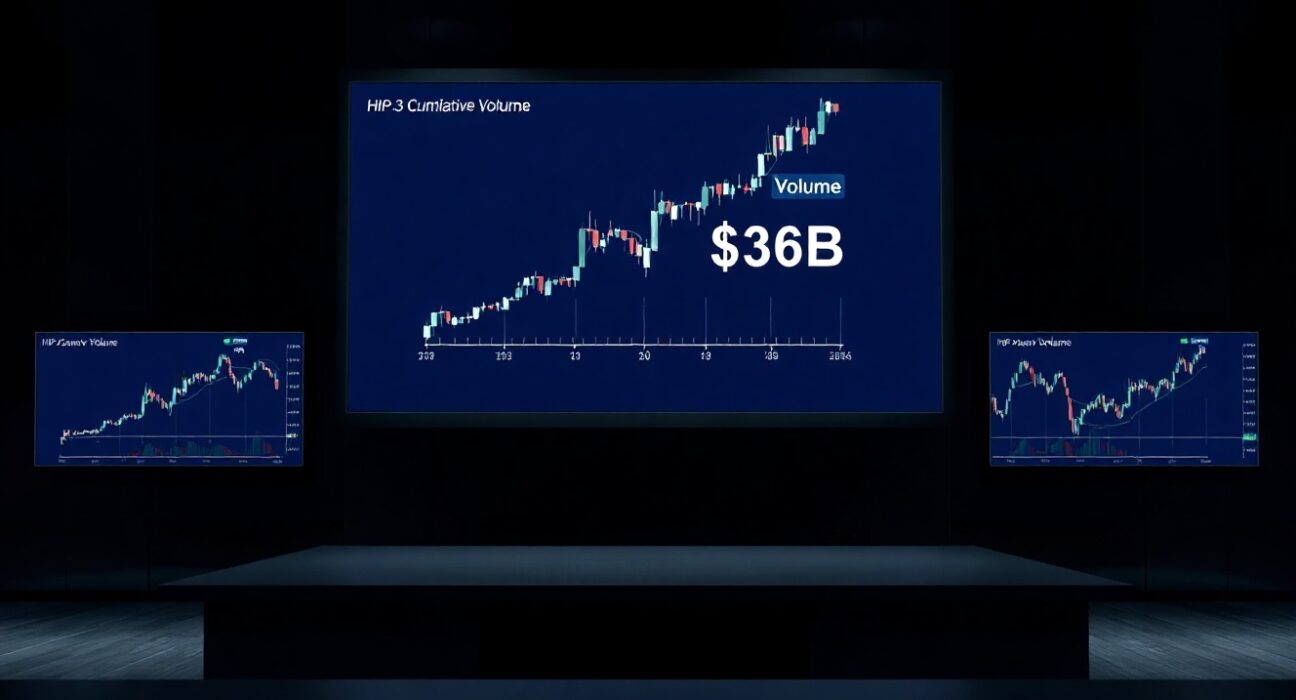
Cumulative trading volume on Hyperliquid’s HIP-3 market has surged past the $300 billion mark, reaching $309.49 billion as of approximately 15 hours ago, according to data from Dune Analytics. The milestone underscores the growing adoption of on-chain perpetual futures trading, a sector that continues to attract both retail and institutional participants.
What Is the HIP-3 Market?
The HIP-3 market is a relatively recent innovation on the Hyperliquid platform that allows any user to create trading markets directly on-chain by staking HYPE, the platform’s native token. Unlike traditional finance futures markets, which operate during set hours and face periodic closures, HIP-3 markets run 24/7. They also focus exclusively on perpetual futures — products that have no expiration dates, enabling traders to hold positions indefinitely without worrying about contract rollovers.
This flexibility has proven attractive in volatile market conditions. The ability to open and close positions at any time, combined with transparent on-chain settlement, differentiates HIP-3 from conventional derivatives exchanges.
Volume Drivers: Geopolitical Tensions and Stock Market Sentiment
Data from Dune Analytics shows that trading activity in commodity-linked perpetual futures on HIP-3 saw a notable uptick earlier this year amid rising geopolitical tensions in the Middle East. Traders turned to these instruments to hedge against energy price volatility and supply disruptions.
More recently, volume for stock-related perpetual futures products has accelerated. This growth aligns with positive sentiment in both U.S. and Asian equity markets, where indices have rallied on the back of easing monetary policy expectations and strong corporate earnings reports. The HIP-3 market’s ability to offer round-the-clock exposure to these assets without traditional market hours has been a key factor in attracting volume.
Why This Matters for Crypto Derivatives
The $300 billion milestone is significant not just for Hyperliquid but for the broader on-chain derivatives ecosystem. It demonstrates that decentralized perpetual futures markets can achieve scale comparable to centralized exchanges, while offering unique advantages such as transparency, self-custody, and continuous operation.
However, the growth also raises questions about market maturity. As volume increases, liquidity depth, slippage, and the risk of smart contract exploits become more consequential. Hyperliquid’s reliance on HYPE staking for market creation ties the platform’s security and governance to its token economics — a model that remains under scrutiny by regulators and risk analysts.
Conclusion
Hyperliquid’s HIP-3 market has crossed a major volume threshold, reflecting sustained demand for on-chain perpetual futures. While geopolitical events and equity market sentiment have fueled recent activity, the platform’s structural advantages — 24/7 operation, no expiration dates, and permissionless market creation — are the underlying drivers. As the DeFi derivatives space matures, the HIP-3 market’s trajectory will be a key indicator of whether decentralized alternatives can sustain their momentum against traditional financial infrastructure.
FAQs
Q1: What is the HIP-3 market on Hyperliquid?
The HIP-3 market is a permissionless on-chain trading system that lets users create and trade perpetual futures markets by staking HYPE tokens. It operates 24/7 and has no expiration dates.
Q2: How does HIP-3 differ from traditional futures exchanges?
Traditional futures exchanges have set trading hours, periodic market closures, and contract expiration dates. HIP-3 markets run continuously and offer perpetual contracts that never expire.
Q3: What drove the recent volume surge past $300 billion?
Geopolitical tensions in the Middle East boosted commodity-linked volume, while positive sentiment in U.S. and Asian stock markets increased activity in stock-related perpetual futures products.
Disclaimer: The information provided is not trading advice, Bitcoinworld.co.in holds no liability for any investments made based on the information provided on this page. We strongly recommend independent research and/or consultation with a qualified professional before making any investment decisions.
