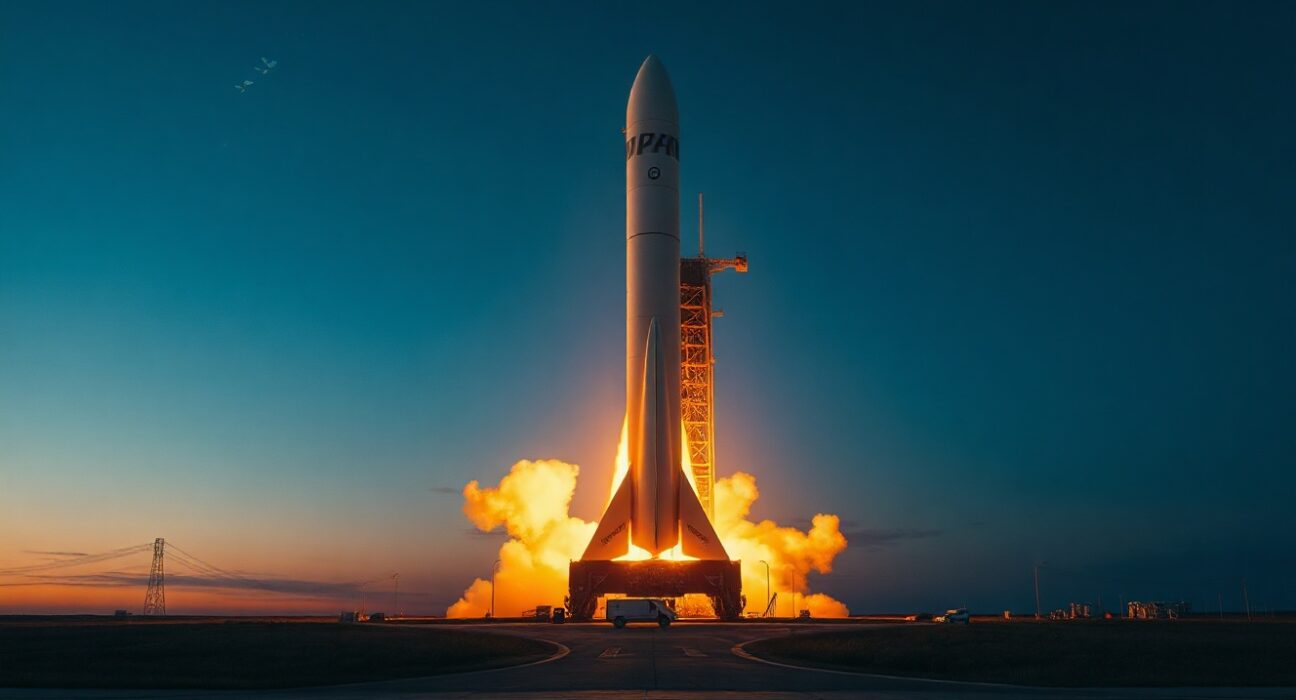
SpaceX is set to go public on Friday, and investor demand has already overwhelmed the $75 billion offering. Reports indicate that some institutional buyers have committed to $10 billion blocks of Elon Musk’s empire, signaling extraordinary confidence — or extraordinary FOMO. While there are plenty of reasons to be skeptical, including the company’s ongoing losses, the historical tendency for big IPOs to underperform, and Musk’s unpredictable public behavior, the frenzy shows no signs of slowing.
But beneath the hype lies a serious and high-stakes business strategy. A careful review of SpaceX’s financial filings and recent executive commentary reveals that the company is betting on three near-impossible engineering feats: a fully reusable rocket, a new American chip foundry, and the ability to manufacture AI satellites at an unprecedented rate. Together, these form the foundation of what Musk calls “orbital data centers” — a concept that has emerged over the last 18 months as the unifying vision for SpaceX’s post-IPO future.
Valuation gap: $825 billion to $1.8 trillion
Two independent analyses published this week offer a more sober assessment of SpaceX’s worth. Morningstar, the financial research firm, values the company at roughly $825 billion. Aswath Damodaran, a finance professor at New York University known for his work on corporate valuation, puts the figure closer to $1.2 trillion. Both are significantly below the nearly $1.8 trillion valuation implied by the company’s bankers.
The discrepancy, according to Morningstar’s analyst, essentially represents a $72 call option per share on SpaceX’s ability to deliver orbital data centers at the scale and speed Musk envisions. The company’s space launch and Starlink satellite internet businesses are widely considered high-margin and relatively predictable. Its AI ambitions, by contrast, are far more speculative.
What is SpaceX’s AI business?
SpaceX’s S-1 filing frames its largest opportunity in enterprise AI. The company claims its models will power coding tools developed by a team acqui-hired from Cursor, and its Macrohard project aims to equip digital agents for white-collar labor. SpaceX estimates the total addressable market for this business at $22.7 trillion, dwarfing the $2.4 trillion it sees in AI infrastructure and the roughly $2 trillion in space-related markets.
Yet the company has also signed deals to sell significant compute capacity to Anthropic and Google — both direct competitors in the AI model space. This is not unusual for Musk’s companies; SpaceX frequently launches satellites for competitors to its Starlink network. But it typically does so from a position of strength, not while playing catch-up. The strategy raises a fundamental question: in the AI tech stack, does value accrue more to compute providers or to model builders?
The orbital data center architecture
In a video released this week, Musk laid out the logic for space-based data centers. He argued that SpaceX is uniquely positioned to put large amounts of mass on orbit cheaply, build extensive solar arrays, and manufacture chips at scale. While most industry experts see space data centers as a decade away, Musk suggested they could arrive much sooner.
“This is not a promise of what we’ll do,” Musk said in the video. “This is what we are going to try to do, and think we probably can do, which is to get to roughly an annualized rate of a gigawatt per year by the end of next year, in terms of space AI compute.”
Based on his expected maximum power delivery of 150kW per satellite, that translates to a production rate of 6,666 satellites per year — about 556 per month. That is roughly double the current reported production rate of Starlink satellites, which stands at about 70 per week. While Musk claims the AI satellites are simpler in design, the ramp-up would require a production facility that does not yet exist.
The company is also still building out its solar panel production capacity. And then there is Terafab, SpaceX’s much-discussed chip foundry, which Musk sees feeding into later stages of the plan as the company aims for a terawatt of annual compute production. Chip fabs are among the hardest modern industrial projects, typically costing billions of dollars and taking up to a decade to complete.
Starship: the linchpin that isn’t ready yet
All of these plans depend on Starship, the massive reusable rocket that is key to economically placing those chips in orbit. A recent test flight was successful in many respects, but it did not demonstrate rapid reusability. SpaceX may initially reuse only the booster, which would raise the cost of the orbital data center rollout. The company is currently under an FAA mishap investigation after the booster failed to make a controlled reentry as planned.
SpaceX has not responded to questions about when Starship will fly again, though it has said it expects to begin launching Starlink satellites with the vehicle by the end of this year. That timeline should be viewed with caution: NASA, which has a nearly $4 billion contract with SpaceX to use Starship as a Moon lander, is not yet ready to commit to a test mission scheduled for late 2027.
What public investors are actually buying
When public investors get their hands on SpaceX shares, they will own a near-monopoly on access to space in the U.S. and Europe, a global communications network, and a high-risk bet on the most ambitious infrastructure project of the AI era. That bet depends on three things SpaceX has never done before:
- A fully reusable rocket that can fly multiple times without major refurbishment
- A high-rate production facility for AI satellites, built in 18 months rather than the decade it took for Starlink manufacturing
- A U.S.-based chip foundry, something even dedicated silicon firms are reluctant to undertake
Musk is correct that SpaceX is the only company positioned to attempt any of this in the near term. But that speaks to the magnitude of the challenge as much as the company’s likelihood of success. Musk used to say he would not take SpaceX public until it reached Mars, fearing that fickle investors might lose faith along the way. Those plans may have been shelved, but what he has laid out ahead of the IPO could prove just as difficult.
Conclusion
SpaceX’s IPO offers public investors a rare chance to own a piece of a company that dominates space launch and satellite communications. But the premium embedded in the offering price reflects a bet on engineering achievements that have never been accomplished — and may not be achievable on the timeline Musk envisions. For investors, the distinction between visionary ambition and realistic execution has never been more important.
FAQs
Q1: When is SpaceX’s IPO expected to happen?
SpaceX is expected to begin trading on Friday, with a $75 billion offering that is already heavily oversubscribed.
Q2: What are the three key technologies SpaceX is betting on?
The company’s strategy depends on a fully reusable rocket (Starship), a high-rate satellite production facility, and a new U.S.-based chip foundry (Terafab).
Q3: How do independent valuations compare to SpaceX’s IPO price?
Morningstar values SpaceX at about $825 billion, and NYU’s Aswath Damodaran estimates $1.2 trillion. Both are well below the $1.8 trillion implied by the company’s bankers, with the difference attributed to the risk of the orbital data center plan.
Disclaimer: The information provided is not trading advice, Bitcoinworld.co.in holds no liability for any investments made based on the information provided on this page. We strongly recommend independent research and/or consultation with a qualified professional before making any investment decisions.