

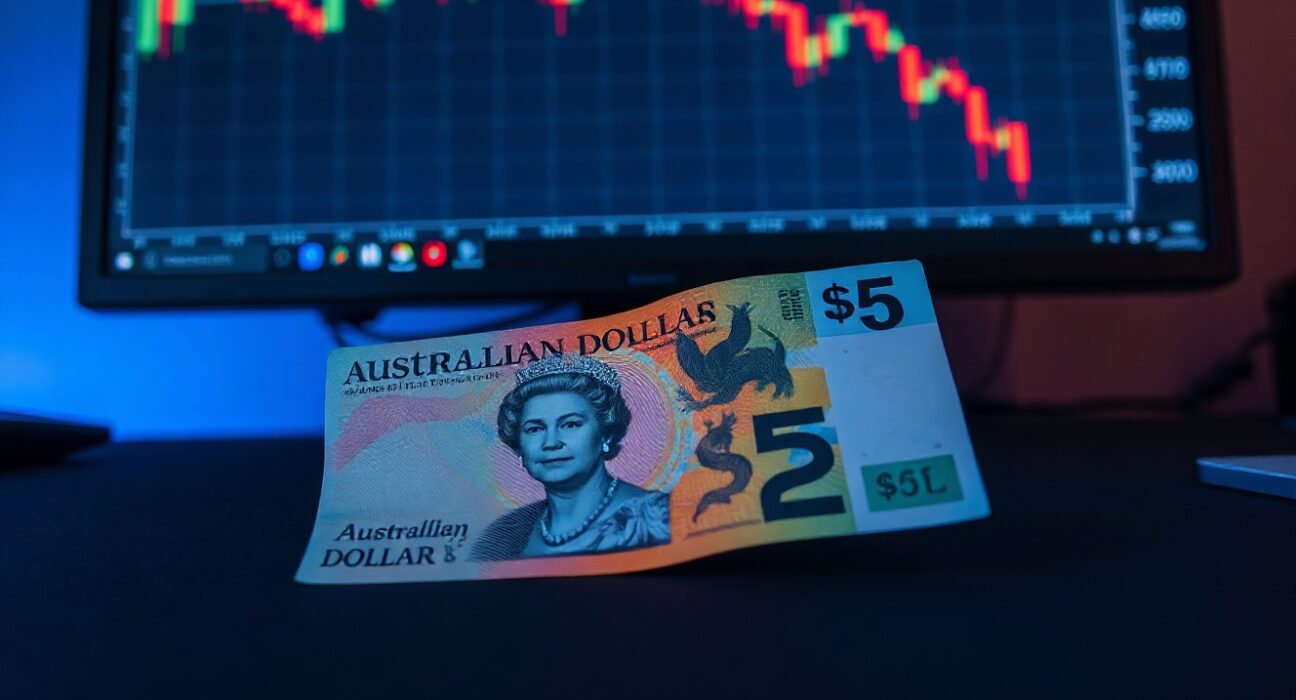
The Australian Dollar remained under pressure on Monday, trading near its lowest levels in two months as a broad shift toward risk-off sentiment weighed on higher-yielding currencies. The AUD/USD pair struggled to recover from recent losses, reflecting investor caution ahead of key economic data and ongoing geopolitical uncertainties.
Risk-Off Mood Dents Demand for the Aussie
Global financial markets have turned increasingly cautious in recent sessions, driven by renewed concerns over the pace of interest rate adjustments by major central banks and persistent inflationary pressures. This environment has pushed investors toward safe-haven currencies like the US Dollar, Japanese Yen, and Swiss Franc, while currencies more sensitive to global growth expectations, such as the Australian Dollar, have faced selling pressure.
The Australian Dollar’s decline is also tied to weaker commodity prices, particularly iron ore, which is a key export for Australia. A slowdown in Chinese economic activity, Australia’s largest trading partner, has added to the headwinds, reducing demand for the nation’s raw materials.
Technical and Fundamental Pressures Converge
From a technical perspective, the AUD/USD pair has broken below several support levels, signaling a bearish trend. The pair is now trading near the 0.6500 handle, a psychologically important level that traders are watching closely. A sustained break below this mark could open the door for further losses toward the 0.6400 region.
On the fundamental side, the Reserve Bank of Australia’s (RBA) recent policy stance has also contributed to the currency’s weakness. While the RBA has held interest rates steady, its commentary has been less hawkish compared to other central banks, such as the Federal Reserve. This divergence in monetary policy expectations has made the Australian Dollar less attractive to yield-seeking investors.
What This Means for Traders and the Economy
For currency traders, the current environment favors a cautious approach. The strength of the US Dollar is likely to persist as long as risk appetite remains subdued. A weaker Australian Dollar has mixed implications for the broader economy: it can boost export competitiveness but also increases the cost of imported goods, potentially adding to inflationary pressures.
Looking ahead, market participants will be watching for Australian employment data and US inflation figures due later this week. These releases could provide fresh direction for the AUD/USD pair. Any signs of resilience in the Australian economy or a shift in global risk sentiment could trigger a recovery, but for now, the bias remains tilted to the downside.
Conclusion
The Australian Dollar’s slide to two-month lows reflects a powerful combination of global risk aversion, falling commodity prices, and a less supportive monetary policy backdrop. While the currency may find some support at current levels, the path of least resistance appears lower in the near term. Traders should remain alert to upcoming economic data and central bank commentary for signs of a potential reversal.
FAQs
Q1: Why is the Australian Dollar falling?
The Australian Dollar is falling due to a combination of risk-off sentiment in global markets, weaker commodity prices (especially iron ore), and a less hawkish stance from the Reserve Bank of Australia compared to other central banks like the Federal Reserve.
Q2: What is the key support level for AUD/USD?
The key support level for AUD/USD is around the 0.6500 psychological mark. A break below this level could lead to further declines toward 0.6400.
Q3: How does a weaker Australian Dollar affect the economy?
A weaker Australian Dollar can boost export competitiveness for Australian goods but also increases the cost of imports, which can contribute to higher inflation.
Disclaimer: The information provided is not trading advice, Bitcoinworld.co.in holds no liability for any investments made based on the information provided on this page. We strongly recommend independent research and/or consultation with a qualified professional before making any investment decisions.
