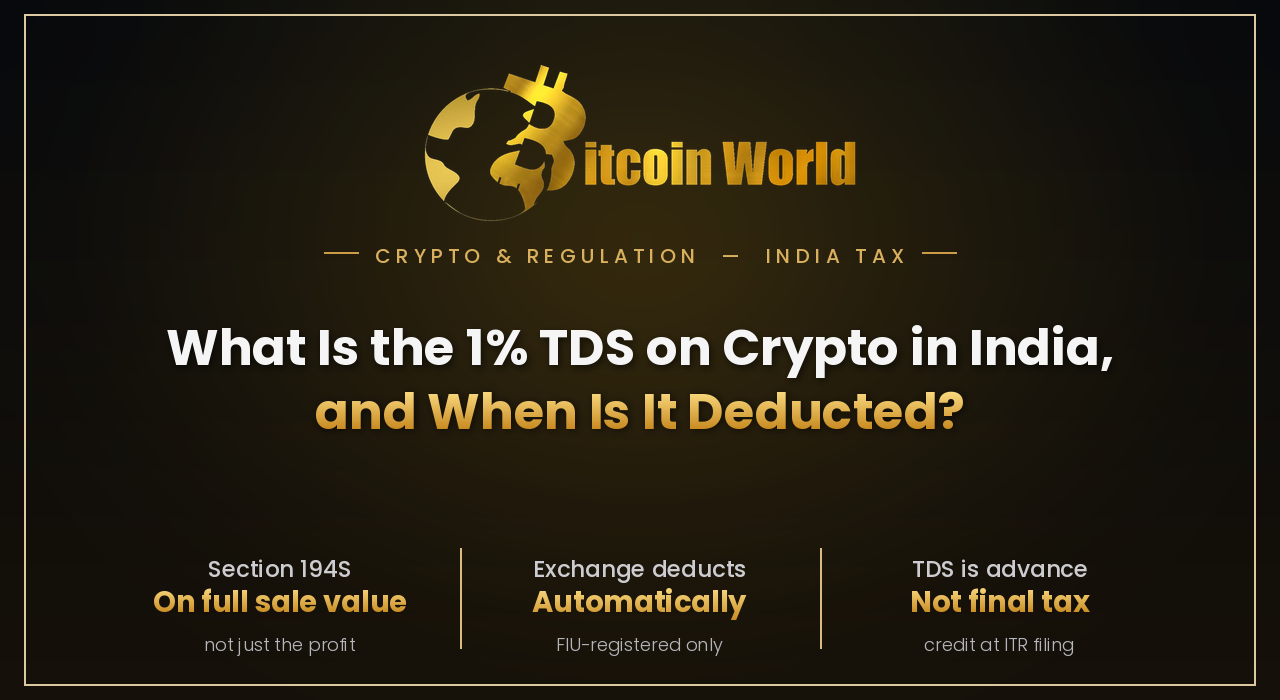
What Is the 1% TDS on Crypto in India, and When Is It Deducted?
The 1% TDS on crypto in India – Tax Deducted at Source under Section 194S of the Income Tax Act 2025 – applies to every qualifying Virtual Digital Asset transfer and has been in force since 1 July 2022. It is not an additional tax; it is advance collection of a portion of the 30% liability, deducted at the point of transaction by the exchange or, in P2P trades, by the buyer. Understanding exactly when it applies, who deducts it, and how it offsets your final tax bill is essential for accurate ITR filing in India. Verified against Income Tax Act 2025 and Budget 2026-27.
What Exactly Is the 1% TDS on Crypto in India?
The 1% TDS on crypto is a transaction-level advance tax collection mechanism under Section 194S of the Income Tax Act 2025.
- Rate: 1% of the total sale consideration – applied to the full amount received, not just the profit.
- Purpose: To create a transaction trail and collect tax in advance, ensuring VDA income doesn’t go unreported.
- Not the final tax: The 1% TDS is credited against the 30% final liability when the ITR is filed.
- In force since: 1 July 2022, introduced by the Finance Act 2022.
- Applies to: All VDA transfers – Bitcoin, Ethereum, altcoins, USDT, stablecoins, NFTs, and other tokens.
When Exactly Is TDS Deducted – and by Whom?
The deduction mechanism and responsible party depend on how the transaction is executed.
- On FIU-registered exchanges: The exchange deducts 1% TDS automatically at the moment of transfer – no user action required. It appears in Form 26AS and the exchange’s TDS certificate.
- On P2P trades: The buyer is responsible for deducting 1% TDS from consideration paid to the seller and depositing it using Form 26QE.
- On DeFi and non-custodial swaps: The legal TDS obligation exists, but enforcement on purely on-chain decentralised transactions remains a grey area in 2026.
- Failure to deduct (P2P): Makes the buyer liable for the TDS amount plus interest at 1.5% per month and a penalty equal to the TDS amount.
What Thresholds Apply – Is Every Transaction Covered?
TDS applies above annual consideration thresholds, not on every micro-transaction.
- General threshold: ₹10,000 per financial year – once total VDA transfer consideration in a year exceeds this, TDS triggers.
- Specified persons threshold: ₹50,000 per financial year – applies to individuals without business income (salaried individuals whose crypto is not a business activity).
- Cumulative tracking: FIU-registered exchanges track total consideration across the year and trigger deduction once the applicable threshold is crossed.
- Below threshold: Transactions below the threshold are not subject to TDS – but the 30% tax on any gain still applies and must be self-declared in the ITR.
How Does TDS Interact With the Final 30% Tax Liability?
Understanding the relationship between TDS and final tax prevents both overpayment and under-payment errors.
- TDS is a credit, not settlement: If your total crypto tax for the year is ₹2 lakh and TDS deducted was ₹50,000, you owe the balance ₹1,50,000 at filing.
- TDS may exceed liability: If you traded at a loss overall but TDS was deducted on the sale consideration, you can claim a refund of the excess TDS in your ITR.
- Reconciliation is essential: Cross-reference TDS credits in Form 26AS and the Annual Information Statement (AIS) before filing.
- Advance tax may also apply: If total crypto tax liability for the year is expected to exceed ₹10,000, quarterly advance tax instalments may be required.
Frequently Asked Questions
Is the 1% TDS on crypto the only tax I need to pay in India?
No – the 1% TDS on crypto in India is advance collection, not a final settlement. Your actual obligation is 30% plus 4% cess on every VDA transfer gain under Section 115BBH. The TDS is credited against that 30% liability when you file your ITR-2 or ITR-3, and you must pay any balance remaining or claim a refund if TDS exceeds the liability.
Does the 1% TDS on crypto apply to crypto-to-crypto swaps in India?
Yes – the 1% TDS under Section 194S applies to crypto-to-crypto swaps on registered Indian exchanges, not only INR disposals. The exchange deducts TDS based on the Fair Market Value of the consideration received in INR at the time of the swap. For swaps on international or decentralised platforms, the buyer is technically required to self-deduct and remit TDS via Form 26QE.
What happens if someone doesn’t deduct TDS on a P2P crypto trade in India?
Failure to deduct and deposit the 1% TDS on a P2P crypto trade makes the buyer liable for the TDS amount itself, plus interest at 1.5% per month from the date it should have been deducted, and an additional penalty equal to the TDS amount. With P2P transaction data increasingly available to the ITD through PMLA reporting and Section 509 exchange data, P2P non-compliance is becoming systematically detectable in 2026.
Conclusion: Why the 1% TDS on Crypto Is a Paper Trail, Not Just a Payment
The 1% TDS on crypto in India functions as a compliance signal as much as a tax collection tool – every deduction creates a footprint in the ITD’s systems via Form 26AS and AIS. For Indian crypto users, understanding that TDS is advance tax and not final tax is critical: the actual 30% obligation is larger, and the gap must be settled at filing. In 2026, with Section 509 cross-referencing TDS data against every ITR filed, treating TDS as a tick-box is no longer sufficient. Use it as the foundation of accurate, complete Schedule VDA compliance – and never assume the 1% discharged the full liability.
Disclaimer: The information provided is not trading advice, Bitcoinworld.co.in holds no liability for any investments made based on the information provided on this page. We strongly recommend independent research and/or consultation with a qualified professional before making any investment decisions.