

General Intuition, a startup spun out of gaming clip platform Medal, has raised $320 million at a $2.3 billion valuation to pursue an ambitious thesis: that the action data embedded in millions of hours of video game footage can teach AI agents to navigate the physical world. The round, led by Khosla Ventures with participation from General Catalyst, Jeff Bezos, Eric Schmidt, and researchers from Google DeepMind and MIT, signals strong investor belief that gameplay offers a scalable shortcut to building generalized AI models for robotics and simulation.
From Fortnite to factory floors
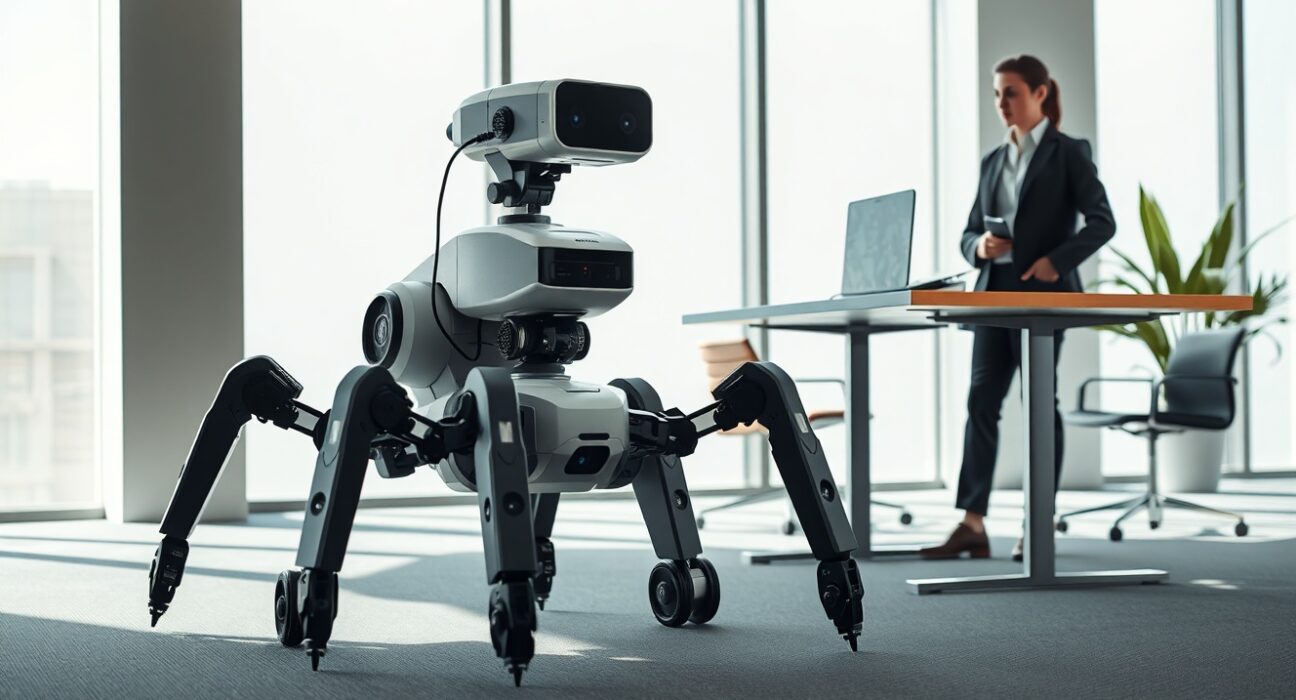
During a visit to General Intuition’s New York office, co-founder and CEO Pim de Witte demonstrated the company’s technology in action. An AI agent had been playing a game similar to Fortnite for 100 hours straight, learning spatial-temporal reasoning — understanding how to move through space and time. The same model was then powering a quadrupedal robot that navigated the office, bumping into chairs and trash bins like a learning toddler. De Witte explained that just eight minutes of real-world data collected on a street was enough to fine-tune the model for the robot’s new environment.
The key differentiator, according to de Witte, is the action labels embedded in Medal’s gameplay clips — records of exactly which buttons players pressed and when. Most competitors try to infer actions from video alone, which he argues is insufficient for building a model that understands causality and the distinction between self and environment.
A data moat built on gaming
General Intuition’s data advantage comes from Medal, de Witte’s previous company, which hosts hundreds of millions of hours of uploaded gameplay. This proprietary dataset provides the foundation for training world models — simulated environments generated frame-by-frame rather than rendered by a traditional game engine. In a demo, a world model correctly treated walls as solid objects, ladders as climbable, and shadows as dynamic, demonstrating an understanding of physics learned purely from gameplay.
The company is not selling the world model itself; instead, it uses the simulation as a training environment, or “the gym,” to improve its agentic model. The ultimate product is an API that allows customers to deploy the model in gaming, simulation, and robotics. De Witte emphasized that General Intuition will not build a self-driving car company but aims to make it “10 times easier for the next person to build a self-driving car company.”
Investor conviction and ethical boundaries
Vinod Khosla, whose firm led the round, described General Intuition as a generational bet, comparing the potential emergence of intuition in world models to the quantum leap of reasoning in large language models. He pointed to the company’s proprietary human action data as the key ingredient for that breakthrough. Khosla also indicated that an acquisition would be uninteresting at this stage, as it would merely be a data acquisition.
De Witte, who spent three years working with Doctors Without Borders, has drawn a clear ethical line: no agents will be employed to harm humans. The company will not pursue lethal autonomy applications, though it is open to search and rescue missions. This stance comes as Silicon Valley grows increasingly bullish on military AI, but de Witte, who is Dutch and employs a largely European team, says his values shape the company’s identity. He brought on chief of staff Brianna Martin in part because she publicly quit Palantir over its work with U.S. Immigration and Customs Enforcement.
Building a data flywheel for the future
General Intuition plans to use the majority of its new funding to scale compute capacity through a deal with CoreWeave, focusing on pre-training the next version of its model. A smaller portion will go toward making its API broadly available by the end of summer. The company has a handful of customers in gaming, simulation, and robotics, and aims to build a data flywheel by prioritizing customers that can offer real-world data to improve its foundation model.
The startup also launched a platform called Nerve, a jobs marketplace that lets gamers earn money using their existing setups, starting with data labeling and moving toward robot teleoperation. De Witte noted that Medal’s user base is the generation most exposed to AI-driven displacement, and he wants them to have a stake in what comes next.
Conclusion
General Intuition’s $2.3 billion valuation reflects investor confidence that video game action data can unlock generalized AI agents capable of bridging simulation and reality. While the company’s technology shows promise in demos, the question of whether simulation-to-real-world transfer can hold at scale remains unanswered. With a proprietary data moat, a clear ethical framework, and a focus on enabling others to build on its platform, General Intuition is positioning itself as a potential backbone for the next generation of AI-powered robotics and simulation.
FAQs
Q1: What makes General Intuition’s approach different from other AI robotics companies?
A1: General Intuition uses action labels — records of exactly which buttons players pressed — from millions of hours of video game footage, rather than trying to infer actions from video alone. This proprietary data helps the model understand causality and distinguish between self and environment.
Q2: How much funding has General Intuition raised?
A2: The company has raised a total of $454 million, including a $134 million round at launch in October and a $320 million round at a $2.3 billion valuation announced in November.
Q3: What are General Intuition’s ethical guidelines for AI use?
A3: CEO Pim de Witte has stated that no agents will be employed to harm humans. The company will not pursue lethal autonomy applications but is open to search and rescue missions.
Disclaimer: The information provided is not trading advice, Bitcoinworld.co.in holds no liability for any investments made based on the information provided on this page. We strongly recommend independent research and/or consultation with a qualified professional before making any investment decisions.
