

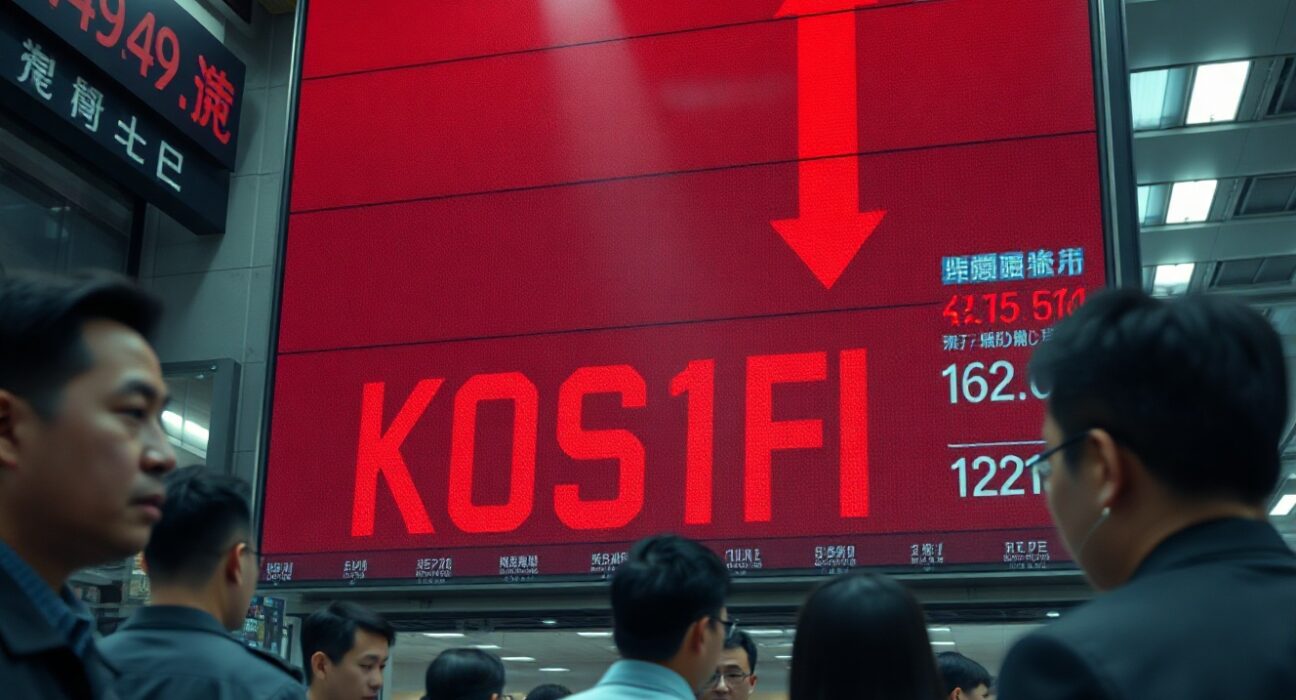
South Korea’s benchmark KOSPI index triggered a circuit breaker on [Date] after a sharp intraday decline, halting trading temporarily as selling pressure intensified across the board. The move, the first of its kind in recent months, underscores heightened volatility in Asian markets amid global economic uncertainty.
What Happened
The KOSPI fell more than 8% in a single session, breaching the threshold that activates a sidecar or circuit breaker mechanism. Under Korea Exchange (KRX) rules, a circuit breaker halts trading for 20 minutes when the index drops more than 8% from the previous day’s close. The halt is designed to give investors time to assess conditions and prevent panic-driven selloffs.
Trading resumed after the pause, but the index continued to fluctuate, closing near session lows. The decline was broad-based, with technology, semiconductor, and export-heavy stocks bearing the brunt of the selloff.
Why It Matters
Circuit breakers are rare events, reserved for moments of extreme market stress. Their activation signals that investor sentiment has turned sharply negative, often driven by external shocks or systemic concerns. For South Korea, a major export economy heavily reliant on semiconductors and consumer electronics, such moves can have ripple effects across global supply chains and investor portfolios.
The last time the KOSPI triggered a circuit breaker was during the COVID-19 market crash in March 2020. That comparison highlights the severity of the current selloff, even if the underlying causes differ.
Potential Triggers
While the exact catalyst remains under analysis, market participants pointed to several contributing factors:
- Renewed fears of a global economic slowdown, particularly in China, South Korea’s largest trading partner.
- Sharp declines in U.S. technology stocks overnight, which weighed on Korean semiconductor giants like Samsung Electronics and SK Hynix.
- Geopolitical tensions on the Korean Peninsula and uncertainty around U.S. trade policy.
- Currency volatility, with the South Korean won weakening against the U.S. dollar, adding pressure on foreign investors.
Conclusion
The triggering of the KOSPI circuit breaker is a significant market event that reflects deep investor anxiety. While temporary halts can calm markets, the underlying economic and geopolitical risks remain unresolved. Investors should monitor further developments closely, including any policy responses from the Bank of Korea or the Korean Financial Services Commission.
FAQs
Q1: What is a circuit breaker in the stock market?
A circuit breaker is a regulatory mechanism that temporarily halts trading when a major index falls by a predetermined percentage. It is designed to prevent panic selling and give investors time to process information.
Q2: How much did the KOSPI drop to trigger the circuit breaker?
The KOSPI triggered the circuit breaker after falling more than 8% in a single trading session, which is the threshold set by the Korea Exchange for a market-wide halt.
Q3: What should investors do during a circuit breaker event?
Investors should remain calm and avoid making impulsive decisions. Circuit breakers are intended to reduce panic. It is advisable to review portfolio exposure, assess risk tolerance, and consult with a financial advisor before making significant moves.
Disclaimer: The information provided is not trading advice, Bitcoinworld.co.in holds no liability for any investments made based on the information provided on this page. We strongly recommend independent research and/or consultation with a qualified professional before making any investment decisions.
