

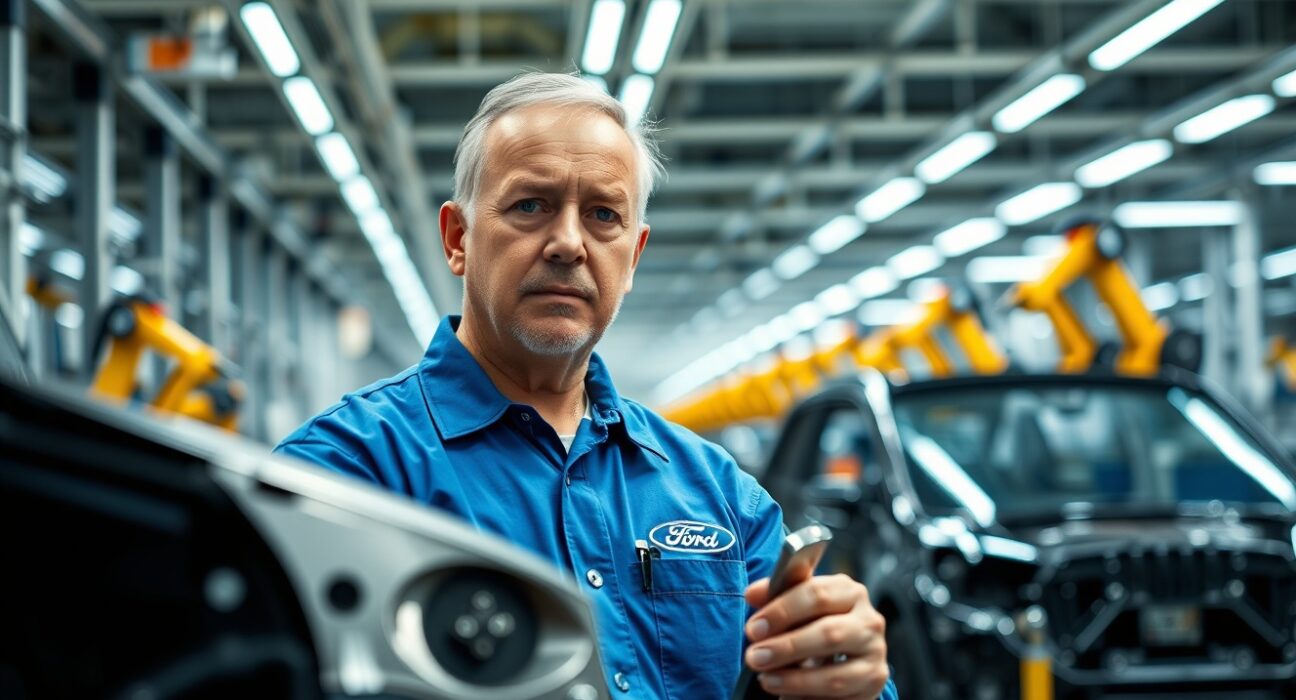
Ford Motor Company has quietly reversed course on its heavy reliance on artificial intelligence for vehicle quality control, rehiring 350 veteran engineers — many of them former employees — after automated systems failed to deliver the expected results. The decision, confirmed by Ford executives last week, marks a notable shift in the automaker’s approach to manufacturing precision and defect detection.
Why Ford turned back to human expertise
Ford’s chief operating officer, Kumar Galhotra, told reporters that the company had been “relying more and more on automated quality systems” but found the outcomes disappointing. In response, Ford brought back technical specialists — referred to internally as “gray beard” engineers — to hunt for failure points before parts ever reach the plant floor. Charles Poon, Ford’s vice president of vehicle hardware engineering, acknowledged the misstep: “Mistakenly we thought that by just introducing artificial intelligence and ingesting the design requirements that we had, that that would produce a high-quality product.”
The role of veteran engineers in an AI-driven era
These rehired engineers are not simply returning to their old roles. Instead, Ford is leveraging their decades of hands-on experience to train younger staff and, notably, to reprogram and refine the very AI tools that initially fell short. The strategy appears to be paying off: Ford anticipates the move will generate $1 billion in cost reductions this year alone. Additionally, the automaker claimed the top spot among mainstream brands in the JD Power Initial Quality Survey released this week, a significant validation of its renewed focus on human-led quality assurance.
What this means for the future of AI in manufacturing
Ford’s experience does not signal an abandonment of artificial intelligence. Rather, it highlights a growing recognition across the automotive industry that AI systems require continuous human oversight, especially in complex physical environments like assembly lines. The company’s hybrid approach — combining veteran intuition with machine learning — may become a template for other manufacturers grappling with similar challenges. The lesson is clear: automation is a tool, not a replacement for deep domain expertise.
Conclusion
Ford’s decision to rehire seasoned engineers after AI fell short underscores a critical industry reality: high-quality manufacturing still depends on human judgment. The move has already delivered measurable financial and quality improvements, positioning Ford as a leader in both traditional craftsmanship and smart automation. For readers, the story serves as a reminder that even the most advanced technology benefits from human experience.
FAQs
Q1: How many engineers did Ford rehire?
Ford rehired 350 veteran engineers, including former employees and specialists from suppliers.
Q2: Why did Ford’s AI quality systems fail?
Ford executives said the automated systems could not match the judgment and experience of human engineers in detecting subtle failure points before production.
Q3: Will Ford stop using AI in manufacturing?
No. Ford is using the rehired engineers to train younger staff and improve its AI tools, creating a hybrid human-AI quality control system.
Disclaimer: The information provided is not trading advice, Bitcoinworld.co.in holds no liability for any investments made based on the information provided on this page. We strongly recommend independent research and/or consultation with a qualified professional before making any investment decisions.
