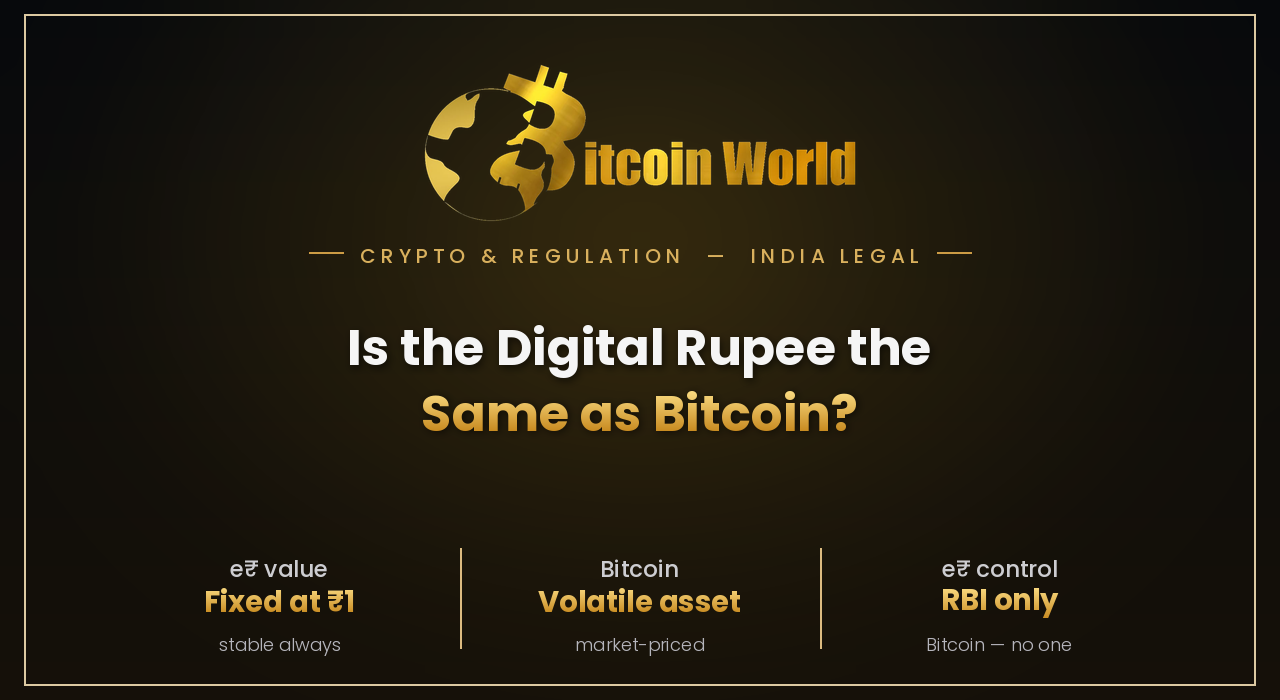
Is the Digital Rupee the Same as Bitcoin?
The Digital Rupee is not the same as Bitcoin – and calling them similar because both are “digital” is like saying a government bond and a painting are the same because both can be stored in a safe. The RBI’s Digital Rupee (e₹) is centralised, government-issued, legally mandated money with a value fixed at exactly ₹1. Bitcoin is decentralised, issued by no authority, not legal tender anywhere in India, and fluctuates in price by thousands of rupees daily. This article explains the differences in plain language – covering issuer, supply, price, privacy, legal status, and practical use – so Indian users can clearly separate government digital money from private digital assets.
Is the Digital Rupee the Same as Bitcoin?
No – the Digital Rupee and Bitcoin are fundamentally different across every dimension that defines money.
- Issuer: The e₹ is issued by the Reserve Bank of India; Bitcoin is issued by no one – it is created by miners following a protocol written in code.
- Legal tender: The e₹ is legal tender in India – it must be accepted; Bitcoin is not legal tender and cannot legally be demanded as payment.
- Price stability: The e₹ always equals ₹1; Bitcoin’s price in rupees can move ±10% or more in a single day.
- Control: The e₹ supply is set by the RBI; Bitcoin’s supply is hard-capped at 21 million coins by code that no authority can change.
- Purpose: The e₹ is designed for everyday payments; Bitcoin is primarily used as a store of value and investment asset.
How Are They Similar – and Why Does the Confusion Arise?
The surface-level similarities that create confusion are real but shallow.
- Both are digital: Neither requires physical notes or coins – both exist as data records.
- Both use some form of ledger: The e₹ uses a permissioned, private ledger controlled by the RBI; Bitcoin uses a permissionless, public blockchain maintained by thousands of independent nodes.
- Both can be transferred electronically: e₹ moves through RBI-approved channels; Bitcoin moves peer-to-peer over the internet.
- The similarity ends there: The underlying philosophy, control structure, volatility, and legal status are completely different.
- Why the confusion exists: New users hear “digital currency” and “blockchain” in the same sentence and assume they describe the same thing – media coverage that uses both terms interchangeably makes it worse.
A Plain-Language Comparison Across What Matters Most
Six dimensions where the Digital Rupee and Bitcoin diverge completely:
- Who controls it: The RBI controls the e₹ supply, issuance, and rules – it can freeze, change, or update e₹ at will. Nobody controls Bitcoin – its rules are enforced by a global network of nodes and cannot be changed by any single entity.
- What it’s worth: The e₹ is always worth exactly ₹1 – it is a digital rupee, not a separate asset. Bitcoin’s value is determined by market demand and changes every second.
- Privacy: e₹ transactions are fully visible to the RBI and government – every payment is trackable. Bitcoin transactions are pseudonymous – publicly visible on the blockchain but not automatically linked to your identity unless you’ve used a KYC exchange.
- How it’s taxed: The e₹ is treated as cash – no VDA tax. Bitcoin attracts a 30% flat tax plus 4% cess on any gain from transfer under Section 115BBH of the Income Tax Act 2025.
- How you get it: e₹ is obtained through RBI-approved banks and wallets at a 1:1 exchange with physical rupees. Bitcoin is obtained on FIU-registered exchanges or mined, at a market price that fluctuates constantly.
- What you can do with it: e₹ can be used to pay bills, buy groceries, receive salary – it is payment infrastructure. Bitcoin can be held as an investment, traded for profit, or transferred internationally – it is an asset.
Does the Government Prefer Indians to Use the e₹ Over Bitcoin?
Yes – the government’s policy architecture clearly prefers the e₹ for everyday transactions while taxing private crypto heavily to discourage speculation.
- e₹ promoted as payment rail: The RBI is routing portions of India’s ₹6.6 lakh crore welfare system through the e₹ and integrating it into BRICS cross-border payments.
- Private crypto taxed to discourage churn: The 30% tax, 1% TDS, no-loss-offset framework makes frequent crypto trading expensive – the tax structure is designed partly to reduce speculation.
- Not mutually exclusive: The government permits both – but treats them as serving completely different functions: the e₹ replaces cash; private crypto is an investment class that happens to exist.
Frequently Asked Questions
Is the Digital Rupee just India’s version of Bitcoin?
No – the Digital Rupee is not India’s version of Bitcoin. It is a Central Bank Digital Currency (CBDC) issued and controlled by the RBI, with a fixed value of ₹1, legal tender status, and full government traceability. Bitcoin is decentralised, price-volatile, issued by no authority, and not legal tender anywhere in India. They share the characteristic of being digital but differ in purpose, design, and every practical use case.
Can I invest in the Digital Rupee like I invest in Bitcoin in India?
No – the e₹ cannot be invested in for returns because it is equivalent to ₹1 and does not change in value. Holding e₹ is the same as holding cash in a wallet – it neither appreciates nor depreciates. Bitcoin and other private cryptocurrencies are investment assets whose prices fluctuate with market demand, making them suitable (with high risk) for investment; the e₹ is a payment tool, not an investment.
Is using the Digital Rupee taxed the same as using crypto in India?
No – transactions in the e₹ are treated as cash transactions and do not attract VDA tax under the Income Tax Act 2025. The 30% flat tax plus 4% cess applies only to the transfer of Virtual Digital Assets, which are private cryptocurrencies as defined under Section 2(47A). Paying for goods with e₹ or receiving salary in e₹ is identical to using physical rupees from a tax perspective.
Conclusion: Why Keeping Bitcoin and the Digital Rupee Separate in Your Mind Matters
The Digital Rupee is not the same as Bitcoin – and confusing them leads to genuine errors: thinking Bitcoin is government-backed and stable, or thinking the e₹ can be traded for profit. They represent two fundamentally different visions of what digital money can be – one centralised, stable, and state-controlled; the other decentralised, volatile, and governed by code. For Indian users, the practical separation is simple: use the e₹ for payments and everyday transactions, treat Bitcoin and other private crypto as investment assets with significant tax obligations, and never assume that the government’s digital currency ambitions signal endorsement of private crypto – they signal the opposite.
Disclaimer: The information provided is not trading advice, Bitcoinworld.co.in holds no liability for any investments made based on the information provided on this page. We strongly recommend independent research and/or consultation with a qualified professional before making any investment decisions.