

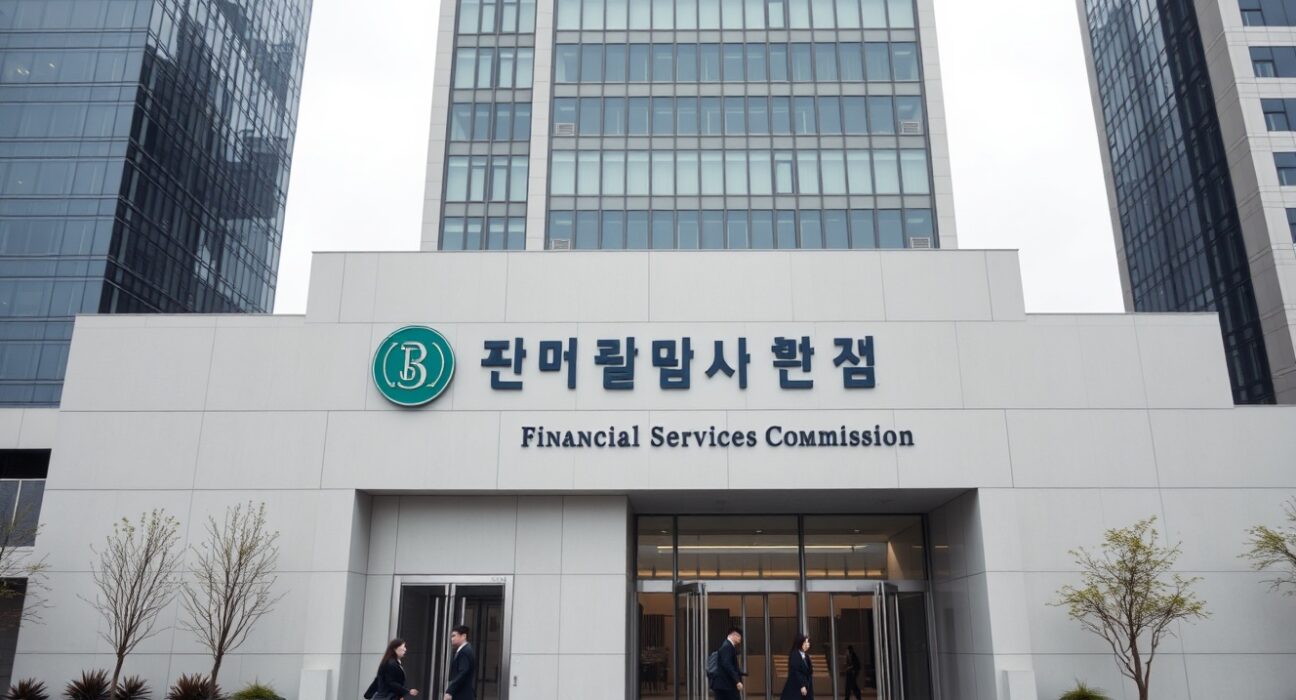
South Korea’s Financial Services Commission (FSC) has initiated a survey of KRW-based virtual asset exchanges and their partner banks, gathering feedback on the structure of real-name account issuance and the potential for accepting corporate clients, according to a report from Financial News. The move signals that authorities are preparing for broader corporate participation in the country’s virtual asset market.
Background of the One-Exchange, One-Bank Rule
Since 2021, South Korean regulators have required each cryptocurrency exchange handling won (KRW) transactions to partner with a single licensed bank for issuing real-name accounts. This one-to-one partnership rule was designed to enhance anti-money laundering (AML) oversight and protect consumers, but it has also limited competition and created barriers for smaller exchanges. Only the largest platforms—Upbit, Bithumb, Coinone, and Korbit—have secured such banking partnerships, effectively consolidating the market.
The FSC’s current survey asks exchanges and their partner banks about how relaxing this requirement could affect key metrics, including user numbers, KRW deposit volumes, and average daily trading activity. This data collection phase suggests the regulator is weighing potential changes to the existing framework, though no formal policy revisions have been announced.
Potential Models Under Discussion
According to the Financial News report, industry discussions have explored several alternative structures:
- One exchange partnering with multiple banks — Allowing exchanges to offer users a choice of banking partners, potentially increasing competition and service quality.
- One bank serving multiple exchanges — Enabling a single bank to provide real-name account services to several exchanges, which could reduce operational redundancies.
- Linking crypto services through securities firms’ Mobile Trading Systems (MTS) — A more integrated approach that could bridge traditional securities trading with digital asset services.
These models are still in the discussion phase, and the FSC has not indicated which direction it favors. The survey results will likely inform future regulatory proposals.
Why This Matters for the Crypto Industry
The potential easing of the one-exchange, one-bank rule could significantly reshape South Korea’s virtual asset landscape. For years, the requirement has been a major barrier to entry for new exchanges and a constraint on existing platforms seeking to expand their user base. Allowing corporate clients—such as institutional investors and businesses—to open real-name accounts would also mark a departure from the current retail-focused market.
South Korea is one of the most active cryptocurrency markets globally, with high retail participation. However, institutional involvement has been minimal due to regulatory restrictions. A shift in policy could unlock new capital flows and increase market depth, while also requiring stronger AML and investor protection measures.
The FSC’s survey comes amid broader global discussions about how to regulate digital assets, with jurisdictions like Hong Kong, Singapore, and the European Union moving toward clearer frameworks for institutional participation. South Korea’s approach will be closely watched as an indicator of how mature markets balance innovation with financial stability.
Conclusion
The FSC’s survey represents a preliminary but meaningful step toward potentially revising the one-exchange, one-bank rule. While no immediate policy changes are expected, the regulator’s willingness to gather industry feedback suggests that corporate entry into the virtual asset market is being actively considered. The outcome will have implications for exchange competition, banking partnerships, and the broader integration of digital assets into South Korea’s financial system.
FAQs
Q1: What is the one-exchange, one-bank rule in South Korea?
The rule requires each KRW-based cryptocurrency exchange to partner with a single licensed bank to issue real-name accounts for users. It was introduced in 2021 to strengthen anti-money laundering compliance.
Q2: Why is the FSC surveying exchanges and banks now?
The FSC is gathering data on how relaxing the rule could affect user numbers, deposit volumes, and trading activity, as part of preparations for allowing corporate clients into the virtual asset market.
Q3: Could corporate investors soon trade crypto in South Korea?
Not immediately. The survey is a preliminary fact-finding step. Any policy change would require formal regulatory proposals and public consultation before implementation.
Disclaimer: The information provided is not trading advice, Bitcoinworld.co.in holds no liability for any investments made based on the information provided on this page. We strongly recommend independent research and/or consultation with a qualified professional before making any investment decisions.
