

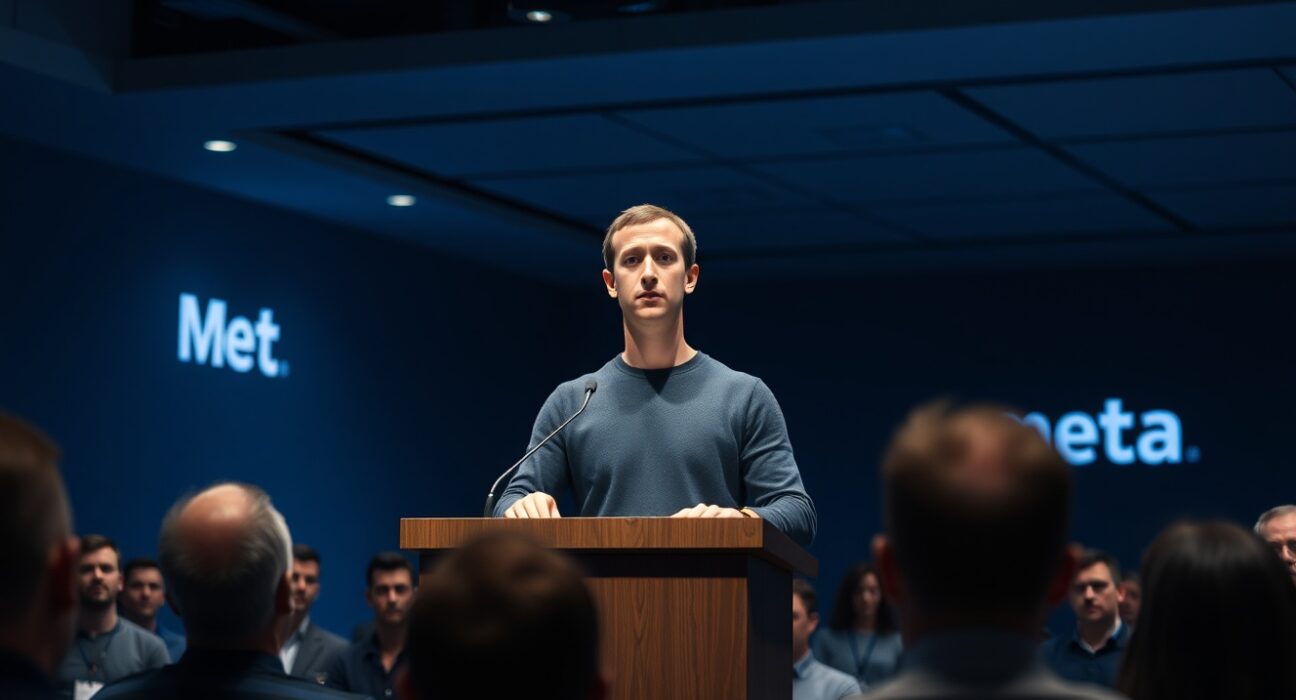
Meta CEO Mark Zuckerberg told employees during an internal town hall on Thursday that the company’s AI agent initiatives have not progressed at the pace executives initially anticipated, according to a Reuters report. The admission comes as Meta has reorganized thousands of workers into AI-focused teams and cut approximately 8,000 jobs earlier this year.
Internal reassessment of AI timelines
During the meeting, Zuckerberg acknowledged that the expected acceleration in AI agent development had not materialized as planned. He noted that the company’s recent layoffs — which affected roughly 10 percent of Meta’s corporate workforce — were not as “clean” as they should have been, and were driven by concerns that the company wasn’t moving quickly enough to adapt to industry changes.
Zuckerberg reportedly said that the anticipated benefits of Meta’s new AI-focused organizational structure have not “come to fruition yet,” though he expressed optimism that improvements would become visible within the next three to six months. The remarks offer a rare window into the gap between corporate AI ambitions and on-the-ground execution challenges.
Massive spending, mixed results
Meta has committed heavily to artificial intelligence, with projected infrastructure spending reaching as high as $145 billion this year alone. Yet the internal admission suggests that even at that scale, translating investment into operational AI agents that can reliably replace or augment human roles remains difficult.
Separate investigative reports have described Meta’s AI unit as a challenging work environment, with some engineers likening it to a “soul-crushing gulag.” The company reassigned roughly 7,000 employees to AI groups, including a unit called Agent Transformation, earlier this year.
Why this matters
Zuckerberg’s comments carry weight beyond Meta. As one of the largest corporate investors in AI, Meta’s struggles to deploy AI agents at scale serve as a reality check for the broader tech industry. The gap between executive expectations and engineering reality highlights the complexity of building AI systems that can reliably replace human judgment in complex workflows.
For investors and industry observers, the timeline adjustment suggests that near-term productivity gains from AI agents may be overstated. It also raises questions about whether other tech companies face similar hurdles despite aggressive public timelines.
Conclusion
Mark Zuckerberg’s candid acknowledgment that AI agent development has not accelerated as expected underscores the technical and organizational challenges of deploying AI at scale. While Meta remains committed to its AI investments, the internal timeline has shifted, with executives now expecting meaningful progress within the next six months rather than immediately. The situation serves as a grounded counterpoint to the hype cycle surrounding AI agents in the enterprise.
FAQs
Q1: What did Mark Zuckerberg say about AI agents at the Meta town hall?
He told staff that AI agent development had not accelerated as executives had hoped, and that the expected benefits of the AI-focused restructuring had not yet materialized.
Q2: How many employees were affected by Meta’s layoffs and reassignments?
Meta laid off approximately 8,000 employees — about 10 percent of its corporate workforce — and reassigned another 7,000 to various AI-focused groups, including an Agent Transformation unit.
Q3: How much is Meta spending on AI infrastructure?
Meta is expected to spend as much as $145 billion on AI infrastructure this year, according to Reuters.
Disclaimer: The information provided is not trading advice, Bitcoinworld.co.in holds no liability for any investments made based on the information provided on this page. We strongly recommend independent research and/or consultation with a qualified professional before making any investment decisions.
