

Before OpenAI’s GPT-3 demonstrated the power of foundation models, companies building natural language processing systems had to train specialized models from scratch for each task. Today, most organizations start with a general-purpose model and fine-tune it for their specific needs. Pim de Witte, CEO of General Intuition, believes the world of robotics is about to undergo a similar transformation.
Rather than collecting massive real-world datasets to build specialized robot models, de Witte argues that the industry should focus on creating high-quality datasets that can produce foundation models capable of transferring intuition about movement and interaction across many different environments. The company has raised $320 million at a $2.3 billion valuation to pursue this vision.
From Video Games to Physical Robots
General Intuition built its foundation model by training on millions of hours of video game data, including detailed information about which buttons on a controller a human pressed and when. Both de Witte and the company’s lead investor, Vinod Khosla, argue that this action data is the key to developing a human-like intuition for spatial-temporal reasoning.
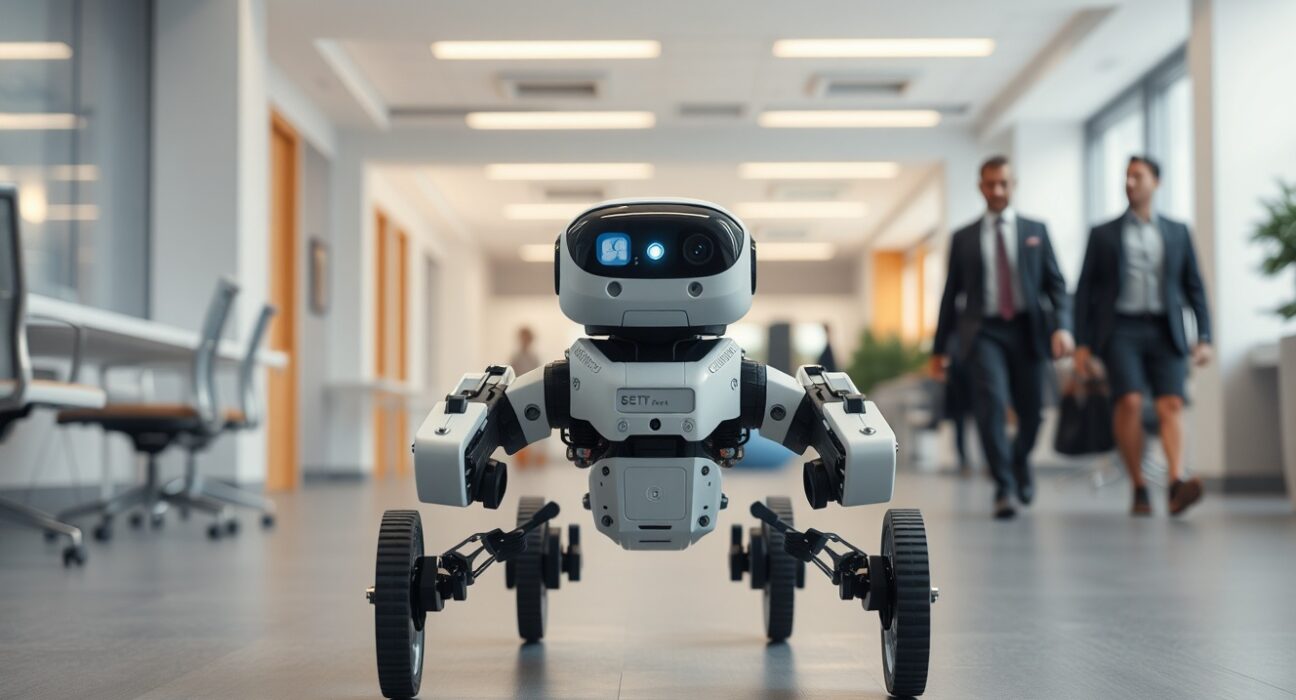
The company has demonstrated that its current model can both play a video game for hours and power a quadrupedal robot. Notably, the robot was fine-tuned on just eight minutes of real-world robotics data. “The fact that [the robot] was actually able to zero-shot on just the front camera, with no other sensors, in the office with dynamic objects being introduced and people walking by was a very big surprise to us,” de Witte said in a recent interview. “I think it’s a sign of what’s to come.”
A Shift in Robotics Development
De Witte argues that much of the current specialized work in robotics will soon become redundant. “A lot of companies right now are doing lots of specialized work focused on individual embodiments, individual environments, and individual robots,” he said. “The generalization of the model itself is the product.”
This approach could dramatically lower the barrier to entry for building new robotic systems. Instead of spending years collecting data and training models for each specific robot, companies could start with General Intuition’s foundation model and adapt it with minimal additional data. “The fact that it has a base level of reasoning about space and time is going to be the reason why people stop collecting hundreds of thousands or millions of hours of real-world data,” de Witte explained. “Because the reality is, you only need a few minutes.”
What This Means for the Robotics Industry
General Intuition’s end game is not to build robots itself, but to become the foundation model for physical AI — a base model that other robotics companies can build upon for their own machines. As de Witte put it: “We’re not gonna build a self-driving car company. We’re gonna make it 10 times easier for the next person to build a self-driving car company.”
If successful, this approach could accelerate innovation across robotics, from warehouse automation and delivery drones to assistive robots and autonomous vehicles. The company’s $320 million raise, led by prominent investors including Vinod Khosla, signals strong belief in this vision. However, the path from video game data to reliable real-world robots remains technically challenging, and the company will need to demonstrate that its approach works across a wide range of environments and tasks.
Conclusion
General Intuition’s thesis — that a foundation model trained primarily on video game data can serve as a general-purpose brain for physical robots — represents a bold bet on the future of embodied AI. With $320 million in new funding and a clear vision, the company is positioning itself at the center of what could be a major shift in how robots are built and deployed. The coming months will show whether their approach can deliver on its promise.
FAQs
Q1: What is a foundation model for robotics?
A foundation model for robotics is a general-purpose AI model that can be adapted to control different types of robots, rather than requiring a separate model to be built from scratch for each robot or task.
Q2: How does General Intuition train its model?
The company trains its model on millions of hours of video game data, including information about controller inputs, to develop a general understanding of movement, space, and interaction.
Q3: Why is this approach potentially important?
If successful, it could dramatically reduce the time, cost, and data required to develop new robotic systems, potentially accelerating innovation across industries from manufacturing to healthcare.
Disclaimer: The information provided is not trading advice, Bitcoinworld.co.in holds no liability for any investments made based on the information provided on this page. We strongly recommend independent research and/or consultation with a qualified professional before making any investment decisions.
