

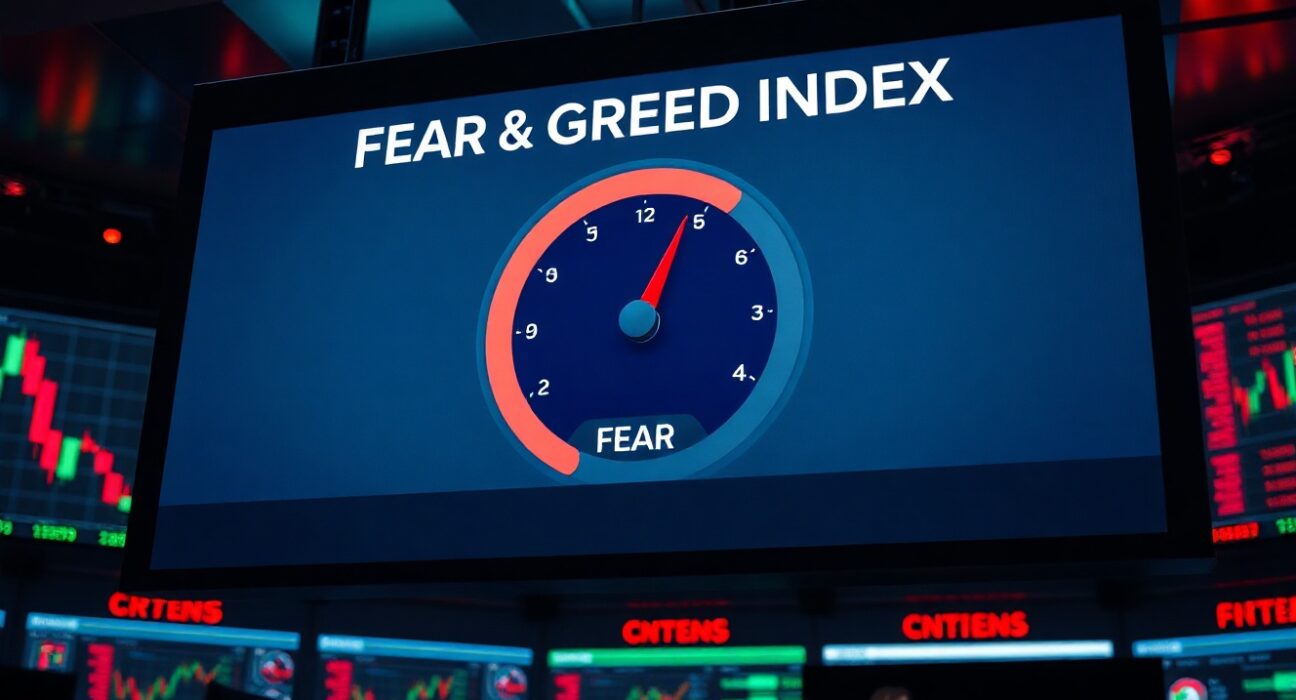
The Crypto Fear & Greed Index, a widely followed barometer of market sentiment, currently sits at 28, remaining firmly in ‘Fear’ territory. While this marks a slight uptick of two points from the previous day, the reading underscores a persistent atmosphere of caution among cryptocurrency investors.
Decoding the Index: More Than Just a Number
Developed and maintained by CoinMarketCap, the index distills complex market data into a single, accessible figure. It operates on a scale where 0 represents ‘Extreme Fear’ and 100 signifies ‘Extreme Greed.’ A reading of 28 places the market squarely in the ‘Fear’ zone, a sentiment that has lingered for several days.
The calculation is not arbitrary. It aggregates several key market metrics to paint a holistic picture of investor psychology. These factors include:
- Price Momentum: The deviation of current prices from their 30-day and 90-day moving averages for the top 10 cryptocurrencies by market capitalization.
- Market Volatility: Measured by the maximum drawdown of prices over the last 30 and 90 days. Higher volatility typically fuels fear.
- Derivatives Data: The ratio of put options to call options (put/call ratio) on major exchanges. A higher ratio indicates more bearish bets.
- Stablecoin Supply Ratio (SSR): This metric compares the market cap of stablecoins to the market cap of Bitcoin. A high SSR suggests limited buying power, often a sign of fear or a wait-and-see approach.
- Search Volume: Internal search data from CoinMarketCap for terms like ‘buy’ versus ‘sell’ provides a real-time pulse on retail sentiment.
Why the ‘Fear’ Reading Matters
For seasoned market observers, a ‘Fear’ reading is not necessarily a signal to panic. In fact, it can be interpreted through two contrasting lenses. On one hand, it confirms a bearish mood, where investors are risk-averse and capital is flowing toward safer assets or stablecoins. On the other hand, historically, periods of extreme fear have sometimes preceded market bottoms, as they can indicate that selling pressure has been largely exhausted.
The current sentiment aligns with a broader macroeconomic environment of uncertainty, including persistent inflation concerns and shifting regulatory landscapes. The lack of a strong, sustained catalyst—such as a major institutional adoption announcement or a clear regulatory framework—has left the market searching for direction.
What This Means for Different Types of Investors
Short-term traders often view these sentiment extremes as potential contrarian indicators. A ‘Fear’ reading might be seen as a potential buying opportunity, anticipating a mean reversion. However, this strategy carries significant risk, as fear can deepen before a recovery begins.
Long-term holders typically use the index as a supplementary tool to gauge market temperature rather than a primary signal. A sustained period of fear may present accumulation opportunities for those with a multi-year horizon, but it does not negate the need for fundamental analysis of individual projects.
Conclusion
The Crypto Fear & Greed Index at 28 is a snapshot of a market in a holding pattern, driven by caution rather than panic. While the two-point increase from yesterday offers a sliver of improvement, the overall sentiment remains decidedly negative. Investors would be wise to monitor not just the index number, but the underlying factors—volatility, derivatives positioning, and stablecoin flows—that drive it. As always, sentiment is a tool, not a crystal ball, and should be used in conjunction with thorough research and risk management.
FAQs
Q1: What is the Crypto Fear & Greed Index?
A1: It is a market sentiment indicator created by CoinMarketCap that measures investor emotions and attitudes toward the cryptocurrency market. It ranges from 0 (Extreme Fear) to 100 (Extreme Greed).
Q2: Is a ‘Fear’ reading a good time to buy Bitcoin?
A2: Not necessarily. While historically, extreme fear has sometimes coincided with market bottoms, it is not a reliable buy signal. It indicates prevailing caution and can precede further declines. It should be considered alongside other fundamental and technical analysis.
Q3: How often is the index updated?
A3: The index is updated daily, providing a fresh reading of market sentiment each day based on the most recent data from the previous 24-hour period.
Frequently Asked Questions
What is the Crypto Fear & Greed Index currently reading?
The index is at 28, which places it firmly in the ‘Fear’ territory.
How is the Crypto Fear & Greed Index calculated?
It aggregates price momentum, market volatility, derivatives data like the put/call ratio, stablecoin supply ratio, and search volume for terms like ‘buy’ vs ‘sell’.
Does a ‘Fear’ reading mean I should sell my crypto?
Not necessarily; historically, periods of extreme fear have sometimes preceded market recoveries, though it does confirm a bearish mood and risk-averse investor behavior.
What does the Stablecoin Supply Ratio (SSR) indicate in this context?
A high SSR suggests limited buying power in the market, often signaling that investors are cautious and waiting on the sidelines.
Why has the index stayed in ‘Fear’ for several days?
Persistent caution is driven by factors like high volatility, bearish derivatives bets, and low buying power indicated by the stablecoin supply ratio.
Disclaimer: The information provided is not trading advice, Bitcoinworld.co.in holds no liability for any investments made based on the information provided on this page. We strongly recommend independent research and/or consultation with a qualified professional before making any investment decisions.
