

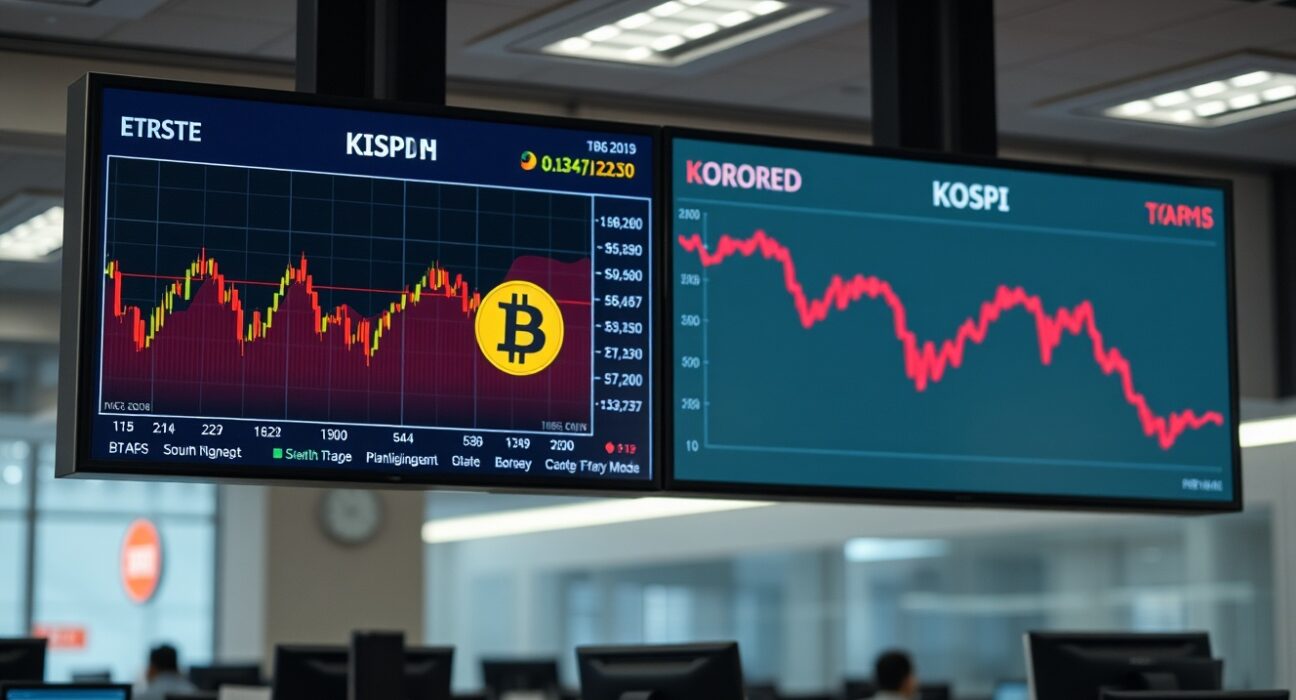
Bitcoin demonstrated notable resilience on [current date], limiting its losses to approximately 3% even as South Korea’s benchmark KOSPI index suffered a dramatic single-day decline of more than 10%. The divergence highlights a shifting dynamic between traditional equity markets and the cryptocurrency sector, with analysts pointing to differing underlying causes and asset-specific factors.
Market Performance Divergence
According to data from CoinGecko, Bitcoin was trading at $63,544 as of 7:00 a.m. UTC, reflecting a 2.9% decrease over the preceding 24 hours. In contrast, the Korea Composite Stock Price Index (KOSPI) closed at 6,023.66, representing a steep 10.84% plunge from the previous trading session. The index has now fallen approximately 25% from its mid-June peak, signaling significant stress in South Korean equities.
The relatively contained decline in Bitcoin stands out against the broader market turmoil, suggesting that the cryptocurrency is not simply mirroring equity market movements in this instance. This observation challenges the narrative that Bitcoin always behaves as a high-beta risk asset correlated with stock indices.
Analyst Insights on Correlation
Analysts at Bitfinex noted that the correlation between Bitcoin and traditional equity markets like the KOSPI is not fixed and can vary considerably depending on the nature of the shock driving market movements. They emphasized that asset-specific supply and demand dynamics also play a crucial role in determining Bitcoin’s price action during periods of broader financial stress.
This nuanced view suggests that while correlations can emerge during certain types of systemic events, they are not a reliable constant. The current episode may reflect a market where Bitcoin is increasingly being evaluated on its own fundamentals rather than simply as a proxy for risk appetite.
Implications for Investors
For investors, the relative stability of Bitcoin during a severe equity sell-off may reinforce the argument for diversification. However, analysts caution against drawing broad conclusions from a single day’s trading. The long-term relationship between crypto and traditional markets remains complex and subject to change based on regulatory developments, macroeconomic conditions, and shifts in investor sentiment.
The KOSPI’s sharp decline appears to be driven by domestic factors, including economic concerns and geopolitical tensions specific to the region, which may have limited direct impact on global cryptocurrency markets. This separation of causal factors helps explain the divergence in performance.
Conclusion
Bitcoin’s ability to limit losses to around 3% while the KOSPI crashed over 10% underscores the evolving and context-dependent nature of the relationship between digital assets and traditional equities. While not a definitive break from correlation, the event provides a real-world example of how different asset classes can respond to distinct shocks. Market participants should continue to monitor these dynamics as both sectors navigate an uncertain economic landscape.
FAQs
Q1: Why did Bitcoin fall less than the KOSPI?
The decline in Bitcoin was smaller because the KOSPI sell-off was driven by factors specific to South Korea, such as domestic economic concerns and geopolitical tensions, which have less direct impact on global cryptocurrency markets. Additionally, asset-specific supply and demand dynamics in the crypto market helped cushion Bitcoin’s fall.
Q2: Is Bitcoin becoming uncorrelated from stock markets?
Not necessarily. The correlation between Bitcoin and equities varies depending on the cause of market shocks. In this case, the divergence suggests that Bitcoin is not simply mirroring equity movements, but correlations can re-emerge under different conditions.
Q3: What does this mean for cryptocurrency investors?
This event highlights Bitcoin’s potential as a diversifier during certain types of market stress. However, investors should be cautious about assuming a permanent decoupling, as the relationship between crypto and traditional markets remains dynamic and subject to change.
Disclaimer: The information provided is not trading advice, Bitcoinworld.co.in holds no liability for any investments made based on the information provided on this page. We strongly recommend independent research and/or consultation with a qualified professional before making any investment decisions.
