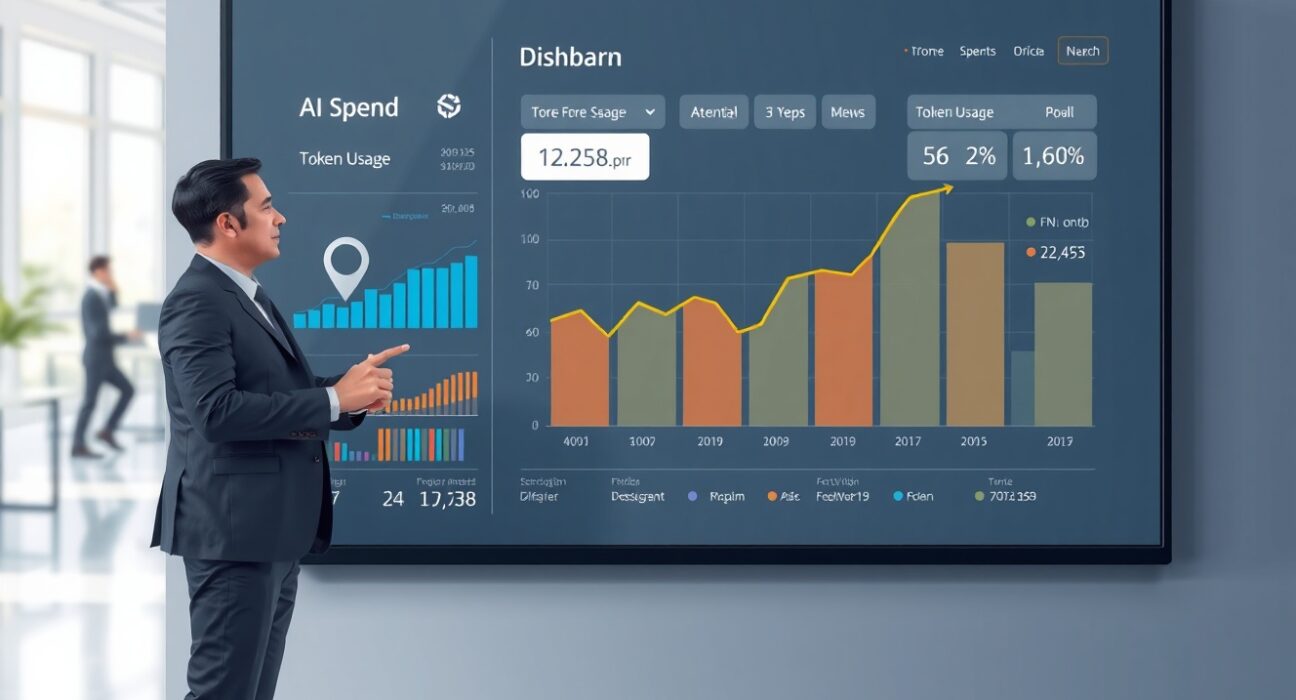
Rippling this week unveiled AI Spend Console, a new product designed to help companies track and control their AI-related spending, after the HR software provider discovered it was burning millions of dollars on AI tokens—spending at one point equivalent to 40% of its R&D headcount budget.
How tokenmaxxing spiraled out of control
At the start of 2026, Rippling, like many enterprises, embraced AI enthusiastically, encouraging employees to use tools like Cursor, OpenAI, and Anthropic. But by March, the company’s CFO, Adam Swiecicki, presented a startling figure to the executive team: Rippling was on track to spend 40% of its R&D headcount budget on AI tokens. In dollar terms, that meant millions of dollars—comparable to the compensation of 40% of the engineering staff. Spending was growing 80% month-over-month, and if unchecked, would nearly equal the entire R&D payroll within a year.
“We were incredulous,” Chief Product Officer Matt MacInnis told Bitcoin World. The company launched an urgent project to understand the spending and what it was getting in return.
The birth of AI Spend Console
Rippling’s analysis revealed a concentrated pattern: roughly 10–15% of employees accounted for about 60% of total AI spend, with one engineer alone spending $50,000 per month. The company didn’t want to ban AI, but it needed to rein in costs. It began by negotiating spending caps with each AI provider, but quickly found a fundamental problem: employees defaulted to the most expensive frontier models for all tasks, and the providers had no incentive to help control costs.
“The inference providers, like Anthropic and OpenAI, have absolutely no incentives to help you control your spend,” MacInnis said. “They have every incentive for it to be a runaway expense.”
To address this, Rippling built its own AI gateway that routes prompts to the most cost-effective model for each task. The AI Spend Console includes dashboards that score attributes like prompts per day, work output (lines of code, pull requests), and spend. It also maps individual, team, and role-level spending, and even flags employees whose AI usage may be producing low-quality work—for example, engineers with high AI spend whose peers frequently ask them to redo work in code reviews.
Results: Cutting costs without cutting AI usage
With the gateway and monitoring in place, Rippling reduced its token spend from 40% of its R&D headcount budget to about 15%. In July, internal usage hit 600 billion tokens—similar to the peak in April—but the cost was only 37% of April’s spend. “That’s just because now we’re routing to the more effective models,” MacInnis said, adding that they’re not letting the sales team use premium models for grammar updates.
The company also identified employees who used AI effectively and designated them as “AI captains” to assist others. However, extending AI beyond engineering is still a work in progress, with efforts focused on customer onboarding teams to automate mailing data and data-reconciliation tasks.
Why this matters for the enterprise
Rippling’s experience reflects a broader trend in 2026: enterprises are realizing they need multiple AI models from multiple labs at various price points, including cost-effective open-weight options like GLM 5.2, which Rippling found to be 85% cheaper than frontier models with nearly identical performance for its internal benchmarks. The company also notes that AI gateways are becoming essential infrastructure for cost control.
The AI Spend Console is included for Rippling’s HR customers, with additional usage-based costs, and can also be purchased as a stand-alone product integrated with other HR systems. MacInnis emphasized that the tool’s success hinges on linking token consumption to productivity across all functions. “If we can’t do that, all bets are off on any of this stuff being available to the broader employee base,” he said.
Conclusion
Rippling’s AI Spend Console offers a practical model for enterprises struggling to balance AI adoption with cost discipline. By combining spending caps, intelligent routing, and productivity tracking, companies can potentially cut AI costs dramatically without sacrificing usage. As AI becomes more integral to business operations, tools that provide visibility and control over AI spend will likely become as essential as HR or finance dashboards.
FAQs
Q1: What is Rippling’s AI Spend Console?
It’s a new product that helps companies track and manage their AI spending. It provides dashboards showing how much employees, teams, and roles spend on AI tools, and whether that spending correlates with productivity gains. It also includes an AI gateway that routes prompts to the most cost-effective models.
Q2: How much did Rippling reduce its AI costs?
Rippling cut its token spend from 40% of its R&D headcount budget to about 15% after implementing the console and gateway. In July, it used the same volume of tokens as its peak month but at 37% of the cost.
Q3: Can other companies use AI Spend Console?
Yes, the product can be purchased as a stand-alone tool and integrated with other HR systems. However, to use the spending governance features, companies would need to use Rippling’s AI gateway.
Disclaimer: The information provided is not trading advice, Bitcoinworld.co.in holds no liability for any investments made based on the information provided on this page. We strongly recommend independent research and/or consultation with a qualified professional before making any investment decisions.