

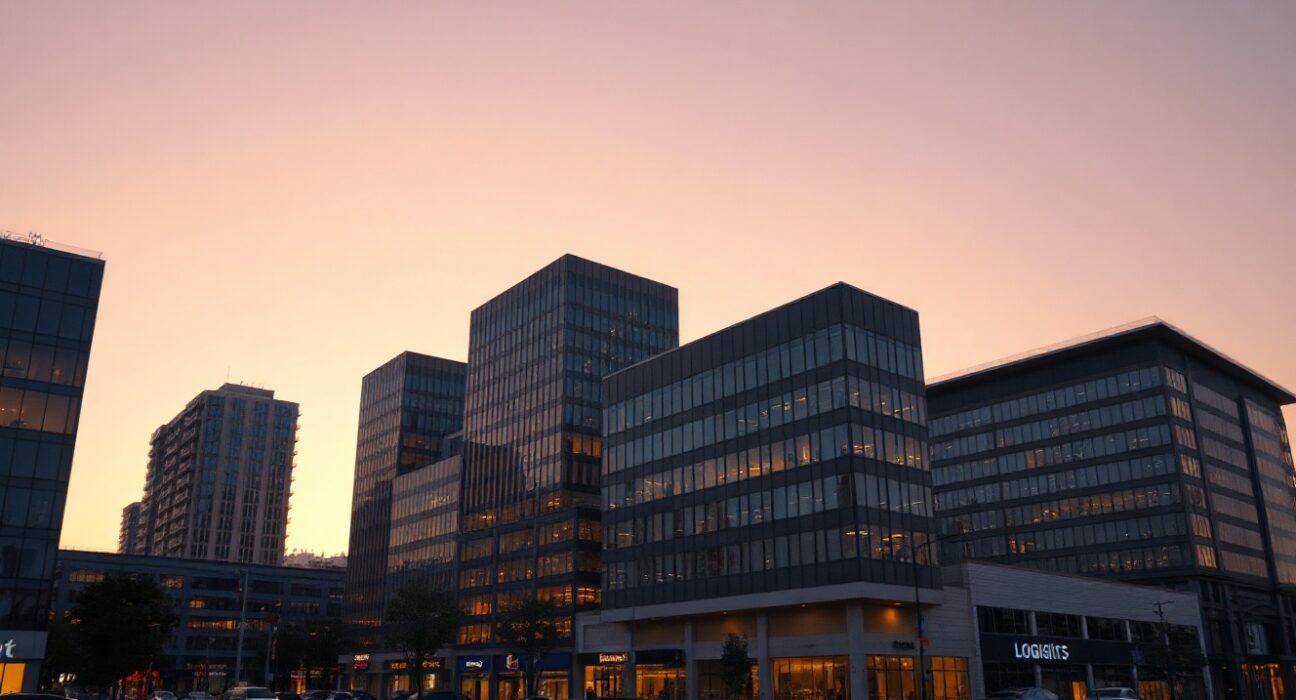
Commercial real estate is showing mixed signals at the midpoint of 2026, with office and retail sectors adjusting to new demand patterns while industrial and logistics properties continue to attract investor interest. The mid-year outlook reflects a market in transition, shaped by interest rates, hybrid work models, and evolving consumer behavior.
Office Sector: Adapting to Hybrid Work
The office sector remains under pressure as hybrid work persists, but the narrative is more nuanced than simple decline. As of mid-2026, premium office spaces in central business districts are seeing stable occupancy, while older, less efficient buildings face higher vacancies. Landlords are increasingly repurposing obsolete office space for residential or mixed-use developments, a trend that is gaining momentum in major metros.
Suburban office parks are also adapting, with some converting to medical or educational uses. The flight-to-quality trend continues, meaning that well-located, amenity-rich properties are outperforming the broader market. Investors are focusing on assets with strong environmental credentials, as tenant demand for sustainable buildings grows.
Retail Real Estate: Resilience Through Experience
Retail real estate is proving more resilient than expected, driven by the rise of experiential retail and the stabilization of brick-and-mortar stores. As of mid-2026, foot traffic in open-air shopping centers is recovering, while enclosed malls continue to struggle unless they offer entertainment or dining options. The retail sector is increasingly bifurcated: high-street locations and necessity-based retailers are thriving, while weaker anchors are closing.
Investors are looking at grocery-anchored centers and mixed-use developments as safer bets. E-commerce’s impact is leveling off, with many online retailers opening physical showrooms to build brand loyalty. This trend is creating opportunities for adaptive reuse of former department store spaces.
Industrial and Logistics: Continued Strength
Industrial and logistics real estate remains the standout performer, supported by e-commerce and supply chain diversification. As of mid-2026, vacancy rates in modern distribution facilities are low, and rental growth is steady, though slower than in previous years. The demand for last-mile delivery hubs near urban centers is particularly strong, while larger warehouses in secondary markets are seeing increased interest as companies seek cost efficiencies.
The sector faces challenges, including rising construction costs and limited land availability in prime locations. However, technological advancements in automation are improving operational efficiency, making these assets more attractive to investors.
Implications for Investors and Developers
For investors, the mid-year outlook suggests a selective approach. Assets with strong fundamentals—good location, modern amenities, and sustainable features—are likely to outperform. Developers should focus on adaptive reuse and mixed-use projects that align with shifting demand patterns. The market is not uniform, and success requires granular analysis rather than broad strokes.
Conclusion
The commercial real estate market at mid-2026 is characterized by divergence across sectors. While office and retail face structural adjustments, industrial and logistics remain robust. The key takeaway is that agility and strategic positioning are essential for navigating the second half of the year. Market participants should monitor interest rate trends and employment data, as these will influence property values and leasing activity.
FAQs
Q1: What is driving the divergence in commercial real estate sectors in 2026?
The divergence is primarily driven by structural changes in work patterns (hybrid work), consumer behavior (experiential retail, e-commerce), and technological advancements (automation in logistics). These factors affect demand for office, retail, and industrial properties differently.
Q2: How are office properties adapting to lower occupancy?
Office properties are adapting through repurposing—converting obsolete spaces to residential or mixed-use developments—and by focusing on premium amenities and sustainability to attract tenants in a flight-to-quality trend.
Q3: What should investors consider before investing in commercial real estate in the second half of 2026?
Investors should evaluate asset-specific fundamentals, including location, property condition, and tenant quality, as well as broader economic indicators like interest rates and employment. A selective approach favoring properties with strong ESG credentials and adaptive reuse potential is recommended.
Disclaimer: The information provided is not trading advice, Bitcoinworld.co.in holds no liability for any investments made based on the information provided on this page. We strongly recommend independent research and/or consultation with a qualified professional before making any investment decisions.
