

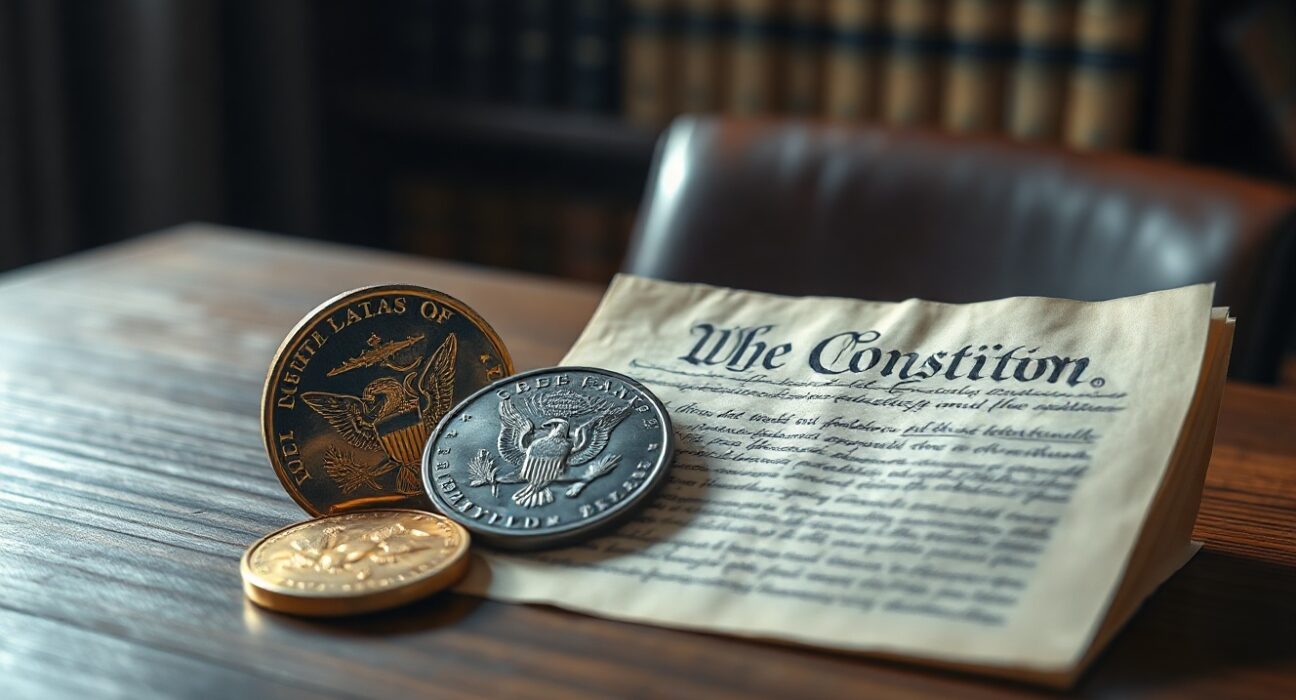
The U.S. Constitution’s Article I, Section 10, which explicitly forbids states from making “any Thing but gold and silver Coin a Tender in Payment of Debts,” is frequently cited by proponents of sound money to argue that only gold and silver are legitimate means of payment. This clause, ratified in 1788, was designed to prevent states from issuing their own paper currency, which had caused rampant inflation and economic instability under the Articles of Confederation. However, its application to the federal government and modern fiat currency remains a subject of intense legal and economic debate, as the Supreme Court has historically upheld the federal government’s broad authority over monetary policy.
What the Constitution Actually Says About Money
The Constitution grants Congress the power to “coin Money” and “regulate the Value thereof,” while simultaneously prohibiting states from coining money, emitting bills of credit, or making anything but gold and silver coin legal tender. This dual structure reflects the Founding Fathers’ intent to create a unified national currency backed by precious metals, shielding the young nation from the inflationary chaos of unbacked paper money. However, the text is notably silent on whether the federal government itself must use gold and silver as legal tender, a gap that has fueled over two centuries of constitutional interpretation.
Modern legal scholars point out that the clause’s wording restricts states, not the federal government. The Supreme Court’s rulings in the Legal Tender Cases (1870-1884) firmly established that Congress has the power to issue paper money and make it legal tender for all debts, public and private. These decisions, which arose during the Civil War era, have never been overturned and remain the bedrock of U.S. monetary law. As of 2025, the Federal Reserve System issues fiat currency that is legal tender, and no court has seriously challenged this authority in over a century.
The Modern ‘Sound Money’ Movement and Its Limits
In recent years, the constitutional argument for gold and silver has been revived by state-level initiatives seeking to recognize precious metals as legal tender. Several states, including Utah, Wyoming, and Texas, have passed laws to exempt gold and silver bullion and coins from state capital gains taxes, arguing that these metals are money, not investments. These efforts aim to encourage the use of gold and silver as alternative currencies, though they do not compel businesses to accept them as payment. Proponents, such as the American Principles Project and the Sound Money Defense League, argue that returning to a gold or silver standard would curb inflation and restore fiscal discipline.
However, the practical and legal obstacles remain formidable. The Supreme Court’s precedents grant Congress near-plenary power over the monetary system, and the U.S. Treasury and Federal Reserve show no indication of altering the current fiat system. Moreover, economic historians point out that the gold standard era was not without its own financial crises, including severe deflation and bank panics. As of 2025, the debate remains largely symbolic, reflecting a broader ideological divide over the proper role of government in the economy.
Why This Matters for Your Wallet
For everyday consumers, the constitutional argument has little direct impact on daily transactions, as federal law clearly designates U.S. dollars as legal tender. However, the debate influences policy discussions around inflation, Federal Reserve independence, and the potential for alternative currencies. Understanding the historical and legal context can help you evaluate political claims about “sound money” and the security of your savings. While gold and silver may offer a hedge against inflation, their legal status as constitutionally mandated payment is not supported by current jurisprudence.
Conclusion
While the Constitution’s gold and silver clause is a powerful symbol for those advocating for hard money, its legal reach is limited to state governments. The federal government’s authority to issue fiat currency has been upheld for over 150 years, and a return to a gold or silver standard would require a constitutional amendment or a dramatic reversal by the Supreme Court. For now, the argument remains a compelling piece of constitutional history and a rallying cry for monetary reform, but not a legal requirement for the U.S. monetary system.
FAQs
Q1: Does the Constitution require the U.S. government to use gold and silver as money?
No. Article I, Section 10 prohibits states from making anything but gold and silver coin legal tender, but it does not restrict the federal government. The Supreme Court has consistently upheld Congress’s power to issue paper money as legal tender.
Q2: Can I use gold or silver coins to pay my debts in the U.S.?
While gold and silver coins are legal tender at their face value, they are not commonly accepted for everyday transactions. Businesses are not required to accept them, and their market value typically far exceeds their face value, making them impractical for small purchases.
Q3: Are there any states that recognize gold and silver as legal tender?
Some states have passed laws to exempt precious metals from certain taxes and affirm their status as money, but no state has successfully made gold and silver a mandatory medium of exchange. These laws are largely symbolic and do not override federal law.
Disclaimer: The information provided is not trading advice, Bitcoinworld.co.in holds no liability for any investments made based on the information provided on this page. We strongly recommend independent research and/or consultation with a qualified professional before making any investment decisions.
