A Solana bot is only as good as its data. Prices arrive late and the fill goes wrong. Balances lag and the position size is wrong.
Most teams learn this after the first bad week. The strategy was fine. One layer of the stack was not.
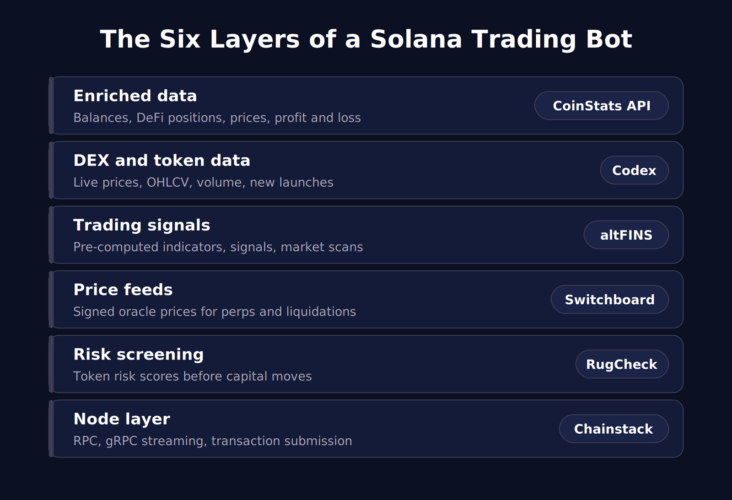
This guide covers six Solana APIs. Each one does a different job in a trading stack. None of them replaces another.
What a Solana API Does for a Trading Bot
A trading bot needs six jobs done. Each job maps to a different kind of provider.
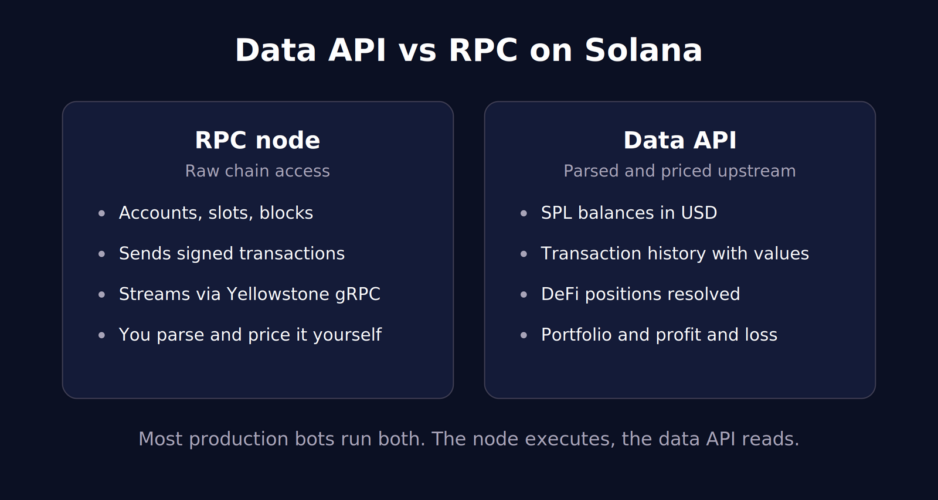
Read chain state. Your bot needs account data, slots, and blocks. It also needs a path to submit signed transactions. That is node access.
Find and price tokens. New pools open constantly on Solana. Your bot needs live token prices, volume, and pool activity.
Confirm the price. An oracle feed gives you a signed reference price. Perps engines and liquidation logic depend on it.
Time the entry. Raw candles are not a strategy. Indicators and signals decide which setups are worth trading.
Screen the token. Most new SPL tokens are not worth touching. A risk API tells you before capital moves.
Know what you hold. Positions sit across tokens, staking, and LP shares. Your bot needs that resolved into USD values.
No single provider covers all six well. Production stacks combine two or three.
Solana API Comparison
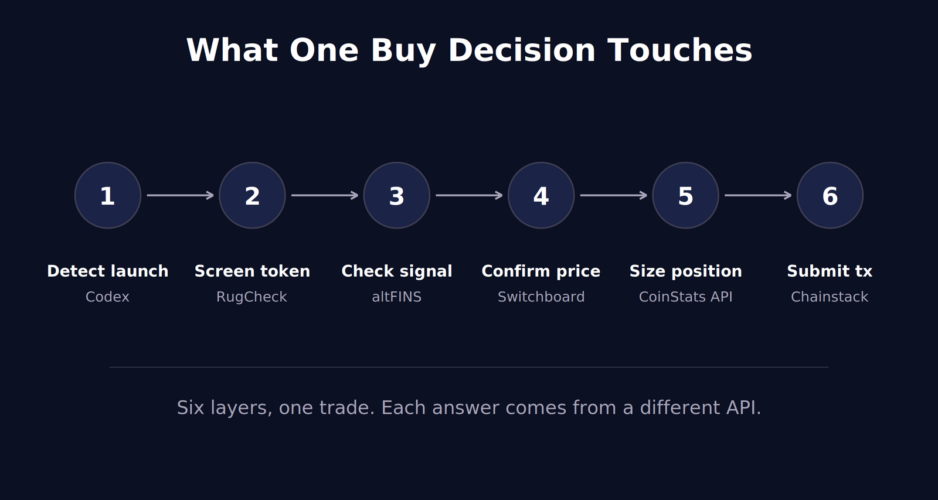
The six providers below sit in different layers. This is what one buy decision touches.
How to Pick the Right One
Start with the job, not the brand.
Data shape. Do you want raw node output or enriched JSON? Raw means you parse and price it yourself.
Freshness. Bots need sub-second updates on the paths that matter. Portfolio views tolerate a few seconds.
Latency and location. Solana leader schedules are deterministic. Regional endpoints matter more here than on other chains.
Pricing model. Some bill per request unit. Others use credits weighted by endpoint complexity. Flat tiers also exist.
AI compatibility. MCP (Model Context Protocol) support is now common. Agents query these APIs directly through it.
1. CoinStats API
CoinStats Solana API returns enriched Solana data behind one key. Pass any Solana address to one endpoint. It returns SPL balances, native SOL, transaction history, and DeFi positions. Every value arrives priced in USD.
The same schema spans 120+ blockchains. Code that reads a Solana wallet also reads an Ethereum or Bitcoin wallet. DeFi resolution is the part most providers skip. Staking, lending, and LP positions are auto-detected across 10,000+ protocols.
Market data sits behind the same key. Prices for 100,000+ coins come from 200+ exchanges, with OHLCV history for backtesting. CoinStats products serve over 1M people every month. CoinStats also publishes a best Solana API guide covering the wider category.
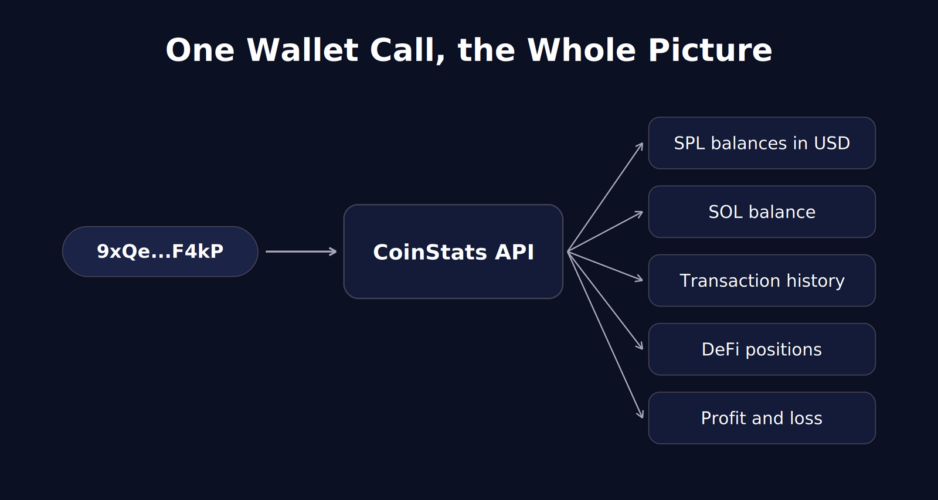
Key features
- Solana wallet data. SPL balances, SOL, and transaction history for any address. Each transfer carries its USD value at the time.
- DeFi positions. Staking, lending, and LP shares auto-detected per wallet across 10,000+ protocols.
- Portfolio analytics. Realized and unrealized profit and loss, allocation, and performance per address.
- Market data. Live prices and OHLCV charts for 100,000+ coins, aggregated from 200+ exchanges.
- CoinStats MCP Server. 20+ wallet, DeFi, and portfolio tools over one URL. Works with Claude, Cursor, Claude Code, and VS Code.
- One schema, 120+ chains. Solana, EVM networks, and Bitcoin behind a single key.
Pricing
Credit-based, with a free tier of 20,000 credits a month and commercial use included. Endpoints cost credits by complexity rather than a flat call cap. Paid plans start at $49 a month.
Where it fits
Solana position tracking, profit and loss engines, and copy-trading size checks. Memecoin bots that need SPL balances and cost basis after each fill. Staking and LP monitors across Marinade, Kamino, Orca, and Raydium. Also Solana tax tools, wallet dashboards, and AI agents querying over MCP.
Limitations
Read only. No RPC node access and no transaction submission. Pair it with a node provider for execution. Not built for microsecond-level high-frequency trading.
2. Chainstack
Chainstack runs the node layer. Solana access comes in tiers. Global Nodes give geo-balanced shared RPC. Unlimited Nodes give flat-fee capacity. Dedicated Nodes give full configuration control.
Trader Nodes are the product built for this use case. They are regionally deployed and tuned for low-latency trading workloads. Jito ShredStream is enabled by default on Solana nodes. Block data arrives faster than RPC polling allows. Warp Transactions optimize the send path toward the current leader.
Pricing is unusually simple for this category. Every standard Solana JSON-RPC call costs one request unit. Archive calls cost two. There are no method multipliers, which matters during volume spikes.
Key features
- Solana node tiers. Global, Unlimited, and Dedicated Nodes, plus Trader Nodes for latency-sensitive workloads.
- Yellowstone gRPC. Geyser streaming for accounts, transactions, and slots, from $49 a month for one stream.
- Jito ShredStream by default. Enabled on Solana nodes with no extra setup.
- Flat request units. One RU per standard call, two for archive, across all methods.
- Compliance posture. SOC 2 Type II and ISO 27001, with 99.99%+ observed uptime.
- Chainstack MCP server. Query live chain data and manage nodes from MCP-compatible agents.
Pricing
Free tier covers 3M requests a month. Growth starts at $49 a month. Unlimited Nodes start at $149 a month for 25 requests per second.
Where it fits
Any bot that reads raw chain state and submits transactions. Also indexers and analytics platforms that want gRPC streaming without enterprise pricing.
Limitations
Node output is raw. Balances, token metadata, and USD pricing are your job to build on top. Coverage spans 70+ protocols, so Solana-only specialists exist if you want single-chain focus.
3. Codex
Codex covers enriched token data without the RPC parsing. Real-time USD prices, OHLCV charts, and holder analytics arrive ready to use. Aggregated volume and launchpad tracking come with them.
Speed is the selling point. Data lands with one-second freshness, and WebSocket subscriptions push live feeds to your bot. Webhooks handle event-driven paths. The developer surface is GraphQL. A TypeScript SDK and an MCP server ship alongside it.
Coverage runs to 90M+ tokens and 700M+ wallets across 80+ networks. A Solana-first bot can expand later without switching providers. Codex powers token data for TradingView, Coinbase, and Uniswap.
Key features
- Real-time token data. USD prices, OHLCV candles, aggregated volume, and holder analytics.
- New-launch tracking. Launchpad activity including Pump.fun, useful for early detection strategies.
- One-second freshness. WebSocket subscriptions and webhooks at 99.9% uptime.
- GraphQL API. TypeScript SDK @codex-data/sdk for typed queries.
- MCP server. Agentic access, plus agentic payments through MPP.
- 80+ networks. EVM chains and Solana under one schema.
Pricing
Free tier includes 10,000 requests a month with full query access. Growth plans start at $350 a month, covering 1M requests, WebSockets, and webhooks.
Where it fits
Memecoin bots, DEX trading dashboards, and early-launch detection. Any strategy driven by live price and volume fits.
Limitations
Onchain data only. It does not decode DeFi positions like LP tokens or staking. Centralized exchange balances are out of scope too. It is data, not execution.
4. altFINS
altFINS Crypto API ships the analytics layer most bots build by hand. Instead of raw candles, it returns pre-computed indicators and trading signals. Your bot moves from data to decision without an indicator engine.
Coverage spans 2,000+ coins plus 200+ tokenized stocks, ETFs, and Gold. That includes SOL and exchange-listed Solana ecosystem tokens. Data aggregates from 30+ exchanges across five timeframes, 15 minutes to daily.
The free tier is unusually complete. Every indicator, signal, and market scan is included from day one. The cap is usage, not features. One credit returns 100 data points.
Key features
- 150+ indicators. MACD, RSI, SMA, EMA, Bollinger Bands, Stochastic, ADX, and Williams %R, pre-calculated per timeframe.
- 130+ trading signals. Ready-made bullish and bearish events, plus golden and death cross analytics.
- 35+ candlestick patterns. Auto-detected, with crossover and trend analytics alongside.
- 160 preset market scans. Coins in uptrend, breakouts, and momentum screens, callable by API.
- Native MCP server. Read-only LLM access to indicators and signals, no integration code.
- CLI included. A terminal-native af tool for command-line and TUI access.
Pricing
Free tier includes 1,000 credits a month at 30 requests per minute. No credit card needed. Standard runs $299 a month, Professional $699. Paid plans scale to 600 requests per minute and seven years of history.
Where it fits
Signal-driven bots trading SOL and ecosystem tokens on exchanges. AI agents reading indicators over MCP. Also screener and dashboard builds that want analytics without an engine.
Limitations
Exchange market data, not onchain state. No wallet balances, DeFi positions, or chain reads. Brand-new SPL launches appear only once exchanges list them.
5. Switchboard
Switchboard is the oracle layer, live on Solana since 2021. Feeds are permissionless. You define the data sources, aggregation logic, and update cadence. Deployment needs no approval from anyone.
Oracle Quotes are the standard integration. They need no feed accounts and no write locks, which keeps onchain costs low. Oracles run inside Trusted Execution Environments and prove their code on bootup. Operators cannot alter or frontrun the data.
Surge is the low-latency layer. It streams prices to your application over WebSocket. That skips the write-and-confirm path slowing standard pull oracles. Standard feeds land near 400ms. Surge targets sub-100ms.
Key features
- Permissionless feeds. Define sources and cadence yourself, including long-tail pairs.
- Oracle Quotes. On-chain integration with no feed accounts and no write locks.
- Surge streaming. WebSocket delivery of price updates, with sub-100ms targets.
- TEE-verified oracles. Hardware proof on bootup under the SAIL framework.
- Crossbar gateway. A self-hosted service for streaming prices into your own frontend.
- Multi-chain. Solana first, with Sui and EVM support alongside it.
Pricing
Surge runs on onchain subscription tiers paid in SWTCH. Plug is free but updates every 10 seconds, with two feeds. Pro runs near $3,000 a month at 450ms, and Enterprise near $7,500 a month.
Where it fits
Perps engines, liquidation logic, and oracle-driven AMMs. Any strategy needing a signed reference price rather than a scraped one.
Limitations
Prices only. It does not return balances, transaction history, or DEX pool data. Free tier updates are too slow for latency-sensitive bots. Real-time tiers carry a meaningful monthly cost.
6. RugCheck
RugCheck answers one question before capital moves. Pass an SPL token mint and get a structured risk report back within milliseconds.
The checks are the ones that matter on Solana. Liquidity locks, mint and freeze authority, and holder concentration. LP and vault status and insider detection come too. Reports return a normalized risk score plus individual flags. A bot can gate any buy on a threshold.
Distribution is the credibility signal. RugCheck scores appear inside Photon, BullX, and Jupiter’s Ape interface. Those labels already sit in front of Solana traders. Coverage extends to Fogo, an SVM-compatible chain built for high-frequency trading.
Key features
- Token risk scoring. Normalized scores with individual risk flags per token.
- Authority checks. Mint, freeze, and metadata mutability surfaced directly.
- Holder analysis. Concentration and top-holder breakdowns for supply risk.
- Insider detection. Insider network signals in real time rather than hours later.
- Liquidity data. LP lock status and vault information per token.
- WebSocket streaming. Live token intelligence on paid plans.
Pricing
Public REST endpoints are free, documented through a Swagger interface. Paid API access runs through a FluxRPC account. Its free plan allows three requests per second. Paid plans add fresher reports, bulk reporting, higher limits, and WebSocket streams.
Where it fits
Sniper bots, launch scanners, and any automated buy path that touches new tokens. Also wallets and dashboards that want a safety label in the UI.
Limitations
Risk signals only. No prices, balances, or portfolio data. It sits alongside a data API rather than replacing one. Scores are heuristic rather than a formal audit. Paid access runs through a separate provider account.
At a Glance
| Provider | Layer | What it returns | Free tier | Entry paid |
| CoinStats API | Enriched data | Balances, transactions, DeFi, prices, P&L | 20,000 credits/mo | $49/mo |
| Chainstack | Nodes | RPC, gRPC streaming, transaction submission | 3M requests/mo | $49/mo |
| Codex | DEX and token data | Prices, OHLCV, volume, holders, launches | 10,000 requests/mo | $350/mo |
| altFINS | Trading signals | Indicators, signals, market scans | 1,000 credits/mo | $299/mo |
| Switchboard | Price feeds | Signed oracle prices and streams | Plug tier, 10s updates | Around $3,000/mo |
| RugCheck | Risk screening | Token risk scores and flags | Public endpoints | Via FluxRPC account |
Figures verified August 2026. Providers change terms often, so confirm before you build.
Picking the Right Provider
No provider here covers a full trading stack. The question is which one carries the largest share of your workload.
CoinStats API does the most per integration. Positions, prices, and profit and loss arrive in one response. One key covers Solana and 120+ other chains.
For node access, streaming, and transaction submission, Chainstack is the infrastructure layer. Data APIs do not touch that job.
For live token prices and launchpad activity, Codex is the specialist. It reads Solana markets faster than parsing them yourself.
For entry timing, altFINS returns the signal itself. Bots read indicators instead of computing them.
For a signed reference price, Switchboard fits perps and liquidation logic. For a safety check before the buy, RugCheck gates the decision.
Start with the job your bot does most. Test on free tiers before committing to any of them.
Disclaimer
This page is for information only. It is not financial or investment advice. Trading crypto assets carries the risk of financial loss.
Disclaimer: The information provided is not trading advice, Bitcoinworld.co.in holds no liability for any investments made based on the information provided on this page. We strongly recommend independent research and/or consultation with a qualified professional before making any investment decisions.