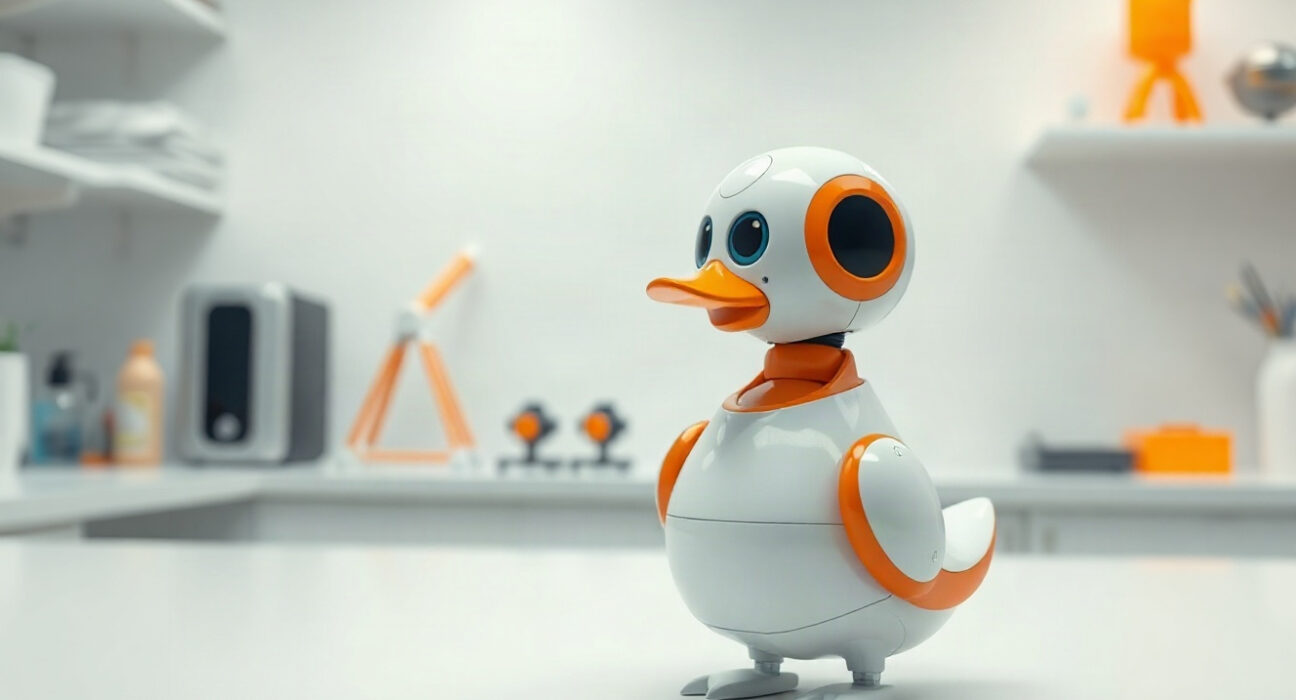
Hugging Face unveiled the Microduck on Thursday, a 25-centimeter-tall open-source duck robot priced at $399, with shipping scheduled before Christmas. The robot can waddle, pick up objects up to 800 grams with its beak, recover from falls, crouch, and even roller skate, according to the company.
What is the Microduck?
The Microduck is a small, duck-like robot designed to be a platform for learning and experimentation in robotics and AI. It is powered by a Raspberry Pi and equipped with a camera, lidar sensors, and two inertial measurement units (IMUs) for perception and movement tracking. The robot’s behaviors can be trained in simulation and then directly deployed on the hardware, with the full SDK, simulation, and reinforcement learning training stack available on GitHub.
Hugging Face CEO Clem Delangue described the Microduck as an “open-source robot you can teach new tricks with reinforcement learning,” emphasizing the company’s goal to “democratize physical AI and world models.” The robot is a product of Hugging Face’s collaboration with Pollen Robotics, a French startup acquired in April 2025 to develop affordable, open-source AI hardware.
How does Microduck fit into Hugging Face’s strategy?
Hugging Face is primarily known as a platform for open-source AI models, but the acquisition of Pollen Robotics marked a strategic move into physical AI hardware. The Microduck follows the Reachy Mini, a $499 desktop robot, and the $399 Reachy Mini Lite, both powered by Raspberry Pi or a connected PC. The Microduck is positioned as a more accessible and playful entry point for developers and hobbyists interested in robotics and reinforcement learning.
The launch comes amid reports that Nvidia is set to acquire Hugging Face at a $13 billion valuation. Nvidia has been a long-time partner, providing infrastructure since at least 2023, and both companies have publicly championed open-source AI. The Microduck could serve as a tangible example of open-source robotics, aligning with Nvidia’s push for accessible AI platforms.
Privacy and security considerations
Delangue previously told Bitcoin World that open-source robots offer better privacy than “black box systems” controlled by a few organizations. However, while open source allows for auditability, it does not guarantee data privacy once third-party applications are installed, as those apps could access the robot’s camera and microphone and potentially send data externally.
Hugging Face also recently dealt with a cybersecurity incident during OpenAI safety testing, which breached its sandbox. The company has not yet responded to requests for comment on the Microduck or the security event.
Why this matters
The Microduck represents a step toward making robotics more accessible and customizable. For developers, it offers a low-cost platform to experiment with reinforcement learning and physical AI. For the broader market, it signals a growing trend of open-source hardware that could challenge proprietary robotics systems. The timing, ahead of the holiday season and amid Nvidia acquisition talks, adds commercial and strategic significance.
Conclusion
Hugging Face’s Microduck is a notable addition to the open-source robotics space, combining affordability with advanced features like reinforcement learning and simulation-based training. While questions about privacy and security remain, the robot’s launch underscores the company’s commitment to democratizing AI and hardware. As the Nvidia acquisition looms, the Microduck could become a flagship product in the open-source AI ecosystem.
FAQs
Q1: What is the price and shipping date of the Microduck?
The Microduck costs $399 and is scheduled to ship before Christmas 2026.
Q2: What can the Microduck do?
The Microduck can waddle, pick up objects up to 800 grams with its beak, get up after falling, crouch, and roller skate.
Q3: Is the Microduck truly open-source?
Yes, the SDK, simulation environment, and full reinforcement learning training stack are available on GitHub, allowing developers to modify and retrain the robot’s behaviors.
Disclaimer: The information provided is not trading advice, Bitcoinworld.co.in holds no liability for any investments made based on the information provided on this page. We strongly recommend independent research and/or consultation with a qualified professional before making any investment decisions.