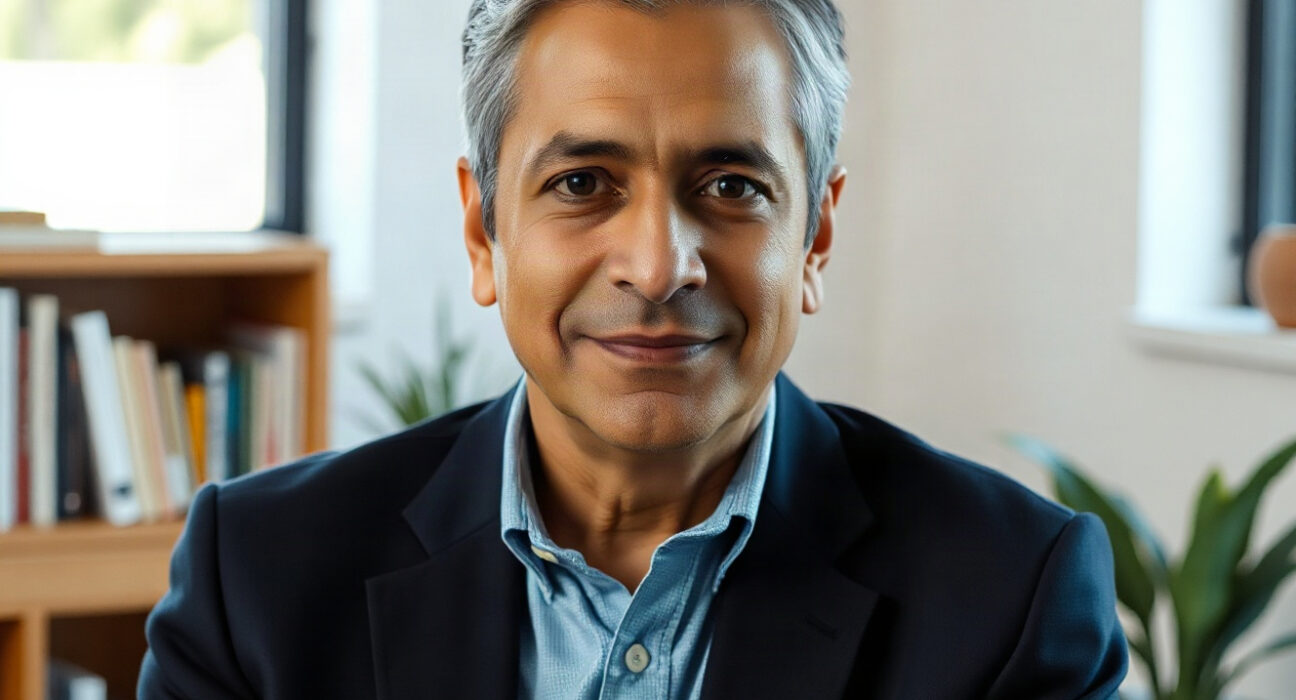
Vijay Pande, the former general partner who built Andreessen Horowitz’s bio fund into a nearly $4 billion practice, has left the firm to launch a new, intentionally small investment vehicle called VZVC, where he and co-founder Zach Werner plan to make only about five concentrated bets per year. In a recent interview, Pande explained why he’s pivoting away from the volume-driven model of traditional venture capital, and how AI is reshaping both drug discovery and his own firm’s operations.
Why Pande left a16z to start VZVC
Pande, a Stanford chemistry professor known for creating the Folding@home distributed-computing project, joined a16z in 2012 when the firm decided to enter healthcare and life sciences. Over the next decade, he grew that practice into one of the most prominent bio-focused VC arms in Silicon Valley, managing close to $4 billion. But in June 2024, he walked away to start VZVC with Zach Werner, a longtime investor. The new firm is deliberately lean: no associates, heavy reliance on AI agents for day-to-day work, and a focus on just a handful of investments each year. “We’re not driving 30 bets per year,” Pande said. “We’re talking about probably five, not a lot of investments — very concentrated.” He compared adding a company to a typical fund to “adding a Facebook friend,” whereas for VZVC, it’s “more like wanting to have another child.”
The shift from discovery to engineering in biology
Pande argues that biology is moving from a “science of discovery” to an engineering discipline, driven by AI and machine learning. Historically, drug development relied heavily on fortuitous findings, but AI now allows computers to model complex biological systems, identify drug targets, and even assist in clinical trials. However, he cautioned that clinical trials remain the most expensive and failure-prone part of the process. “The probability of a drug going successfully from the first trial to the end of the third trial is just 20%,” he noted. “If 8 out of 10 fail, and these things cost hundreds of millions of dollars, the amortized cost gets really high.” The primary reason for failure, he explained, is that drugs are often tested on animal models that don’t predict human responses well. AI models, while not perfect, have the potential to be “way better than any animal model,” which is where the excitement lies.
Precision medicine and the data challenge
Pande sees AI enabling true precision medicine, where treatments are tailored to the individual rather than based on population averages. He pointed to advances in proteomics and automated robotic measurements that, combined with AI, are making this vision more tangible. Yet he also highlighted a critical bottleneck: unlike text or images, biological data cannot be scraped from the internet. Every company ends up building its own walled-off dataset, which limits the potential for AI to learn from vast, diverse sources. “When the data is just simply not there, then AI can’t magically solve that problem,” he said. He drew a parallel to the siloed nature of medical specialties, where an oncologist and an endocrinologist often don’t sync well, but AI could, in principle, be a specialist in everything.
Open-source biology models and data sharing
Pande believes that the industry is beginning to see a shift toward building “atlases of biological information” — typically foundation models — and that open-source versions could have a broad impact, similar to what happened with open-source LLMs. He referenced his involvement with Genesis Therapeutics, which came out of his Stanford lab, and Insitro, founded by Daphne Koller, as examples of companies pushing these boundaries. For VZVC, he is focusing on AI for healthcare delivery and AI for clinical trials, and he looks for founders with high integrity and a long-term perspective. “I’m expecting this relationship to be 5, 10 years plus into, ideally, their next company,” he said.
Lessons learned and what’s overhyped
Reflecting on his career, Pande acknowledged that he was early to champion AI in biotech, facing resistance a decade ago, but now that resistance is largely gone. He also admitted that he initially underestimated the importance of go-to-market. “It really always comes back to go-to-market,” he said, advising founders to apply as much creativity to that side as to the technology. As for what’s overhyped in AI and biotech, Pande warned against the notion that AI will “cure all everything.” The limitation is not AI itself but the availability of high-quality data. “LLMs work because there’s so much data to learn from,” he said. “When the data is just simply not there, then AI can’t magically solve that problem.”
Conclusion
Vijay Pande’s move from a16z’s massive bio fund to a deliberately small, concentrated investment firm reflects a broader trend in venture capital toward focus and operational efficiency. His insights underscore both the promise and the challenges of applying AI to biology, where data scarcity remains a fundamental hurdle. For founders and investors, his emphasis on trust, long-term thinking, and the primacy of go-to-market offers a grounded perspective in a hype-driven field.
FAQs
Q1: Why did Vijay Pande leave a16z to start VZVC?
Pande left to create a smaller, more focused investment firm where he and co-founder Zach Werner make only about five concentrated bets per year, allowing for deeper hands-on involvement and a longer-term relationship with founders.
Q2: What is VZVC’s investment focus?
VZVC focuses on AI for healthcare delivery and AI for clinical trials, with an emphasis on companies that are building proprietary biological datasets and foundation models.
Q3: What does Pande see as the biggest challenge in AI-driven biotech?
The biggest challenge is the scarcity of high-quality biological data, which cannot be scraped from the internet like text or images. This limits AI’s ability to make broad predictions and underscores the need for data sharing and open-source models.
Disclaimer: The information provided is not trading advice, Bitcoinworld.co.in holds no liability for any investments made based on the information provided on this page. We strongly recommend independent research and/or consultation with a qualified professional before making any investment decisions.