

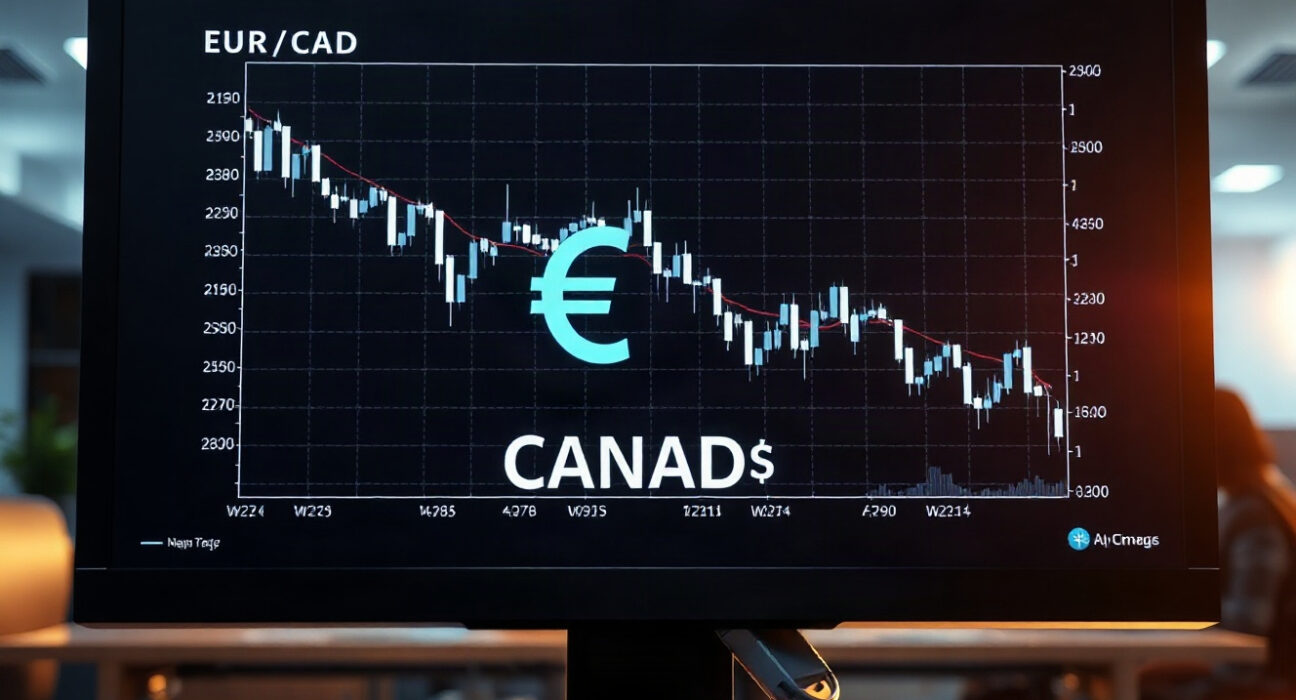
The Euro remained under pressure against the Canadian Dollar (EUR/CAD) on [Date of publication], holding its losses after the release of the latest Eurozone Harmonised Index of Consumer Prices (HICP) data. The currency pair traded lower as investors weighed the inflation figures, which showed a modest increase that was broadly in line with market expectations, providing little new momentum for the single currency.
Eurozone HICP Data and Market Reaction
The Eurozone’s flash HICP reading for [Month, Year] came in at [X]% year-on-year, matching the consensus forecast. Core inflation, which excludes volatile energy and food prices, also met expectations at [Y]%. Despite the data aligning with projections, the Euro failed to gain traction, as the figures did little to alter the European Central Bank’s (ECB) expected policy path.
Traders have largely priced in a cautious approach from the ECB, which has signaled it will keep interest rates at current levels for a sustained period to ensure inflation returns to its 2% target. The lack of a surprise in the inflation data meant that the Euro’s focus shifted back to broader market dynamics, including the relative strength of the Canadian Dollar, which has been supported by firm commodity prices and a resilient domestic economic outlook.
Canadian Dollar Strength and Key Drivers
The Canadian Dollar’s resilience has been a key factor in the EUR/CAD pair’s downward movement. As of [Date], the loonie has found support from elevated crude oil prices, a major Canadian export, and a Bank of Canada (BoC) that has adopted a more hawkish stance than its European counterpart. The BoC’s recent communications have suggested that it remains open to further policy tightening if inflation pressures persist, a contrast to the ECB’s more data-dependent and neutral tone.
This divergence in monetary policy expectations between the two central banks has created a favorable environment for the Canadian Dollar, putting downward pressure on the EUR/CAD cross. The pair’s movement reflects a broader trend in the forex market, where currencies from economies with higher interest rates or more hawkish central banks are outperforming.
Technical Levels and Outlook for EUR/CAD
From a technical perspective, the EUR/CAD pair is currently testing a key support zone near [Price Level]. A break below this level could open the door for further downside, with the next major support area seen around [Next Price Level]. On the upside, the pair faces resistance at [Resistance Price Level], which has acted as a ceiling in recent trading sessions.
Market analysts suggest that the pair’s direction will likely be dictated by upcoming economic data from both regions. Key releases to watch include Canadian employment figures and the Eurozone’s final GDP numbers, which could provide fresh catalysts. For now, the market’s focus remains on the policy divergence theme, which is expected to keep the Euro on the defensive against the Canadian Dollar in the near term.
Conclusion
In summary, the Euro’s losses against the Canadian Dollar are a direct reflection of the latest Eurozone HICP data, which failed to provide any fresh impetus for the single currency. With the ECB and BoC on diverging policy paths, and commodity prices supporting the loonie, the near-term outlook for EUR/CAD remains tilted to the downside. Traders will be watching key technical levels and upcoming economic indicators for the next directional move.
FAQs
Q1: What is the Eurozone HICP and why does it matter for EUR/CAD?
The HICP is the European Central Bank’s key measure of inflation. It matters for EUR/CAD because it influences the ECB’s monetary policy decisions. Higher-than-expected inflation could lead to a more hawkish policy, potentially strengthening the Euro, while lower figures can have the opposite effect.
Q2: Why is the Canadian Dollar performing well against the Euro?
The Canadian Dollar is being supported by high commodity prices, particularly oil, and a Bank of Canada that has a more hawkish monetary policy stance compared to the European Central Bank. This policy divergence makes the Canadian Dollar more attractive to investors.
Q3: What are the key levels to watch for EUR/CAD?
As of [Date], the key support level for EUR/CAD is near [Price Level]. A break below this could lead to further declines. The primary resistance level to watch is [Resistance Price Level]. Traders should monitor these levels for potential breakout or reversal signals.
Disclaimer: The information provided is not trading advice, Bitcoinworld.co.in holds no liability for any investments made based on the information provided on this page. We strongly recommend independent research and/or consultation with a qualified professional before making any investment decisions.
