AI Data Centres vs Bitcoin Mining: Which Consumes More Electricity?
In this article
The AI data centres vs Bitcoin mining electricity consumption debate now has a clear answer: data centres already draw far more power than the Bitcoin network, and artificial intelligence is the force widening that gap. This article breaks down the latest global energy figures for both sectors, explains the structural reasons AI infrastructure is so power-hungry, and shows how the two industries are colliding over the same grid capacity. You will also find a head-to-head comparison of growth, flexibility, and cooling, followed by FAQs and a strategic takeaway. Data reflects the most recent figures available as of June 2026.
How Much Electricity Do AI Data Centres and Bitcoin Mining Farms Use Globally?
AI data centres vs Bitcoin mining electricity consumption comes down to scale and trajectory. The Bitcoin network has matured into a relatively stable footprint, while data centre demand, driven overwhelmingly by AI, is climbing at roughly 15% per year, more than four times faster than total electricity demand growth across all other sectors.
Here is how the two footprints compare:
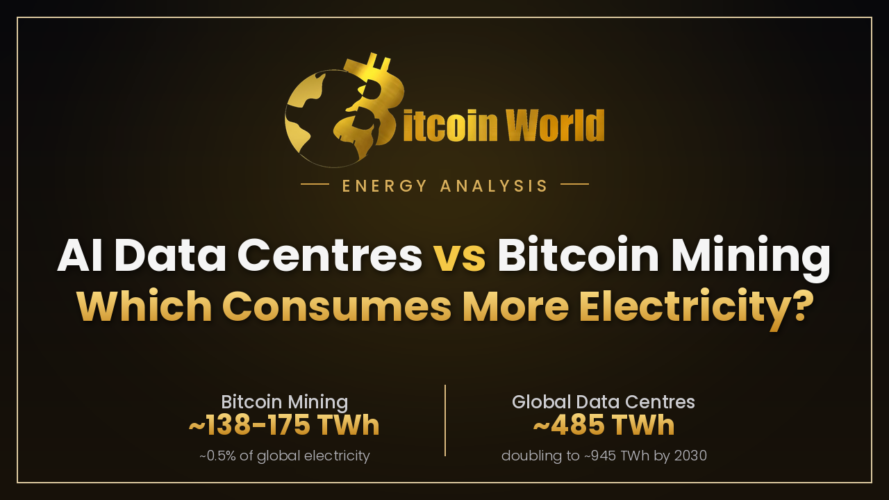
- Bitcoin mining: Estimated at 138–175 TWh annually, depending on the model used, equal to about 0.5% of global electricity supply. The Cambridge Centre for Alternative Finance puts its central 2025 estimate at the lower end of that band, with roughly 52% of mining energy now drawn from renewable and nuclear sources.
- Global data centres: Consumed about 415 TWh in 2024 and roughly 485 TWh in 2025, equal to around 1.5% of global electricity, already about three times the Bitcoin network’s draw.
- AI specifically: Accelerated (AI) servers are the single largest growth driver, expanding at around 30% per year and accounting for nearly half of the net increase in data centre power use.
The trajectory matters more than the snapshot. According to the International Energy Agency (IEA), total data centre electricity consumption is projected to roughly double to around 945 TWh by 2030, reaching close to 3% of global electricity demand, while power use from AI-focused facilities is expected to triple over the same period.
Why Do AI Data Centres Consume So Much More Power Than Bitcoin Mining?
The two industries look superficially similar, racks of specialized chips burning electricity, but their power profiles diverge sharply across three structural factors.
- Growth trajectory: Bitcoin’s demand is contained and predictable, because efficiency gains in ASIC mining hardware largely offset rising network difficulty. AI demand is exponential, because training next-generation large language models (LLMs) and serving billions of daily inference queries require ever-larger compute clusters.
- Grid flexibility: Bitcoin miners run a highly interruptible load and can power down within seconds when electricity prices spike or grids face stress, which makes them attractive as flexible demand. AI workloads are always-on, requiring continuous, uninterrupted uptime for mission-critical enterprise and consumer applications.
- Cooling demands: Bitcoin farms rely on moderate, often air-based cooling and can operate in remote, harsh environments. Dense AI clusters generate extreme heat, pushing operators toward liquid cooling and other complex thermal infrastructure that adds further to total facility power.
The net effect is that AI infrastructure is both larger today in aggregate and structurally locked into faster, less flexible growth.
How Is the AI Power Crunch Reshaping Bitcoin Mining Operations?
Because both industries depend on large, reliable blocks of grid capacity, they are now directly competing for the same power assets. AI operators generate far higher revenue per megawatt than crypto miners, so hyperscalers such as Amazon, Microsoft, and Google routinely outbid mining firms for premium grid interconnections, long-term power purchase agreements, and nuclear capacity.
- Capital advantage: AI revenue per megawatt dwarfs mining margins, giving tech giants the ability to pay a premium for scarce grid access.
- Asset conversion: A growing number of former Bitcoin mining sites are being repurposed into high-performance AI data centres, since they already hold valuable grid interconnection rights and power contracts.
- Geographic concentration: AI buildout is heavily clustered in markets like Virginia, Texas, and Ireland, where data centres already consume an outsized share of local electricity, intensifying regional grid stress.
For miners, this has turned cheap, stranded, or curtailed energy, the kind big AI tenants cannot reliably use, into a defining competitive edge.
Frequently Asked Questions
Do AI data centres use more electricity than Bitcoin mining in 2025?
Yes. In the AI data centres vs Bitcoin mining electricity consumption comparison, global data centres consumed roughly 485 TWh in 2025, about three times the Bitcoin network’s 138–175 TWh. AI is the dominant growth driver within that data centre total, and the gap is widening every quarter as AI compute demand accelerates.
How much electricity will AI data centres consume by 2030?
The IEA projects global data centre electricity consumption will roughly double to around 945 TWh by 2030, close to 3% of global electricity demand, with AI-focused facilities expected to triple their power use. By comparison, Bitcoin mining is expected to stay near its current footprint as ASIC efficiency offsets network growth, so the divergence will become far more pronounced.
Why are Bitcoin mining farms converting into AI data centres?
Because AI tenants generate dramatically higher revenue per megawatt, mining firms can earn far more by leasing or rebuilding their sites for AI workloads. These facilities already hold scarce grid interconnection rights and power contracts, which are the hardest assets to secure in today’s power crunch, making conversion faster and more profitable than building AI capacity from scratch.
Conclusion: Why the AI vs Bitcoin Energy Race Matters Now
The AI data centres vs Bitcoin mining electricity consumption story is no longer a close contest; it is a structural shift in how the world allocates power. Data centres already consume roughly three times the electricity of the entire Bitcoin network, and AI is on track to double that demand again within five years. For investors, energy planners, and operators, the strategic signal is clear: the competition for grid capacity, renewable supply, and nuclear contracts is intensifying right now, and the players who lock in power assets early will define the next decade of digital infrastructure. Watching where megawatts flow has become one of the sharpest leading indicators of where value, and market power, is heading next.