
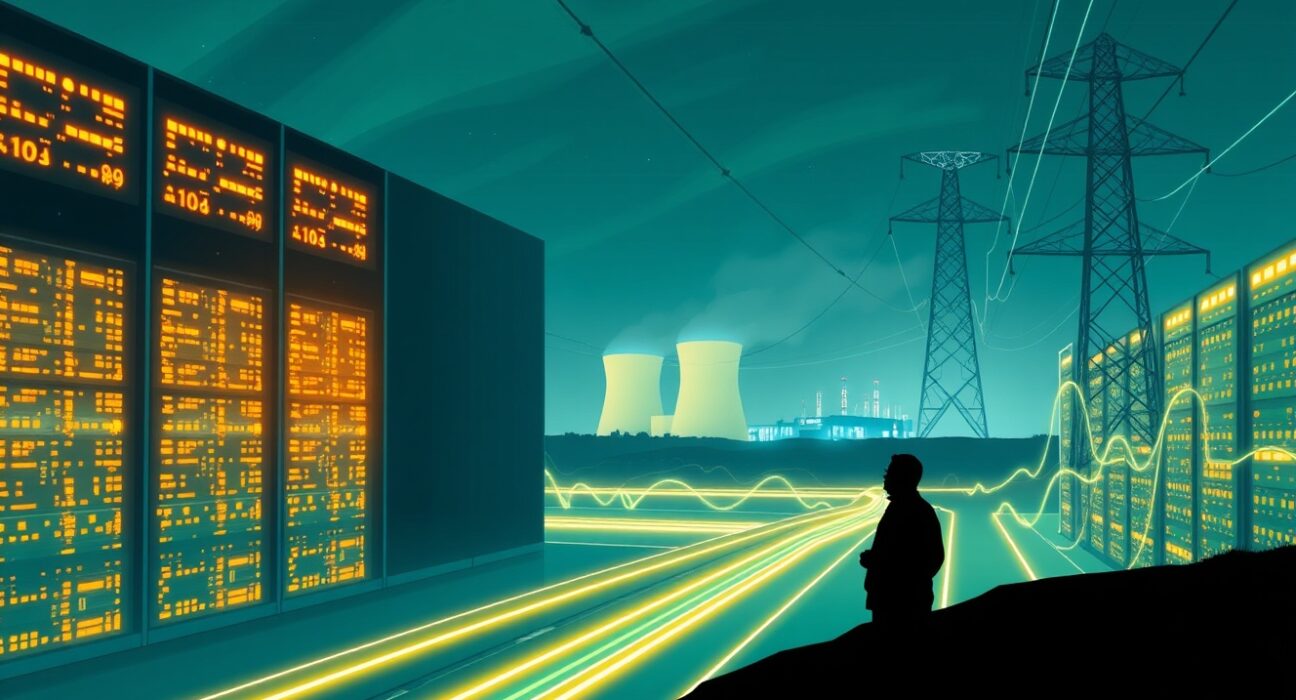
The cryptocurrency world often focuses on digital scarcity and decentralized power, but beneath the surface of every transaction and every AI-driven trading bot lies a fundamental truth: power. Not just computational power, but raw, physical electricity. As artificial intelligence rapidly evolves, the hunger for energy is becoming an unprecedented challenge, putting even the most forward-thinking tech giants like OpenAI and Microsoft in a bind. This surge in AI power demand is creating a fascinating, and at times alarming, bottleneck that could redefine the future of technology and its underlying infrastructure.
The Unprecedented Surge in AI Power Demand: A Looming Crisis?
For years, the tech industry operated with a relatively stable assumption about energy: it would always be there, scalable and affordable. Software and silicon scaled rapidly, but the physical infrastructure for power generation remained a slow-moving giant. Now, with the explosion of AI, that assumption is being tested like never before. The insatiable appetite of AI models for processing power translates directly into an escalating need for electricity, far beyond what current grids and data center plans can accommodate.
Consider the scale: training a single large AI model can consume as much energy as hundreds of homes for an entire year. Multiply that by thousands of models, continuous training, and inference across countless applications, and you begin to grasp the enormity of the challenge. This isn’t just about faster chips; it’s about the very foundation upon which those chips operate.
Why Data Center Energy is the New Bottleneck for AI
The conventional wisdom has long held that compute power, specifically the availability of GPUs, was the primary bottleneck for AI deployment. Companies have been racing to secure these powerful chips, leading to massive orders and significant investments. However, a stark reality is emerging: having the chips is one thing; powering them is another entirely.
Microsoft CEO Satya Nadella articulated this problem clearly on the BG2 podcast, stating, “The biggest issue we are now having is not a compute glut, but it’s a power and it’s sort of the ability to get the [data center] builds done fast enough close to power.” He went on to describe a scenario where companies have “a bunch of chips sitting in inventory that I can’t plug in,” because the “warm shells” — the commercial real estate term for buildings ready for tenants with adequate power connections — simply aren’t available. This highlights a fundamental disconnect between the rapid pace of software and chip development and the much slower, more complex reality of energy infrastructure.
This challenge is particularly acute for several reasons:
- Lagging Infrastructure: For over a decade, electricity demand in the U.S. remained relatively flat. Utilities, therefore, had little incentive to rapidly expand generating capacity.
- Sudden Demand Spike: The last five years have seen an exponential surge in demand from data centers, outpacing existing plans for new power plants.
- Complex Permitting and Construction: Building new power plants, especially large-scale ones, is a multi-year process involving extensive planning, regulatory approvals, and construction.
- Location Constraints: Data centers need to be built where power is available and reliable, often leading to competition for limited resources in specific regions.
Sam Altman and the Quest for Sustainable AI Energy
OpenAI CEO Sam Altman, a prominent figure in the AI revolution, is keenly aware of this energy crunch. His concerns extend beyond immediate power supply to the long-term implications of energy costs and availability. Altman believes that a dramatic reduction in the cost of intelligence — currently averaging a staggering 40x per year for a given level — creates a “very scary exponent from an infrastructure buildout standpoint.”
Altman’s perspective is not just theoretical; he’s actively investing in solutions. His portfolio includes significant stakes in advanced energy technologies:
- Nuclear Fission: Investments in startups like Oklo, which focuses on small modular reactors.
- Nuclear Fusion: Support for companies like Helion, aiming to harness the power of the stars.
- Advanced Solar: Investment in Exowatt, a solar startup that concentrates the sun’s heat and stores it for later use.
While these ventures hold immense promise for future energy independence and sustainability, they are not yet ready for widespread, immediate deployment. The reality is that even traditional fossil-based power plants, like natural gas facilities, take years to build, with orders for new turbines often not fulfilled until later in the decade.
This urgency has driven tech companies to adopt solar power at a rapid pace. Solar’s appeal lies in its relatively inexpensive cost, emissions-free operation, and — crucially — its ability to deploy more quickly than traditional large-scale power plants. Solar photovoltaic (PV) technology shares a kinship with semiconductors; both are built on silicon substrates and produced as modular components that can be scaled into powerful arrays. This modularity and speed of deployment make solar an attractive, though still not instantaneous, solution for the burgeoning data center energy needs.
Satya Nadella‘s Urgent Call: Addressing Microsoft’s AI Infrastructure Challenges
As the CEO of Microsoft, a company deeply invested in AI through its partnership with OpenAI and its own extensive cloud services, Satya Nadella is at the forefront of tackling these infrastructure challenges. His candid remarks underscore the shift in priorities from pure compute acquisition to securing the foundational energy resources.
Microsoft, like other hyperscalers, has resorted to “behind-the-meter” arrangements, where electricity is fed directly to the data center, bypassing the traditional grid. This approach, while offering some immediate relief, also highlights the strain on existing energy networks and the need for innovative, decentralized power solutions. The irony is palpable: a company built on software innovation now finds itself wrestling with the very physical constraints of power generation and distribution.
The implications for Microsoft and its competitors are profound:
- Capital Allocation: A significant portion of capital is now being redirected from chip purchases to energy infrastructure development.
- Strategic Partnerships: Increased collaboration with energy providers and a deeper understanding of utility-scale projects are becoming essential.
- Geographic Considerations: The availability of reliable, affordable power will heavily influence future data center locations.
- Innovation in Energy Storage: Developing and deploying advanced energy storage solutions becomes critical to manage intermittent renewable sources.
These challenges are not merely operational; they are strategic. The ability to scale AI effectively will depend directly on the ability to scale energy. This makes the energy sector a new battleground in the AI race.
Navigating the Future: Powering the Next Generation of Microsoft AI Infrastructure
The path forward for powering the next generation of AI, particularly for massive operations like Microsoft’s cloud and AI services, involves a multi-pronged approach. While the immediate focus is on securing existing power and accelerating solar deployment, the long-term vision includes advanced nuclear and other transformative energy technologies.
One of the intriguing aspects of this situation is the interplay of efficiency and demand. Sam Altman appears to be a firm believer in Jevons Paradox, which posits that increased efficiency in resource use often leads to an increase, rather than a decrease, in total resource consumption. He elaborates: “If the price of compute per like unit of intelligence — however you want to think about it — fell by a factor of a 100 tomorrow, you would see usage go up by much more than 100 and there’d be a lot of things that people would love to do with that compute that just make no economic sense at the current cost.” This suggests that even if AI becomes vastly more efficient, the sheer expansion of its applications will continue to drive unprecedented AI power demand.
Discussions around these critical infrastructure challenges are front and center at major industry gatherings, such as the upcoming Disrupt 2026 event. Leaders from companies like Google Cloud, Netflix, and Microsoft convene to discuss the future of technology and innovation, where topics like energy sustainability and data center scalability are paramount for fueling growth and sharpening competitive edge.
Conclusion: The Energy Imperative for AI’s Future
The journey of AI is inextricably linked to the availability of abundant, affordable, and sustainable energy. The current bottleneck, where chips outpace power supply, is a wake-up call for the entire tech industry. Leaders like Sam Altman and Satya Nadella are not just building software; they are actively shaping the future of global energy infrastructure. Their investments in nuclear and advanced solar, coupled with their candid assessments of current challenges, underscore the critical importance of solving the AI power demand equation. The future of AI, and indeed much of our digital economy, hinges on how effectively we can power this revolutionary technology.
Frequently Asked Questions (FAQs)
Q: Who is Sam Altman?
A: Sam Altman is an American entrepreneur, investor, and programmer. He is best known as the CEO of OpenAI, a leading artificial intelligence research organization responsible for models like ChatGPT.
Q: Who is Satya Nadella?
A: Satya Nadella is an Indian-American business executive who is the chairman and CEO of Microsoft. He has been instrumental in Microsoft’s shift towards cloud computing and AI.
Q: What is OpenAI?
A: OpenAI is an artificial intelligence research and deployment company. Its mission is to ensure that artificial general intelligence (AGI) benefits all of humanity.
Q: What is Microsoft?
A: Microsoft Corporation is an American multinational technology corporation that produces computer software, consumer electronics, personal computers, and related services. It is a major player in cloud computing (Azure) and AI development.
Q: What is Jevons Paradox?
A: Jevons Paradox, named after William Stanley Jevons, states that as technological progress increases the efficiency with which a resource is used, the rate of consumption of that resource tends to increase rather than decrease. This happens because the improved efficiency lowers the effective cost of using the resource, leading to increased demand.
Q: What is “behind-the-meter” power?
A: “Behind-the-meter” refers to electricity generation or storage that is connected on the customer side of the utility meter. This means the power is generated or stored on-site (e.g., at a data center) and used directly by the consumer, often reducing reliance on the main electrical grid and potentially offering more control over power supply.
Q: What are Oklo and Helion?
A: Oklo is a company focused on developing advanced fission reactors, specifically small modular reactors (SMRs) designed for efficient and clean energy production. Helion is a fusion energy company working to develop commercial fusion power, aiming to provide clean, abundant electricity.
Q: What is Exowatt?
A: Exowatt is a solar startup that focuses on concentrating the sun’s heat and storing it for later use, aiming to provide dispatchable clean energy that can operate 24/7, unlike traditional intermittent solar PV.
To learn more about the latest AI market trends, explore our article on key developments shaping AI features.
Disclaimer: The information provided is not trading advice, Bitcoinworld.co.in holds no liability for any investments made based on the information provided on this page. We strongly recommend independent research and/or consultation with a qualified professional before making any investment decisions.