

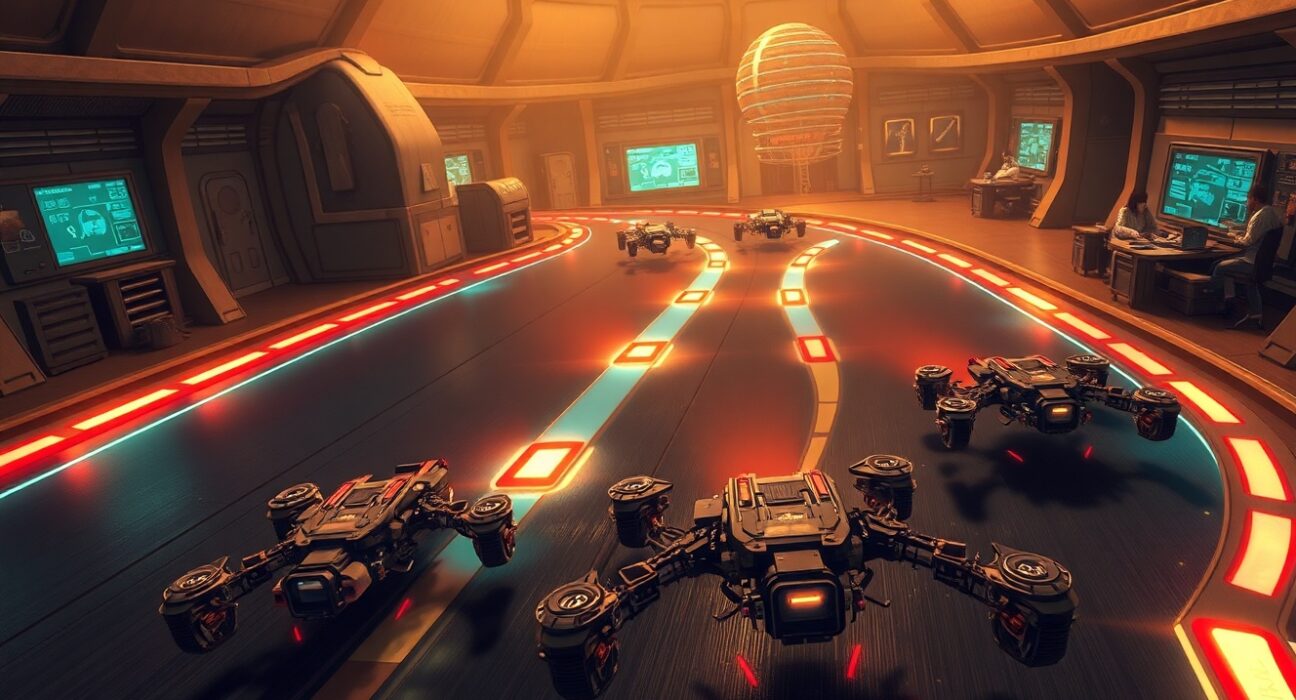
In a bold move reshaping defense technology recruitment, Anduril Industries has launched the groundbreaking AI Grand Prix—an autonomous drone racing competition where software engineering prowess directly translates to career opportunities and substantial financial rewards. This innovative event, announced October 2025, represents a paradigm shift in how defense contractors identify and attract top artificial intelligence talent through practical demonstration rather than traditional interviews.
Anduril’s AI Grand Prix: Redefining Defense Tech Recruitment
Palmer Luckey’s vision for the AI Grand Prix emerged from a fundamental realization about autonomous systems development. During strategic recruitment discussions, Anduril’s founder recognized that sponsoring conventional drone racing contradicted the company’s core mission. “Our entire impetus centers on autonomy advancing beyond human micromanagement,” Luckey explained to Bitcoin World. Consequently, the team conceived a competition testing programmers’ ability to make drones fly independently.
The competition structure features three qualifying rounds beginning April 2026, culminating in a November final event in Ohio. Remarkably, participants won’t operate Anduril’s own drones but will program Neros Technologies’ racing quadcopters. This decision stems from practical considerations—Anduril’s defense-focused drones prove too large for the contained Ohio course. The company partners with established organizations including the Drone Champions League and JobsOhio to execute this ambitious event.
Autonomous Drone Racing Mechanics and Competition Details
The AI Grand Prix operates on fundamentally different principles than traditional drone racing. Teams develop sophisticated software enabling drones to navigate complex courses without human intervention. This approach tests multiple AI capabilities including real-time obstacle avoidance, optimal pathfinding, and adaptive flight control. The competition format emphasizes practical engineering skills over theoretical knowledge.
Key competition elements include:
- Autonomous Navigation Systems: Drones must interpret course layouts and environmental variables independently
- Real-Time Decision Making: Software must process sensor data and adjust flight parameters within milliseconds
- Energy Optimization: Efficient algorithms extend operational duration and improve performance
- Fault Tolerance: Systems must maintain functionality despite unexpected conditions or partial failures
Anduril anticipates at least 50 teams from universities and research institutions worldwide. The company has structured substantial incentives including a $500,000 prize pool distributed among top performers. Most significantly, exceptional participants receive direct job offers bypassing Anduril’s standard recruitment pipeline. This approach mirrors emerging trends in technology hiring where demonstrated capability outweighs conventional credentials.
Strategic Implications for Defense Technology Development
The AI Grand Prix represents more than an isolated recruitment event—it signals broader shifts in defense technology priorities. Autonomous systems increasingly dominate military planning across global powers. By focusing competition on software rather than hardware, Anduril emphasizes the critical importance of algorithmic superiority in modern warfare. This approach acknowledges that advanced platforms prove ineffective without sophisticated control systems.
Industry analysts note the competition’s timing coincides with accelerated autonomous weapons development. Major defense contractors increasingly prioritize AI integration across land, sea, air, and space domains. Anduril’s event specifically addresses talent shortages in autonomous systems engineering—a critical bottleneck affecting multiple defense sectors. The competition format allows direct assessment of candidates’ abilities to solve complex, real-world problems under competitive pressure.
Geopolitical Considerations and International Participation
Anduril has implemented selective participation policies reflecting current geopolitical realities. While welcoming international teams generally, the company explicitly excludes Russian participants. Luckey clarified this decision parallels World Cup exclusion policies, citing Russia’s ongoing military actions in Europe. The concern centers on potential competitors’ affiliations with foreign military programs.
Interestingly, Chinese teams remain eligible despite strategic competition between Washington and Beijing in autonomous weapons development. Luckey acknowledged this apparent contradiction while noting practical limitations. “If you work for the Chinese military, you’re not going to be allowed to get a job at Anduril,” he stated, referencing existing legal restrictions. All job candidates undergo standard vetting regardless of competition performance.
The participation framework reveals nuanced approaches to international technology competition. While seeking global talent, defense contractors must balance innovation against security considerations. This tension increasingly characterizes technology sectors with dual-use applications. The AI Grand Prix navigates these complexities through transparent eligibility criteria and compliance with export control regulations.
Future Expansion and Autonomous Systems Evolution
Success with the inaugural AI Grand Prix could trigger expansion into additional autonomous domains. Luckey envisions future competitions involving underwater vehicles, ground systems, and potentially spacecraft. This progression aligns with Anduril’s broader portfolio spanning multiple operational environments. Each domain presents unique challenges requiring specialized AI approaches.
| Domain | Key Challenges | Military Applications |
|---|---|---|
| Underwater | Limited communication, pressure effects | Mine detection, submarine tracking |
| Ground | Terrain navigation, obstacle avoidance | Logistics, reconnaissance, combat support |
| Aerial | Current competition focus | Surveillance, electronic warfare, strike |
| Space | Orbital mechanics, radiation hardening | Satellite servicing, debris removal |
This expansion strategy acknowledges diverse autonomous system requirements across military operations. Different environments demand specialized sensor suites, propulsion systems, and control algorithms. By exploring multiple domains, Anduril cultivates expertise transferable between platforms. The company’s approach reflects comprehensive understanding of autonomous warfare’s multidimensional nature.
Broader Industry Impact and Recruitment Innovation
The AI Grand Prix establishes precedents potentially influencing technology recruitment broadly. Traditional hiring processes often struggle evaluating candidates’ practical problem-solving abilities. Competition-based assessment provides direct observation of skills under realistic conditions. This methodology proves particularly valuable for autonomous systems where theoretical knowledge insufficiently predicts real-world performance.
Other defense contractors monitor Anduril’s experiment closely. Successful outcomes could inspire similar initiatives across the sector. The competition format offers multiple advantages including public engagement, talent identification, and technology demonstration. Additionally, events generate valuable data about autonomous system capabilities under stress conditions—information difficult obtaining through conventional testing.
Educational institutions increasingly align curricula with competition requirements. Universities recognize value preparing students for practical challenges beyond academic exercises. This alignment benefits both industry and academia by closing gaps between theoretical education and operational requirements. The AI Grand Prix thus influences talent development pipelines beyond immediate recruitment objectives.
Conclusion
Anduril’s AI Grand Prix represents a transformative approach to defense technology recruitment and autonomous systems development. By creating competitive environments where software engineering excellence determines success, the company identifies talent capable of advancing next-generation autonomous platforms. This innovative strategy addresses critical industry needs while establishing new paradigms for evaluating technical capabilities. As autonomous systems assume increasingly prominent military roles, initiatives like the AI Grand Prix will prove essential cultivating necessary expertise. The competition’s outcomes will influence not only Anduril’s recruitment but broader approaches to autonomous warfare development across defense sectors.
FAQs
Q1: What makes Anduril’s AI Grand Prix different from traditional drone racing?
The AI Grand Prix focuses exclusively on autonomous operation—teams develop software enabling drones to fly themselves without human intervention, unlike conventional racing where pilots control drones remotely in real-time.
Q2: What specific prizes can winners expect from the competition?
Top performers split a $500,000 prize pool and receive job offers at Anduril Industries, potentially bypassing standard recruitment processes. The competition also provides networking opportunities with defense technology leaders.
Q3: Why isn’t Anduril using its own drones for the competition?
Anduril’s defense-focused drones are physically too large for the contained racing course in Ohio. The company instead uses Neros Technologies’ racing quadcopters better suited for high-speed indoor competition.
Q4: How does this competition address defense industry talent shortages?
By identifying candidates through practical demonstration rather than traditional interviews, Anduril accesses software engineers with proven autonomous systems capabilities—a critical skillset increasingly difficult finding through conventional recruitment.
Q5: What are the geopolitical restrictions on competition participation?
Russian teams are excluded due to ongoing military actions in Europe, while Chinese teams may participate but face standard employment restrictions if seeking jobs at Anduril. All candidates undergo security vetting regardless of competition performance.
Disclaimer: The information provided is not trading advice, Bitcoinworld.co.in holds no liability for any investments made based on the information provided on this page. We strongly recommend independent research and/or consultation with a qualified professional before making any investment decisions.
