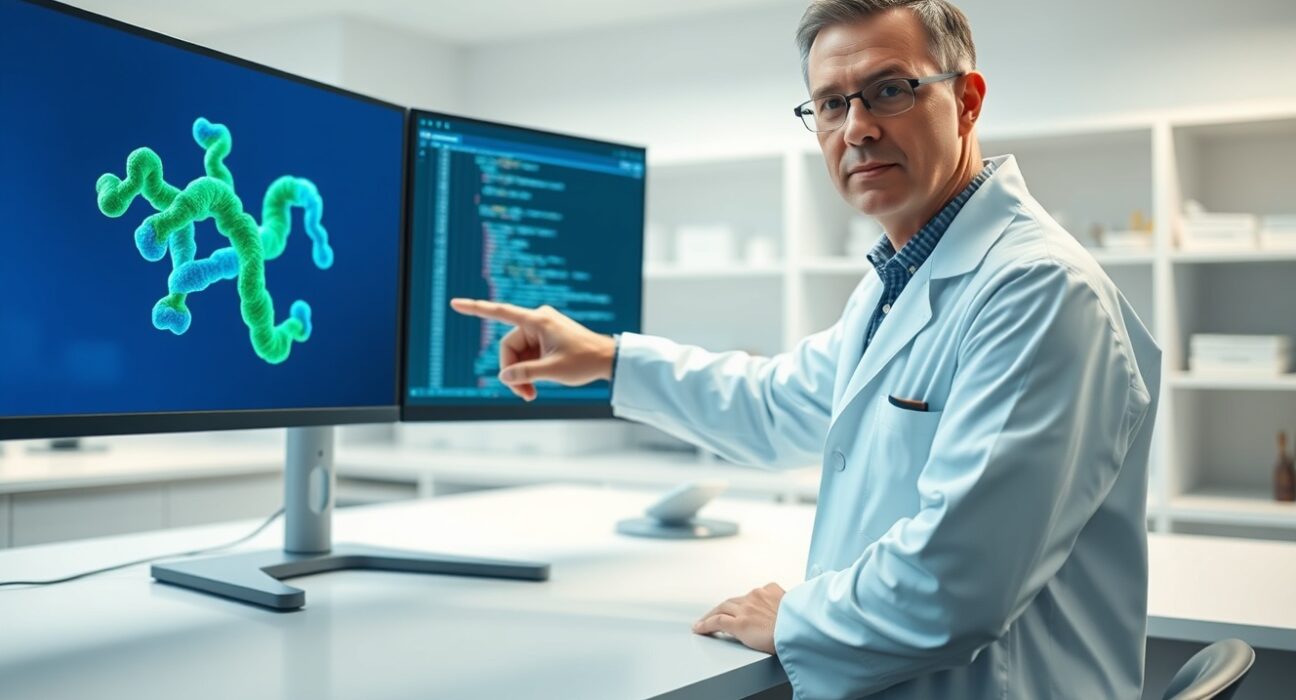
Anthropic introduced Claude Science on Tuesday, an AI workbench designed to give scientists a single, unified environment for computational research. The goal is to eliminate the friction of jumping between databases, pipelines, and tools — a common pain point in modern data-heavy science.
What Claude Science is — and isn’t
Anthropic is explicit that Claude Science is “not a new AI model and not a more capable model for biology.” It runs the same Claude models already available to everyone, including Claude Opus 4.8, with no special access or gating. The workbench builds on the October 2025 launch of Claude for Life Sciences, which improved the chatbot’s ability to handle life sciences tasks. Claude Science is a dedicated, persistent environment for that work.
The launch, announced at an AI for Science briefing, fits into Anthropic’s broader strategy to be more than a model provider. The company is increasingly betting on vertical, workflow-level products — similar to how Claude Code has become the operating layer for software development. This approach could shape how Anthropic competes and prices against rivals.
How the workbench works
At the center of Claude Science is a main AI assistant that acts as a project manager for scientists. It connects to more than 60 scientific databases and comes with pre-built toolkits for genomics, protein structure, chemistry, and other fields. That assistant can create sub-assistants to split up work — like a lead researcher delegating tasks to specialists — or hand work off to a custom “expert” assistant built by the user.
A separate fact-checker AI then double-checks citations and calculations before anything goes to publication. This is a notable addition, as AI-assisted writing has led to fabricated citations and unverifiable stats slipping into papers. That said, it’s still the same underlying model checking itself, not an independent source of truth.
Reproducibility is a core design principle. The workbench can generate figures — like 3D protein structures and chemistry diagrams — alongside the code that produced them. Each figure includes the exact code and environment, a plain-language description of how it was created, and the full message history. Scientists can also edit figures using plain language, prompting the agent to modify its own underlying code. Additionally, Claude Science can run on the lab’s own infrastructure, avoiding the need to send sensitive data to Anthropic’s servers.
Early user results
Early users are already putting the tool to work. Sean Whalen, a principal scientist in machine learning and functional genomics at Gladstone Institutes, used Claude Science to build a genome browser from scratch in days, according to Anthropic. Allen Institute neuroscientist Jérôme Lecoq used the tool to build a multi-agent computational review pipeline, shaving off years of human work.
How it compares to rivals
The launch comes months after OpenAI released GPT-Rosalind in April, a specialized model fine-tuned for biological reasoning. The difference is not just about whether a specialized model is necessary — it also comes down to access and speed. Rosalind launched as a research preview limited to qualified U.S. enterprise customers, gated behind a qualification and safety review. Partners like Amgen, Allen Institute, Moderna, Thermo Fisher, and Novo Nordisk got early access.
Google DeepMind is playing a different game entirely, owning foundational science models like AlphaFold and AlphaGenome, which the other two can only call into as tools. Its Gemini for Science platform bundles those models with more than 30 life science databases into one skill set.
Claude Science is available in beta to anyone on Pro, Max, Team, and Enterprise subscriptions. Anthropic also named Novo Nordisk and Allen Institute as customer case studies, suggesting pharma organizations are already working with multiple AI vendors.
Support for early-career researchers
Anthropic will support up to 50 Claude Science projects, providing up to $30,000 in credits. The company is looking for postdoctoral and graduate projects that span domains and explore the boundaries of science, with an early focus on biomedical research. Applications are open through July 15, 2026, with award notifications sent by July 31. Projects will run from September 1 to December 1, 2026.
Conclusion
Anthropic’s bet with Claude Science is that scientists need a better workflow, not a smarter model. By prioritizing integration, reproducibility, and infrastructure flexibility, the company is carving out a distinct position in the increasingly crowded AI-for-science market. Whether that approach wins over researchers long-term will depend on how well the workbench adapts to the messy, domain-specific realities of real labs — and whether the built-in fact-checking can keep pace with the speed of AI-generated research.
FAQs
Q1: Is Claude Science a new AI model?
No. Claude Science is a workbench environment that uses the same Claude models already available to the public. It is not a new or more capable model for biology.
Q2: How does Claude Science ensure reproducibility?
It generates figures alongside the code that produced them, including the exact environment, a plain-language description, and the full message history. Scientists can also edit figures using natural language, prompting the AI to modify the underlying code.
Q3: How does Claude Science compare to OpenAI’s GPT-Rosalind?
OpenAI’s GPT-Rosalind is a specialized, fine-tuned model for biological reasoning, currently limited to qualified enterprise customers. Claude Science is a general workbench available to all subscription tiers, focusing on workflow integration rather than a specialized model.
Q4: Can Claude Science run on a lab’s own infrastructure?
Yes. The workbench can run on the lab’s own infrastructure setup, avoiding the need to send sensitive data to Anthropic’s servers.
Q5: Who can apply for the Claude Science project grants?
Postdoctoral and graduate students working on projects spanning domains in biomedical research are eligible. Applications are open through July 15, 2026.
Disclaimer: The information provided is not trading advice, Bitcoinworld.co.in holds no liability for any investments made based on the information provided on this page. We strongly recommend independent research and/or consultation with a qualified professional before making any investment decisions.