
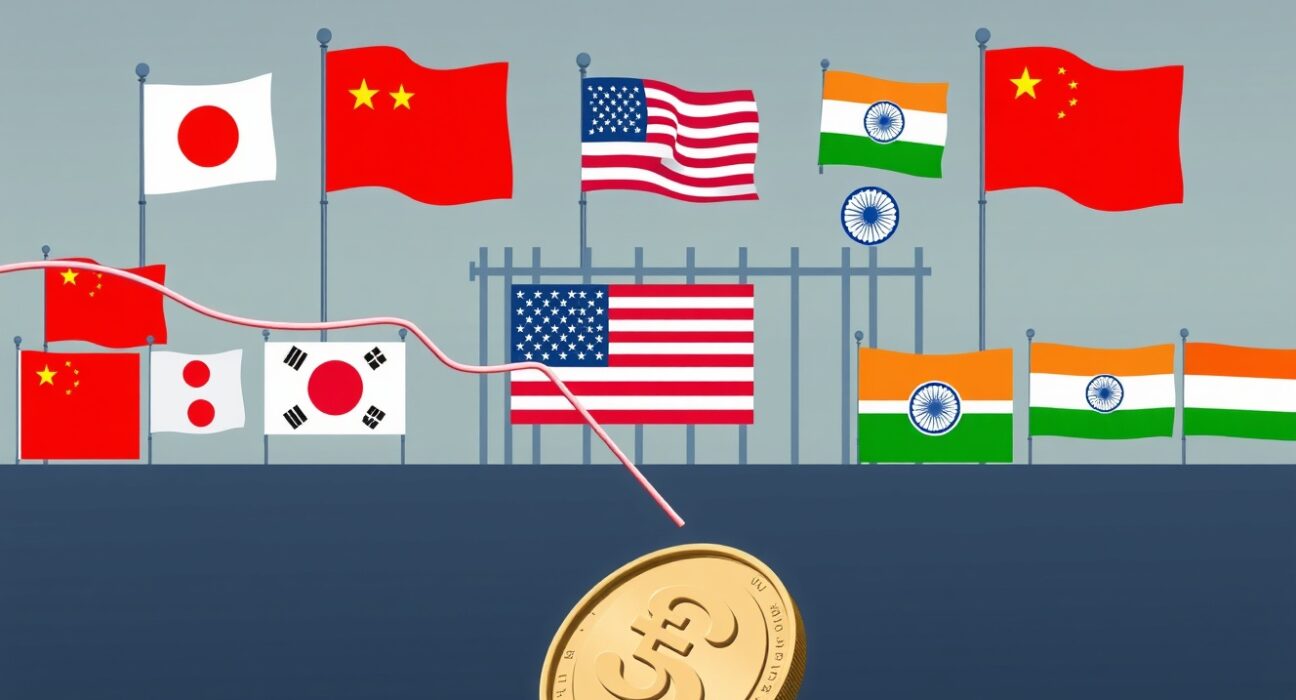
In the dynamic world of finance, where every ripple can create a wave, the recent weakening of Asia FX has sent tremors across global markets. For those invested in cryptocurrencies, understanding these macro shifts is paramount, as traditional market instability often influences digital asset valuations. The current climate, marked by escalating US-China trade tensions and a relentless slide in the Japanese Yen, presents a complex picture that demands close attention. Is this merely a blip, or are we witnessing the early stages of a significant realignment in global economic power and currency dynamics? Let’s dive deep into the forces at play and uncover what this means for investors everywhere.
Asia FX Under Pressure: Unpacking the Decline
The collective weakening of Asian currencies against the US dollar is not an isolated event but rather a symptom of deeper economic and geopolitical currents. Several factors converge to create this downward pressure on Asia FX, impacting economies from Seoul to Mumbai. Understanding these drivers is crucial for anyone trying to navigate the complex financial landscape.
What’s Driving the Depreciation?
- Interest Rate Differentials: The aggressive monetary tightening by the US Federal Reserve, contrasted with more dovish stances in many Asian central banks, creates a significant yield advantage for dollar-denominated assets. This encourages capital outflow from Asia into the US, increasing demand for the dollar and weakening local currencies.
- Economic Slowdown Concerns: China’s slower-than-expected economic recovery and ongoing property sector woes cast a long shadow over regional growth prospects. As a major trade partner and economic engine, China’s performance directly impacts its neighbors, leading to reduced export demand and investor caution.
- US-China Trade Tensions: The looming threat of more trade curbs between the world’s two largest economies introduces significant uncertainty. This impacts supply chains, reduces foreign direct investment, and dampens business confidence across Asia.
- Commodity Price Volatility: Many Asian economies are net importers of commodities, particularly oil. Rising global commodity prices, often denominated in US dollars, increase import bills and can put further pressure on local currencies.
For instance, the South Korean Won, the Indian Rupee, and the Thai Baht have all experienced notable depreciation. This makes imports more expensive, potentially fueling inflation, and can also make foreign debt servicing more burdensome for governments and corporations. While some depreciation can make exports more competitive, the current environment suggests a broader loss of confidence rather than a strategic move.
US-China Trade Curbs: A Brewing Storm?
The specter of renewed or intensified US-China trade curbs is arguably the most significant geopolitical risk factor influencing global markets today. What began as a tariff war under a previous administration has evolved into a multifaceted competition encompassing technology, national security, and strategic influence. The implications for global supply chains and economic stability are profound.
Beyond Tariffs: The New Fronts in US-China Economic Rivalry
- Technology Restrictions: The US has increasingly imposed restrictions on the sale of advanced semiconductors and related manufacturing equipment to China. These measures aim to curb China’s technological advancement, particularly in critical areas like AI and defense. Such actions disrupt global tech supply chains and force companies to ‘de-risk’ or ‘friend-shore’ their operations.
- Investment Screening: Both countries are scrutinizing foreign investments more closely, especially in sensitive sectors. This can deter cross-border capital flows and limit access to vital technologies or markets.
- Geopolitical Friction: Issues such as Taiwan, human rights, and maritime disputes in the South China Sea contribute to a broader climate of mistrust, making economic cooperation more challenging and unpredictable.
- Supply Chain Reshaping: Companies are actively diversifying their manufacturing bases away from China, seeking to reduce reliance on a single, potentially volatile, source. While this creates opportunities for other Asian nations, it also entails significant costs and disruptions in the short to medium term.
The uncertainty generated by these potential curbs creates a chilling effect on investment and trade. Businesses hesitate to make long-term commitments when the regulatory and geopolitical landscape is constantly shifting. This directly impacts the economic outlook for many Asian nations heavily integrated into the global supply chain, exacerbating the pressure on their currencies.
The Yen’s Troubling Trajectory: Why the Weakness?
The Japanese Yen, once considered a quintessential safe-haven currency, has been on a relentless downward trajectory, resuming its slide and reaching multi-decade lows against the US dollar. This sustained Yen weakness is a standout feature of current currency market dynamics and has significant implications for Japan and the global economy.
Factors Fueling the Yen’s Plunge
- Divergent Monetary Policies: The primary driver is the stark contrast between the Bank of Japan’s (BoJ) ultra-loose monetary policy and the aggressive rate hikes by the US Federal Reserve. While the Fed has been raising interest rates to combat inflation, the BoJ has maintained negative interest rates and yield curve control to stimulate Japan’s sluggish economy. This creates a massive interest rate differential, making dollar-denominated assets far more attractive than yen-denominated ones.
- Carry Trade Resurgence: The significant interest rate gap has reignited the ‘yen carry trade.’ Investors borrow yen at low rates and invest in higher-yielding currencies or assets abroad, further increasing selling pressure on the yen.
- Loss of Safe-Haven Appeal: In times of global uncertainty, investors traditionally flocked to the yen. However, with Japan’s economic challenges, persistent deflationary pressures, and the BoJ’s unconventional policies, some of its safe-haven luster has diminished. Investors might now look to other assets, including potentially some stable cryptocurrencies or gold, for security.
- Trade Deficit Concerns: While a weaker yen can boost exports, Japan has been running a trade deficit due to high energy import costs and a shift in manufacturing overseas. This structural issue further weighs on the currency.
The BoJ has intervened in the past to support the yen, but without a fundamental shift in its monetary policy stance relative to other major central banks, any interventions are likely to offer only temporary relief. The prolonged weakness raises concerns about imported inflation for Japan and the broader impact on global financial stability.
Navigating Global Trade Tensions: What’s at Stake?
The increasing intensity of Global trade tensions, particularly between the US and China, extends far beyond simple tariff disputes. It represents a fundamental shift in international relations, with profound economic and geopolitical consequences that reverberate across continents. Understanding what’s at stake is crucial for policymakers, businesses, and investors.
The Broader Impact of Geopolitical Friction
- Supply Chain Fragmentation: The drive for ‘de-risking’ or ‘friend-shoring’ leads to the fragmentation of global supply chains. While aiming for resilience, this can increase costs, reduce efficiency, and potentially lead to higher consumer prices.
- Inflationary Pressures: Tariffs, trade barriers, and supply chain disruptions can all contribute to inflationary pressures. Businesses face higher input costs, which are often passed on to consumers. This complicates central banks’ efforts to manage inflation.
- Slower Global Growth: Trade is a key engine of global economic growth. When trade flows are impeded, and uncertainty rises, investment slows, and economic activity can be stifled. The IMF and other international bodies have repeatedly warned about the negative impact of trade protectionism on global GDP.
- Technological Decoupling: The focus on technology restrictions aims to create separate technological ecosystems. This could lead to a less interconnected and less innovative global economy, with implications for everything from AI development to cybersecurity.
- Geopolitical Realignment: Trade tensions are often intertwined with broader geopolitical competition. Countries are increasingly forced to choose sides or navigate a complex web of alliances, impacting trade agreements, investment flows, and even military cooperation.
For investors, this means a higher degree of uncertainty and a need to carefully assess geopolitical risks alongside traditional economic indicators. Industries heavily reliant on cross-border trade and integrated supply chains are particularly vulnerable. This environment also underscores the importance of diversification, including exploring uncorrelated assets like certain cryptocurrencies, as traditional markets face heightened volatility.
Understanding Currency Market Volatility: Implications for Investors
The current environment of weakening Asian currencies, renewed US-China trade friction, and significant Yen weakness highlights the critical importance of understanding currency market volatility. For investors, especially those with diversified portfolios including digital assets, these fluctuations are not just abstract economic indicators; they have tangible impacts on returns, purchasing power, and investment strategies.
How Currency Swings Affect Your Investments
- Impact on Export/Import Businesses: Companies involved in international trade are directly affected. A weaker local currency makes exports cheaper and imports more expensive. This can boost export-oriented sectors but hurt those reliant on imported raw materials or components.
- Inflationary Pressures: For countries with weakening currencies, imported goods become more expensive, contributing to inflation. This erodes the purchasing power of consumers and can lead to higher interest rates to curb inflation, impacting borrowing costs.
- Foreign Debt Burden: Governments and corporations that have borrowed in foreign currencies (e.g., US dollars) face a higher debt burden when their local currency weakens. Servicing these debts becomes more costly.
- Investment Returns: For investors holding foreign assets, currency movements can significantly impact their total returns. A strong dollar can erode the value of overseas investments when converted back to the local currency, even if the asset itself performs well.
- Flight to Safety: During periods of high volatility and uncertainty, investors often seek safe-haven assets. Historically, this has included the US dollar, gold, and sometimes the Japanese Yen. However, the current Yen weakness suggests a shift. Some investors might now look to alternative digital assets that offer perceived stability or decentralization as a hedge against traditional market turmoil.
Actionable Insights for Navigating Volatility
Given the current landscape, what steps can investors take to protect and grow their portfolios?
- Diversify Across Geographies and Assets: Don’t put all your eggs in one basket. Diversifying investments across different countries and asset classes (stocks, bonds, real estate, commodities, and digital assets) can help mitigate risks associated with specific regional or currency downturns.
- Consider Hedging Strategies: For those with significant exposure to foreign currencies, consider using currency hedges (e.g., forward contracts, options) to lock in exchange rates and protect against adverse movements.
- Monitor Central Bank Policies: Keep a close eye on the monetary policies of major central banks, particularly the US Federal Reserve and the Bank of Japan. Their decisions on interest rates and quantitative easing/tightening are primary drivers of currency movements.
- Assess Geopolitical Risks: Beyond economic data, geopolitical developments like US-China trade relations are increasingly important. Understand how potential policy shifts or conflicts could impact your investments.
- Evaluate Alternative Assets: For cryptocurrency investors, understand how macro trends influence digital assets. While crypto can be volatile, some argue that Bitcoin, for example, could act as a ‘digital gold’ during periods of traditional currency instability, though this remains a debated topic. Stablecoins, pegged to fiat currencies, offer a way to navigate volatility within the crypto ecosystem.
- Stay Informed: Knowledge is power. Regularly follow financial news and expert analysis to stay abreast of developments in Asia FX, Yen weakness, and broader Global trade tensions.
The current environment underscores that currency markets are not isolated. They are deeply interconnected with trade policies, monetary decisions, and geopolitical events. For investors seeking to navigate these turbulent waters, a comprehensive understanding of these dynamics is not just beneficial but essential.
Conclusion: A Shifting Global Financial Landscape
The persistent weakening of Asia FX, driven by the dual forces of escalating US-China trade curbs and the relentless slide of the Japanese Yen, paints a vivid picture of a global financial landscape in flux. We are witnessing a complex interplay of divergent monetary policies, geopolitical rivalry, and structural economic challenges that collectively contribute to heightened currency market volatility. The days of predictable economic patterns seem to be fading, replaced by an era where rapid shifts and unexpected events are the new norm.
For investors, particularly those engaged with the burgeoning cryptocurrency space, these macro trends are not distant concerns but direct influences on portfolio performance and strategic decisions. The search for stability and uncorrelated returns becomes more pressing as traditional markets grapple with these formidable headwinds. Whether through careful diversification, strategic hedging, or exploring the unique characteristics of digital assets, adapting to this evolving environment is key to safeguarding and growing wealth. The coming months will undoubtedly test the resilience of global economies and the ingenuity of investors as they navigate these profound shifts.
To learn more about the latest Forex market trends, explore our article on key developments shaping currency market volatility.
Disclaimer: The information provided is not trading advice, Bitcoinworld.co.in holds no liability for any investments made based on the information provided on this page. We strongly recommend independent research and/or consultation with a qualified professional before making any investment decisions.