

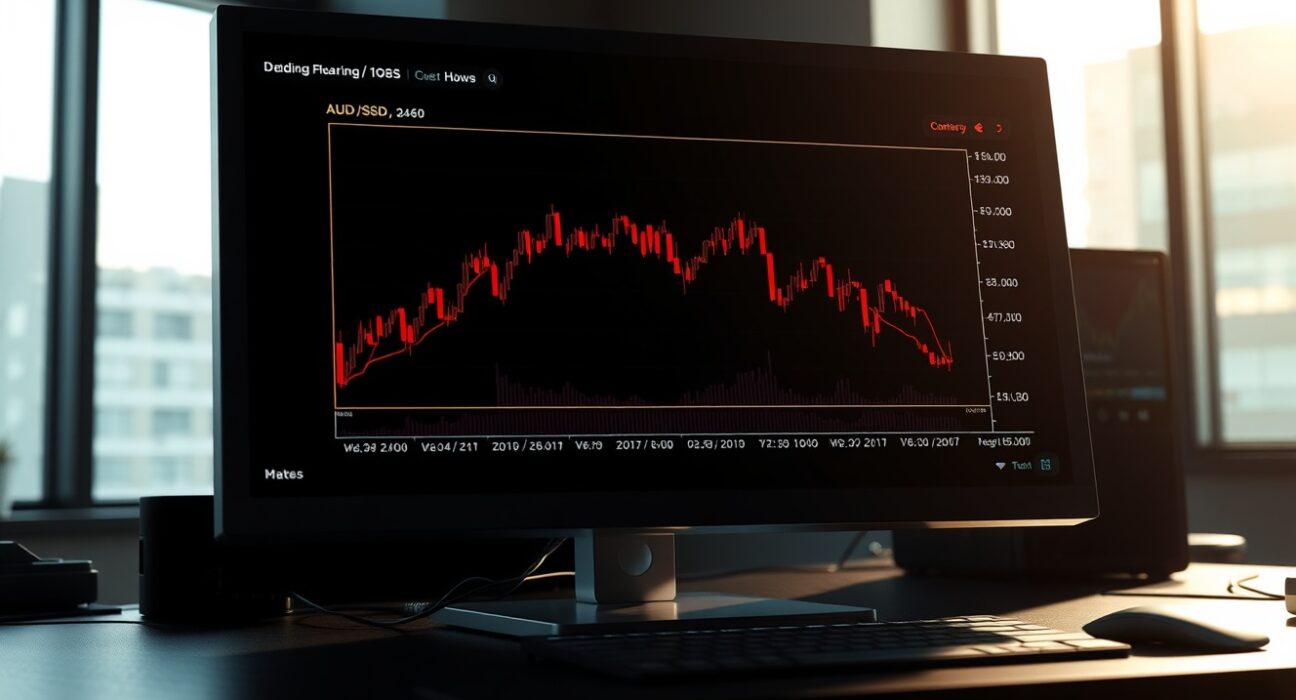
The Australian dollar continues its sharp descent against the US dollar, marking a fifth consecutive day of losses as global forex markets enter a pivotal week packed with high-stakes economic data from both nations.
AUD/USD Forecast: Analyzing the Five-Day Slide
The AUD/USD pair, a key benchmark for commodity-linked currencies and Asia-Pacific risk sentiment, has now recorded its longest losing streak in over two months. This persistent decline reflects a confluence of shifting monetary policy expectations and pre-positioning by institutional traders. Market participants are actively reducing exposure to the Australian dollar ahead of significant data releases that could dictate the near-term trajectory for both central banks. Consequently, the pair has breached several technical support levels, increasing bearish momentum.
Several interbank trading desks reported elevated selling volumes throughout the Asian and European sessions. This activity underscores the market’s defensive posture. The Reserve Bank of Australia’s recent communications have been carefully parsed by analysts, who note a marginally less hawkish tone compared to the Federal Reserve’s steadfast focus on inflation. Furthermore, fluctuating iron ore prices, Australia’s largest export, have added to the currency’s volatility. This creates a complex environment for the AUD/USD forecast.
The Upcoming Data Deluge: A Timeline of Market Catalysts
The immediate catalyst for the currency’s weakness is the densely packed economic calendar. Traders are preparing for data that will offer fresh insights into inflation, employment, and consumer health. The sequence of releases will provide critical evidence for central bank policy paths.
Key Australian Data Points
Domestic focus will center on several high-impact indicators. First, the monthly Consumer Price Index (CPI) indicator will offer the latest snapshot of inflationary pressures. Second, retail sales figures will reveal the resilience of the Australian consumer amid higher interest rates. Finally, building approval data will signal the health of the crucial housing sector. Strong results could potentially stall the AUD’s decline, while soft prints may accelerate the sell-off.
Critical US Indicators
- Non-Farm Payrolls (NFP): The primary gauge of US labor market strength.
- ISM Manufacturing PMI: A leading indicator of economic activity.
- Federal Reserve Meeting Minutes: Insights into the Fed’s policy deliberations.
Analysts from major financial institutions emphasize that the US data, particularly the NFP report, will likely have an outsized impact. A strong jobs report could reinforce expectations for a more hawkish Federal Reserve, widening the interest rate differential that pressures the AUD/USD pair. Conversely, a soft report could trigger a corrective rally for the battered Australian dollar.
Technical and Fundamental Drivers Converge
From a chart perspective, the pair’s breakdown below the 0.6550 support level has triggered further technical selling. Momentum indicators like the Relative Strength Index (RSI) are approaching oversold territory, which sometimes precedes a short-term bounce. However, the prevailing trend remains decisively downward, as confirmed by moving averages.
| Factor | Impact on AUD | Impact on USD |
|---|---|---|
| Central Bank Tone | Neutral to Dovish | Hawkish |
| Commodity Prices (Iron Ore) | Mixed | Neutral |
| Risk Sentiment | Negative | Positive (Safe-Haven) |
Fundamentally, the interest rate differential remains a core driver. The US dollar continues to benefit from its yield advantage, attracting capital flows. Meanwhile, concerns about China’s economic recovery, Australia’s largest trading partner, indirectly weigh on the Aussie dollar’s outlook. This combination of domestic and external factors creates a challenging environment for the currency pair.
Conclusion
The AUD/USD forecast is now squarely focused on the upcoming wave of economic data. The pair’s five-day losing streak highlights the market’s cautious and reactive stance. While technical conditions suggest the potential for a near-term pause or rebound, the fundamental direction will be determined by the comparative strength shown in Australian and US economic indicators. Traders and investors should prepare for elevated volatility as each data release has the power to significantly alter the short-term AUD/USD trajectory.
FAQs
Q1: Why is the AUD/USD pair falling?
The AUD/USD is falling due to a stronger US dollar driven by hawkish Federal Reserve expectations, a less aggressive Reserve Bank of Australia stance, pre-data market positioning, and concerns about global risk sentiment impacting commodity currencies.
Q2: What is the most important data point for AUD/USD this week?
The US Non-Farm Payrolls report is typically the most volatile and impactful single data release for the pair, as it directly influences Federal Reserve interest rate expectations, which drive USD strength.
Q3: Could the Australian dollar recover soon?
A recovery is possible if Australian data significantly outperforms expectations or if US data disappoints, leading to a repricing of Fed rate hike bets. A technical bounce from oversold conditions could also provide short-term relief.
Q4: How does China’s economy affect AUD/USD?
China is Australia’s largest export destination. Weakness in Chinese economic data or demand for commodities like iron ore negatively impacts Australia’s trade outlook, which in turn weighs on the Australian dollar’s value.
Q5: What are key support and resistance levels to watch?
Key support levels breached during the decline now become resistance. Traders watch psychological levels and recent lows for support, while previous consolidation zones and moving averages act as resistance. Specific levels are identified through real-time chart analysis.
Disclaimer: The information provided is not trading advice, Bitcoinworld.co.in holds no liability for any investments made based on the information provided on this page. We strongly recommend independent research and/or consultation with a qualified professional before making any investment decisions.
