

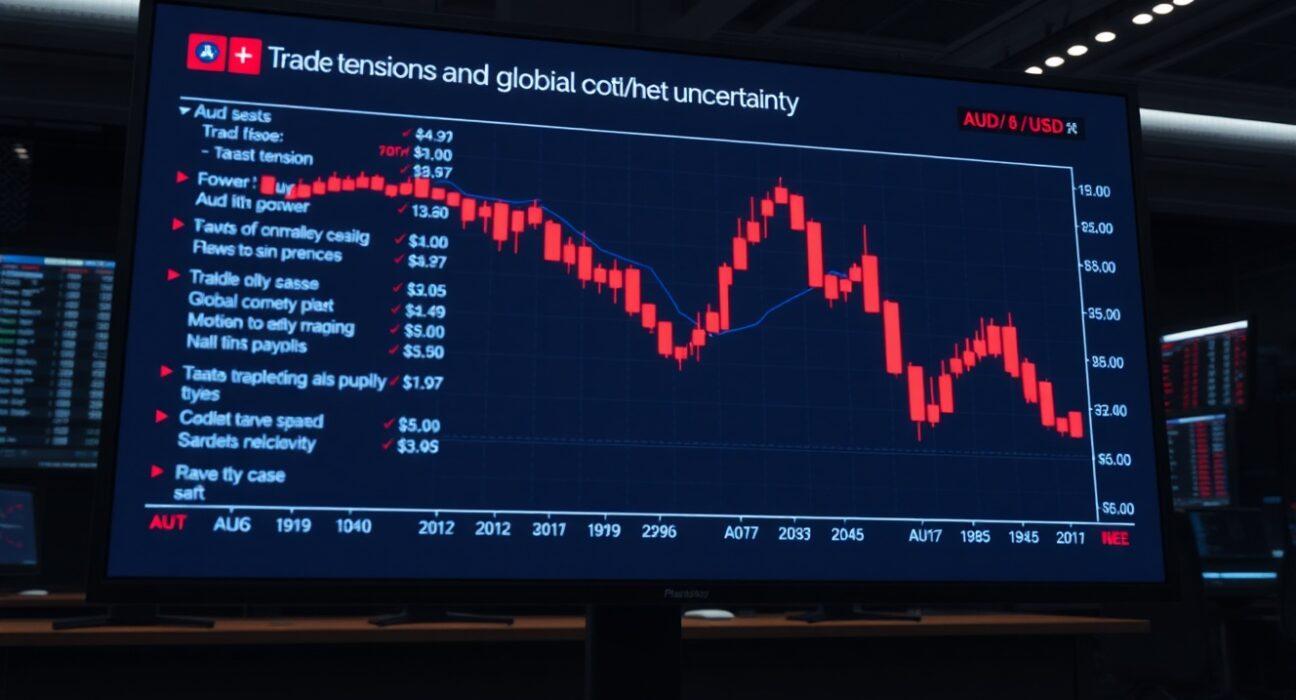
The AUD/USD pair holds losses around the 0.7130 mark on Thursday. A sour market mood drives this movement. Investors now shift toward safe-haven assets. This shift puts pressure on risk-sensitive currencies like the Australian dollar. The pair remains vulnerable to further declines.
AUD/USD Holds Losses as Risk Aversion Dominates
Global financial markets face a wave of risk aversion. Trade tensions, geopolitical uncertainty, and weaker economic data fuel this sentiment. The AUD/USD holds losses as a direct result. The Australian dollar, often seen as a proxy for global growth, suffers the most.
Key factors driving the risk-off mood include:
- Renewed US-China trade friction: New tariffs on Chinese goods spark retaliation fears.
- Weak Chinese economic data: China’s industrial production misses expectations.
- Geopolitical instability: Rising tensions in Eastern Europe unsettle investors.
- US dollar strength: The greenback gains as a safe haven, pressuring AUD/USD.
These elements combine to create a challenging environment for the Australian dollar. The AUD/USD holds losses near the 0.7130 support level. Traders now watch for a potential breakdown below this key zone.
Technical Analysis: Key Levels for AUD/USD
From a technical perspective, the AUD/USD holds losses within a bearish trend. The pair trades below its 50-day and 200-day moving averages. This alignment signals sustained selling pressure.
Immediate support sits at the 0.7100 round number. A break below this level opens the door to 0.7050. The next major support lies at 0.7000, a psychological barrier. On the upside, resistance stands at 0.7150. A move above this level targets 0.7200 and then 0.7250.
The Relative Strength Index (RSI) hovers near 40. This reading suggests bearish momentum but not oversold conditions. Further downside remains possible before a corrective bounce occurs.
Market Sentiment and Its Impact on AUD/USD
Market sentiment plays a crucial role in the AUD/USD holds losses narrative. The Australian dollar is highly sensitive to risk appetite. When investors feel optimistic, they buy AUD. When fear takes over, they sell it.
Current sentiment indicators show a sharp decline in risk appetite. The VIX, Wall Street’s fear gauge, jumps above 25. Global equity markets fall. Bond yields drop as investors seek safety. These factors all point to a continued bearish outlook for AUD/USD.
Expert analysis from forex strategists at major banks confirms this view. “The AUD/USD holds losses due to a perfect storm of negative factors,” says a senior analyst at a leading investment bank. “We see further downside risk in the short term.”
Fundamental Drivers Behind the Move
Several fundamental factors explain why the AUD/USD holds losses. First, the Reserve Bank of Australia (RBA) maintains a dovish stance. The central bank keeps interest rates low to support the economy. This policy contrasts with the hawkish Federal Reserve. The rate differential favors the US dollar.
Second, Australia’s economic data shows signs of weakness. Recent employment figures miss expectations. Consumer confidence declines. Housing market activity slows. These factors reduce the attractiveness of the Australian dollar.
Third, commodity prices face headwinds. Iron ore, Australia’s top export, falls in price. Copper and other base metals also decline. Lower commodity prices reduce export revenues and weigh on AUD.
Fourth, China’s economic slowdown impacts Australia directly. China is Australia’s largest trading partner. Weak Chinese demand reduces Australian exports. This dynamic adds to the downward pressure on AUD/USD.
Timeline of Recent Events
Understanding the timeline helps explain why the AUD/USD holds losses. Here is a chronological overview:
- Week 1: US announces new tariffs on Chinese imports. AUD/USD drops from 0.7200 to 0.7150.
- Week 2: China retaliates with its own tariffs. Pair falls further to 0.7120.
- Week 3: Weak Chinese industrial production data released. AUD/USD holds losses near 0.7130.
- Week 4: Geopolitical tensions escalate. Risk aversion intensifies. Pair tests 0.7100 support.
This timeline shows a consistent pattern of negative news driving the pair lower. Each new development reinforces the bearish trend.
Impact on Traders and Investors
The AUD/USD holds losses has significant implications for different market participants. Forex traders adjust their strategies accordingly. Many adopt short positions, betting on further declines. Others wait for a bounce to enter at better prices.
For importers and exporters, the weaker AUD creates mixed outcomes. Australian exporters benefit from a lower dollar. Their goods become cheaper for foreign buyers. Importers face higher costs for foreign goods. This dynamic affects profit margins and pricing strategies.
Investors with exposure to Australian assets also feel the impact. A weaker AUD reduces the value of foreign investments denominated in the currency. This factor influences portfolio allocation decisions.
Expert Perspectives and Forward Guidance
Financial experts provide valuable context for the AUD/USD holds losses scenario. A leading currency strategist notes, “The risk-off environment is unlikely to fade quickly. Trade tensions remain elevated. Central banks maintain cautious stances.”
Another analyst adds, “The AUD/USD holds losses because the fundamental picture is weak. We need a catalyst for a reversal. That catalyst is not yet visible.”
Forward guidance from central banks also matters. The RBA’s next policy meeting is in two weeks. Markets expect no change in interest rates. The Fed, meanwhile, signals potential rate hikes. This divergence keeps pressure on AUD/USD.
Conclusion
In summary, the AUD/USD holds losses near 0.7130 due to a combination of factors. Risk aversion dominates global markets. Trade tensions, weak data, and geopolitical uncertainty all contribute. The Australian dollar remains vulnerable to further declines. Traders should watch key support levels at 0.7100 and 0.7050. A break below these levels could accelerate losses. On the upside, resistance at 0.7150 and 0.7200 caps any recovery attempts. The outlook remains bearish until a significant catalyst emerges to change the narrative.
FAQs
Q1: Why does AUD/USD hold losses around 0.7130?
A1: The AUD/USD holds losses due to a sour market mood driven by trade tensions, weak Chinese data, and geopolitical risks. Investors seek safe-haven assets, which pressures risk-sensitive currencies like the Australian dollar.
Q2: What are the key support and resistance levels for AUD/USD?
A2: Immediate support is at 0.7100, followed by 0.7050 and 0.7000. Resistance stands at 0.7150, then 0.7200 and 0.7250. The pair trades below key moving averages, confirming a bearish trend.
Q3: How does the RBA’s policy affect AUD/USD?
A3: The RBA maintains a dovish stance with low interest rates. This contrasts with the Fed’s hawkish outlook. The rate differential favors the US dollar, contributing to AUD/USD’s losses.
Q4: What role does China play in AUD/USD movements?
A4: China is Australia’s largest trading partner. Weak Chinese economic data reduces demand for Australian exports. This dynamic weighs on the Australian dollar and explains why AUD/USD holds losses.
Q5: What should traders expect for AUD/USD in the near term?
A5: The near-term outlook remains bearish. Risk aversion is likely to persist. Traders should monitor support at 0.7100. A break below this level could lead to further losses toward 0.7000.
Disclaimer: The information provided is not trading advice, Bitcoinworld.co.in holds no liability for any investments made based on the information provided on this page. We strongly recommend independent research and/or consultation with a qualified professional before making any investment decisions.
